

Why RGB Laser Has ChangedCalibration Forever
With traditional light sources, calibration has always been a relatively predictable process, because what you measure is, in most cases, very close to what you actually see on the screen. Lamp and phosphor-based systems produce a broad and continuous spectrum of light, which means that both measurement instruments and the human visual system respond in a similar way, allowing calibration to work as expected.
With RGB laser projectors, this relationship starts to break down.
The reason is simple. Instead of a smooth and continuous spectrum, RGB laser uses extremely narrow and precise wavelengths for red, green and blue, and this changes the way light interacts with our eyes in a fundamental way. You can now have a projector that measures perfectly, with accurate grayscale tracking, a white point exactly on target, and color coordinates aligned with Rec.709, DCI-P3 or even BT.2020, yet the image still doesn’t look quite right, especially when it comes to white balance and grayscale.
When measurements no longer match perception
So you end up in a situation where the calibration charts look flawless, deltaE values are extremely low, and everything appears technically correct, but visually something feels off. And this remains true even when using high-end spectroradiometers, because at that point the limitation is no longer the measurement equipment, but the way the human visual system perceives this type of light.
This is where metamerism becomes critical.
Metamerism and human vision
Human vision is not identical from person to person. Each individual has slightly different spectral sensitivity due to variations in the response of the L, M and S cones, and under normal conditions the brain compensates for these differences through chromatic adaptation, allowing us to perceive a consistent image. However, this compensation mechanism has evolved under continuous spectrum light sources, such as daylight or incandescent lighting.
L cones peak at around 564 nm, M cones peak at around 534 nm, S cones peak at around 420 nm
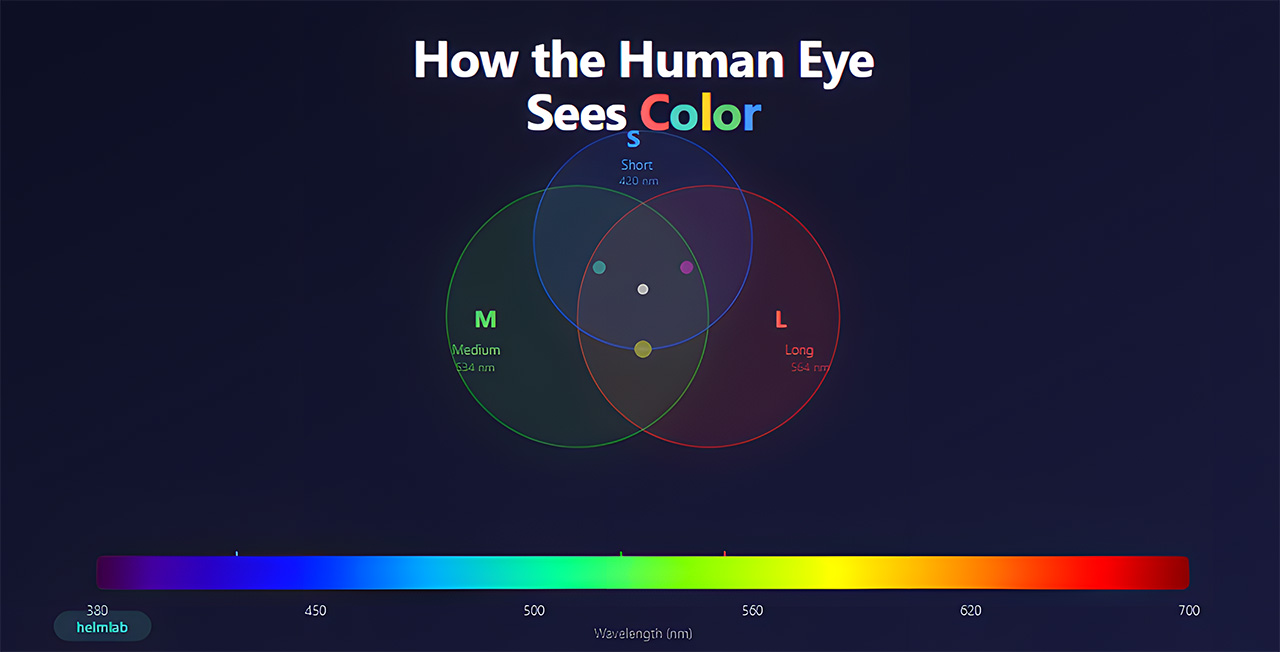
RGB laser does not behave like that.
Because its spectral output is extremely narrow, the interaction with the cone response curves becomes much more specific, and instead of smooth blending across wavelengths, you get very sharp interaction points. This makes even small biological differences between viewers more visible, and the brain does not compensate in the same way, simply because it does not have enough spectral information to work with.
As a result, two people can look at the exact same calibrated image and perceive it differently, whether in white balance or overall color balance, even though the projector is technically perfectly calibrated. At that point, the idea of a single “correct” visual reference becomes much less clear.
The effect of age on perception
There is also another factor that makes things even more complex, and that is the human eye itself.
The lens of the eye changes over time, starting clear when we are young and gradually becoming more yellow as we age, which affects how different wavelengths, especially in the blue region, are transmitted to the retina. Under normal lighting conditions, we do not notice this change because the brain slowly adapts and compensates for it.
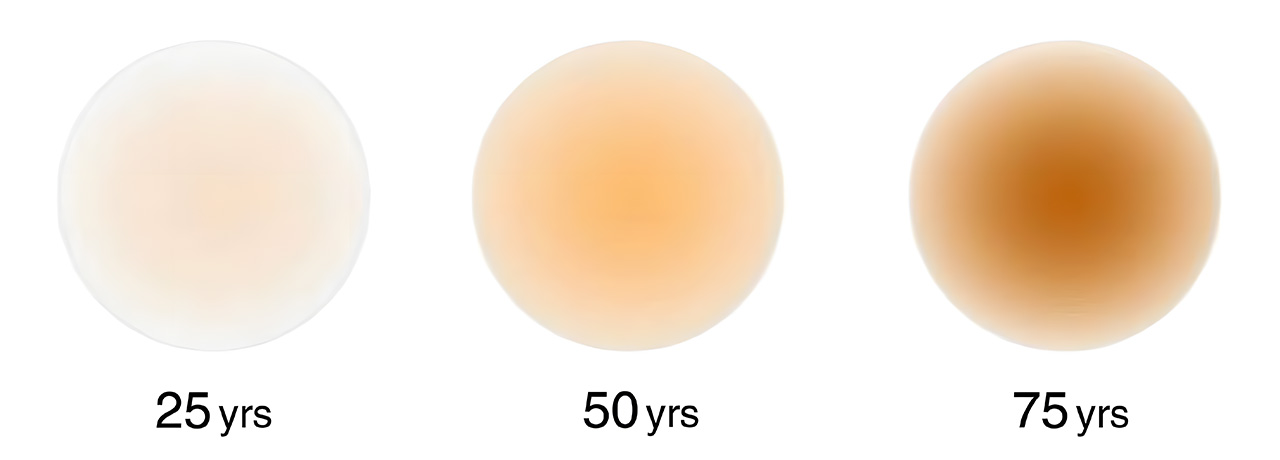
But once again, this adaptation depends on having a continuous spectrum as a reference.
With RGB laser, that reference is effectively missing. The narrow spectral peaks do not provide enough information for stable adaptation, which makes it harder for the brain to separate the actual image from the color shift introduced by the eye itself. This means that age can amplify the metamerism effect, increasing the difference between what instruments measure and what different viewers perceive.
Dynamic image processing
If we now add the way modern RGB laser projectors actually operate, things move even further away from traditional calibration assumptions.
Dynamic tone mapping continuously reshapes the PQ EOTF depending on the content, dynamic contrast systems adjust the laser output in real time, and even the effective RGB balance can shift based on scene brightness and metadata. So you are no longer calibrating a fixed output device, but a system that is constantly changing its behavior.
At that point, any static pattern measurement does not show what is actually happening in the real viewing.
Why calibration, as we knew it, no longer works
And this is the key point.
Calibration has always been based on a simple assumption, that what you measure is what you see. With RGB laser, this assumption no longer holds, and that is why traditional calibration methods start to lose their meaning in this context.
This is not a new discovery. The cinema industry has been aware of these issues for years, especially after the transition from xenon lamps to RGB laser projection systems, where these effects became very clear from day one.
If someone calibrates an RGB laser projector using only measurement instruments and claims that the image is now “accurate,” there are really only two possibilities. Either they do not fully understand how RGB laser behaves, or they are ignoring how human perception actually works in this case.
Because here, accuracy is no longer defined only by numbers.
I often see perfect measurement charts from RGB laser projectors being presented online as proof of reference image quality, but in reality, those charts does not tell us he whole truth, but just a piece of it.
Further reading and references
For those who want to explore this topic in more depth, there are some excellent sources available.
The lecture by Kommer Kleijn at the International Federation of Cinematographers conference in 2024:
http://www.kommer.com/2024-03-08-Kleijn-RGB_Laser_Light_in_Cinema.pdf
An article from the Belgian Society of Cinematographers:
https://www.sbcine.be/?p=14115
And the well-known study on observer variability by Yuta Asano:
https://library.imaging.org/cic/articles/22/1/art00001
Now that you understand this, you can approach RGB laser projectors with a completely different perspective.
ent perspective.