

True 4K 120Hz Is Finally Here:A New Chapter for DLP Projection
For many years, DLP projector owners have lived with a very specific limitation: we could have 4K resolution, or we could have very high refresh rates, but we could not have both at the same time.
A modern DLP projector could display a full 3840 × 2160 image at 60Hz, while the same basic DLP platform could often run at 1080p 120Hz or even 240Hz. For gaming, this usually meant making a choice between maximum resolution and maximum frame rate.
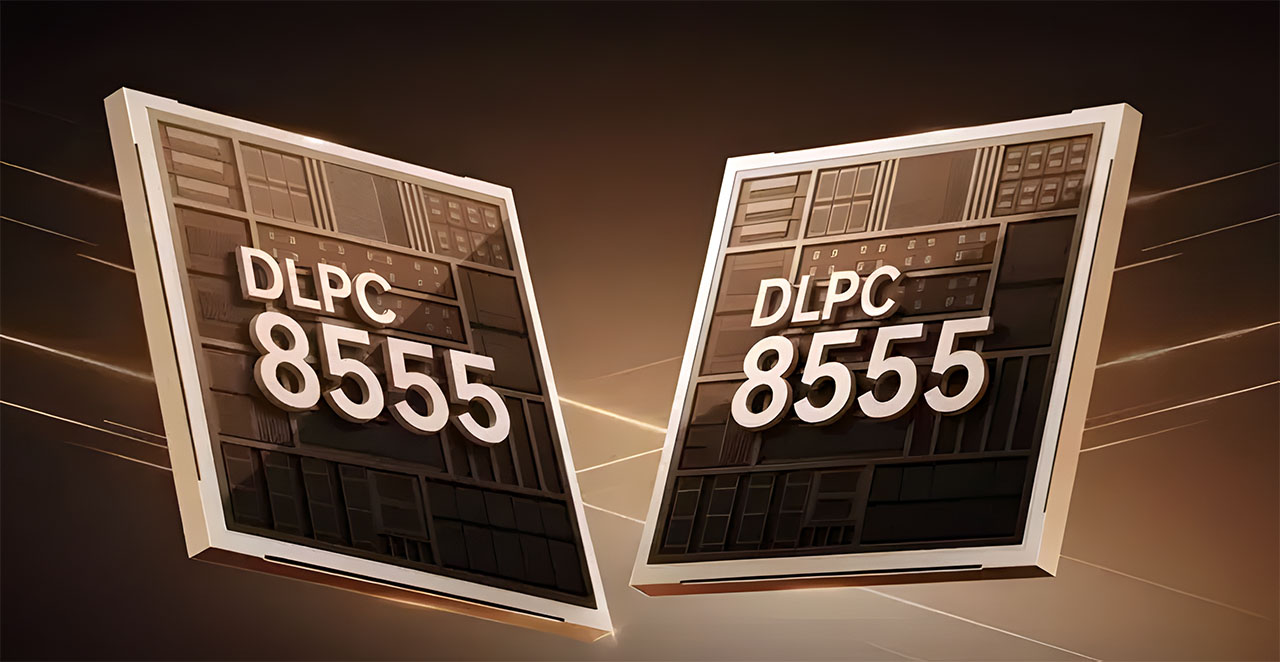
That is now changing. Texas Instruments has introduced a new generation of DLP controllers, the DLPC8545 and DLPC8555, built around a dual-controller architecture that allows a DLP projector to display 3840 × 2160 at a real 120Hz refresh rate.
TI officially specifies the new dual DLPC85x5 architecture for up to 4K UHD at 120Hz, and interestingly, up to 1080p at 360Hz in 2D. The DLPC8545 supports the DLP472TP and DLP391TP DMDs, while the DLPC8555 is paired with the DLP473TE.
And the interesting part is that TI did not achieve this by suddenly creating a consumer DMD containing 8.3 million physical mirrors. The familiar XPR concept is still here. What has fundamentally changed is the processing architecture surrounding the DMD.
So before looking at 4K120, we first need to understand how modern DLP projectors have been producing a 4K image until today, because this is the key to understanding why breaking the 60Hz barrier was so difficult.
How does a 1080p-class DLP chip produce a 4K image?
This is probably one of the most misunderstood subjects in modern projection. When we see “4K DLP” written on a projector box, it does not necessarily mean that the DMD inside contains 3840 × 2160 physical mirrors. Many consumer 4K DLP projectors use a DMD whose native mirror array contains considerably fewer than the 8.29 million pixels of a 3840 × 2160 image.
A 1920 × 1080 mirror array, for example, contains:
1920 × 1080 = 2,073,600 physical mirrors
Yet with four-way pixel shifting, those mirrors can address:
2,073,600 × 4 = 8,294,400 pixel positions
And:
3840 × 2160 = 8,294,400 pixels
How?
The answer is XPR.
So, what exactly is XPR?
XPR is Texas Instruments’ optical pixel-shifting technology. In simple terms, an extremely fast optical actuator in the light path changes the position at which the image produced by the DMD lands on the screen. The mirrors themselves are not physically moving around the chip. Instead, the DMD displays different image information while the optical actuator shifts the projected image by tiny amounts.
This happens extremely quickly. The different spatial positions are displayed one after another and together form the complete 4K image that reaches our eyes. In a four-way XPR implementation, the system uses four spatially shifted positions to construct the final UHD image. The new DLPC85x5 datasheet is particularly useful here because TI explicitly identifies multiple Primary-controller GPIO outputs as “4 way XPR”, confirming that four-way XPR remains part of this new architecture.
In simple terms, XPR does not create more physical mirrors. It allows the light generated by those mirrors to address multiple spatial positions on the screen.
You can see how an XPR actuator actually works in practice in the video below, where its operation is shown in slow motion.

If DLP is so fast, why were we stuck at 4K60?
The problem was not simply how quickly an individual micromirror could switch. The real challenge was how much image information the entire DLP display pipeline could receive, process and deliver to the DMD while simultaneously coordinating the pixel-shifting system and illumination timing.
Consider the scale of the problem. A 3840 × 2160 image contains:
8,294,400 pixels
At 60 complete frames per second:
8,294,400 × 60 = 497,664,000 pixel positions per second
At 120Hz:
8,294,400 × 120 = 995,328,000 pixel positions per second
So at 4K120, we are talking about almost one billion final image pixel positions every second.
This calculation is useful for understanding the scale of the workload, although it should not be confused with the internal DMD clock or an XPR operating frequency. Inside the projector, things are considerably more complicated because the controller also has to deal with color and bit-plane sequencing, DMD data loading, illumination timing and XPR synchronization.
There is also a very simple time problem. At 60Hz, the system has:
16.67ms per complete frame
At 120Hz:
8.33ms per complete frame
So the entire display chain effectively has only half as much time to deal with each incoming complete 4K frame.
The controller architecture was the wall
Previous DLP controller generations could already operate the DMD at very high speed, but their 4K display pipeline topped out at 60Hz. Simply receiving more HDMI bandwidth was not enough. The controller architecture itself had to be capable of processing and feeding the DMD at the required rate.
And this is where Texas Instruments made the fundamental change.
Instead of trying to make one controller perform the entire 4K120 workload, TI divided the work between two controllers operating together.
This is not an interpretation based on the block diagram. The new datasheet says it explicitly: the DLP chipset comprises two display controllers and one matched DMD, and TI designed this dual-controller architecture specifically to support high resolution at high frame rates.
Enter DLPC8545 and DLPC8555 : Cut the 4K image in half
The new generation consists of the DLPC8545 and DLPC8555 High-Speed UHD 4K Controllers. TI specifies the dual DLPC85x5 architecture for:
4K UHD up to 120Hz
and:
1080p up to 360Hz in 2D
with 1080p 3D operation specified up to 120Hz.
The DLPC8545 supports the DLP472TP and DLP391TP, while the DLPC8555 supports the DLP473TE. Each controller has a single V-by-One HS input of up to eight lanes, with a maximum input resolution of 1920 × 2160 at 120Hz and up to 3.0Gbps per input transmission rate.
That 1920 × 2160 figure is the first major clue to how TI makes 4K120 possible.
This is probably the most interesting part of the entire architecture.
Imagine a complete:
3840 × 2160 @ 120Hz
video frame.
Instead of sending the complete 3840-pixel-wide image through one DLP controller, the video frontend divides the workload between the two DLPC85x5 controllers.
And this time TI tells us exactly what happens.
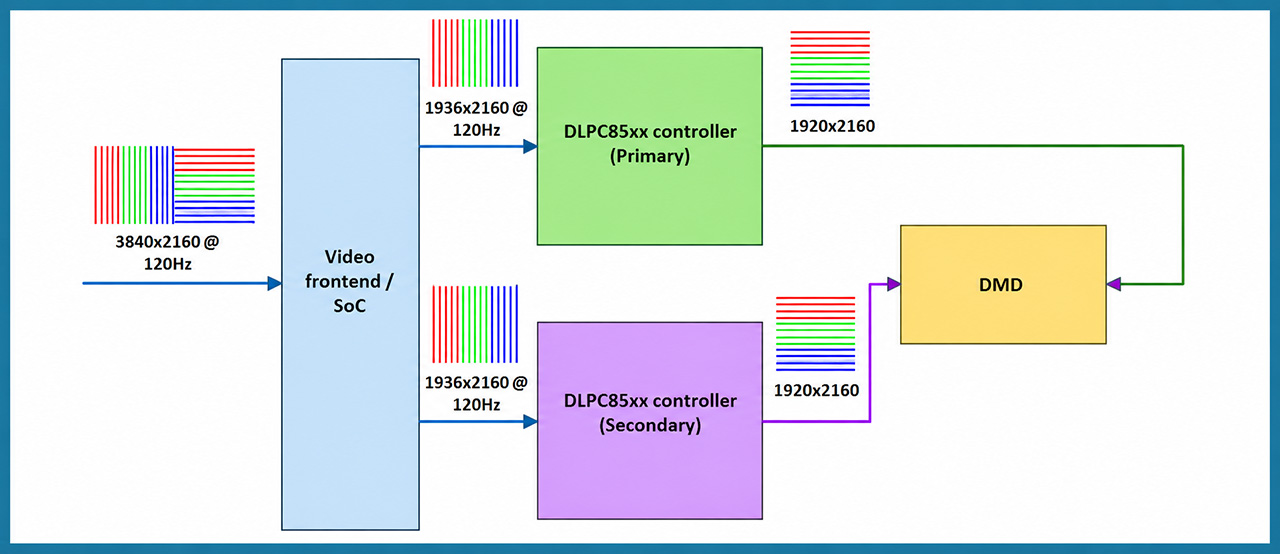
According to DLPC8555 datasheet, each controller drives one half of the DMD, left or right. Each controller therefore receives the appropriate half of the image, but TI adds an additional 16 columns from the opposite side to help mitigate artifacts at the central seam.
The 3840 × 2160 @ 120Hz source therefore becomes:
Primary input → 1936 × 2160 @ 120Hz
Secondary input → 1936 × 2160 @ 120Hz
while each controller ultimately drives:
1920 × 2160
of the DMD.
Those extra 16 columns are effectively overlap information around the center boundary. TI even lists “Overlap color support” among the image-processing features of the DLPC85x5.
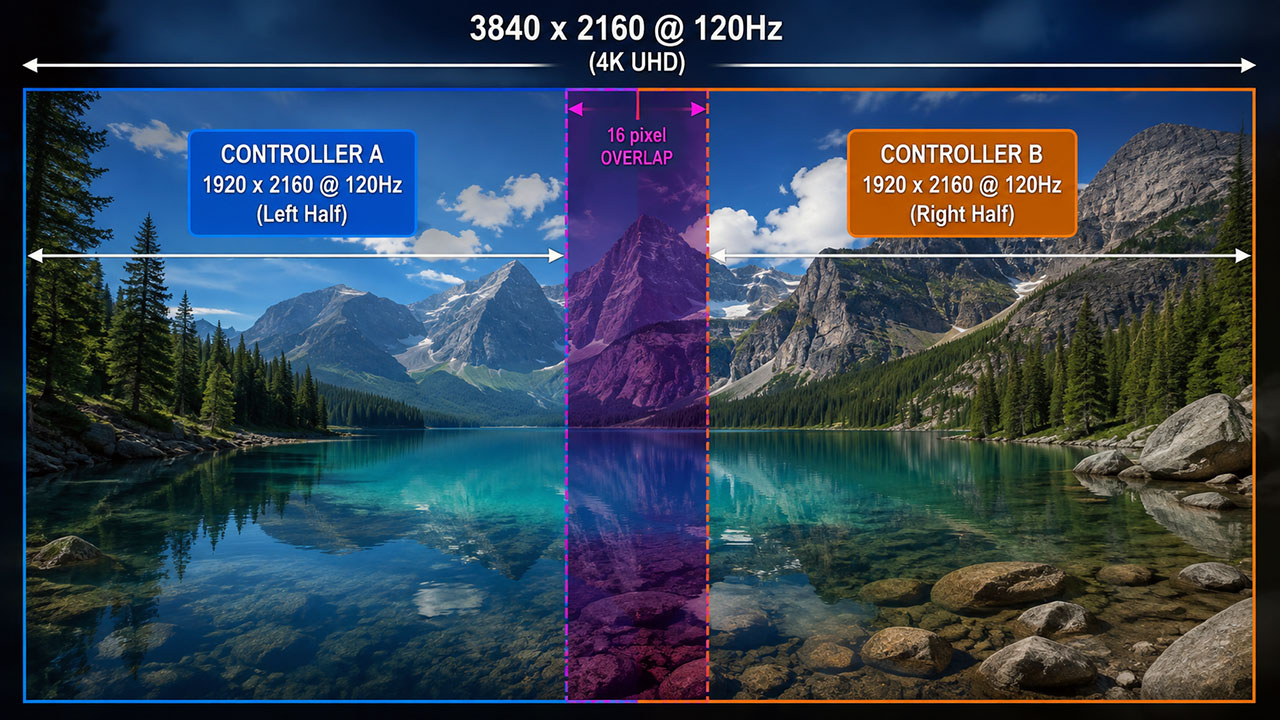
This is a very important correction compared with simply saying that the 4K image is “cut into two 1920 × 2160 pieces.” Functionally that is the idea, but electrically the controllers actually receive 1936 × 2160 streams, because each needs those additional columns around the seam.
And this is probably the easiest way to understand how TI broke the old 4K60 ceiling:
Instead of one controller processing the complete 4K120 workload, two controllers process the left and right portions of the image simultaneously.
Two brains, one DMD
Of course, dividing an image in half is the easy part. Making two controllers drive one DMD as if they were one perfectly synchronized system is the difficult part.
The Primary and Secondary controllers cannot operate independently. Their timing has to remain synchronized, their respective halves have to meet correctly in the center, DMD data loading has to occur at the correct moment, XPR operation has to remain synchronized with the displayed information, and illumination has to follow the DMD timing.
The TI functional diagram makes this architecture very clear. It shows a Primary DLPC85xx and Secondary DLPC85xx, each with its own Sub-LVDS connection to the DMD, synchronization connections between the controllers, and the actuator drive circuitry.
https://www.ti.com/product/DLPC8555
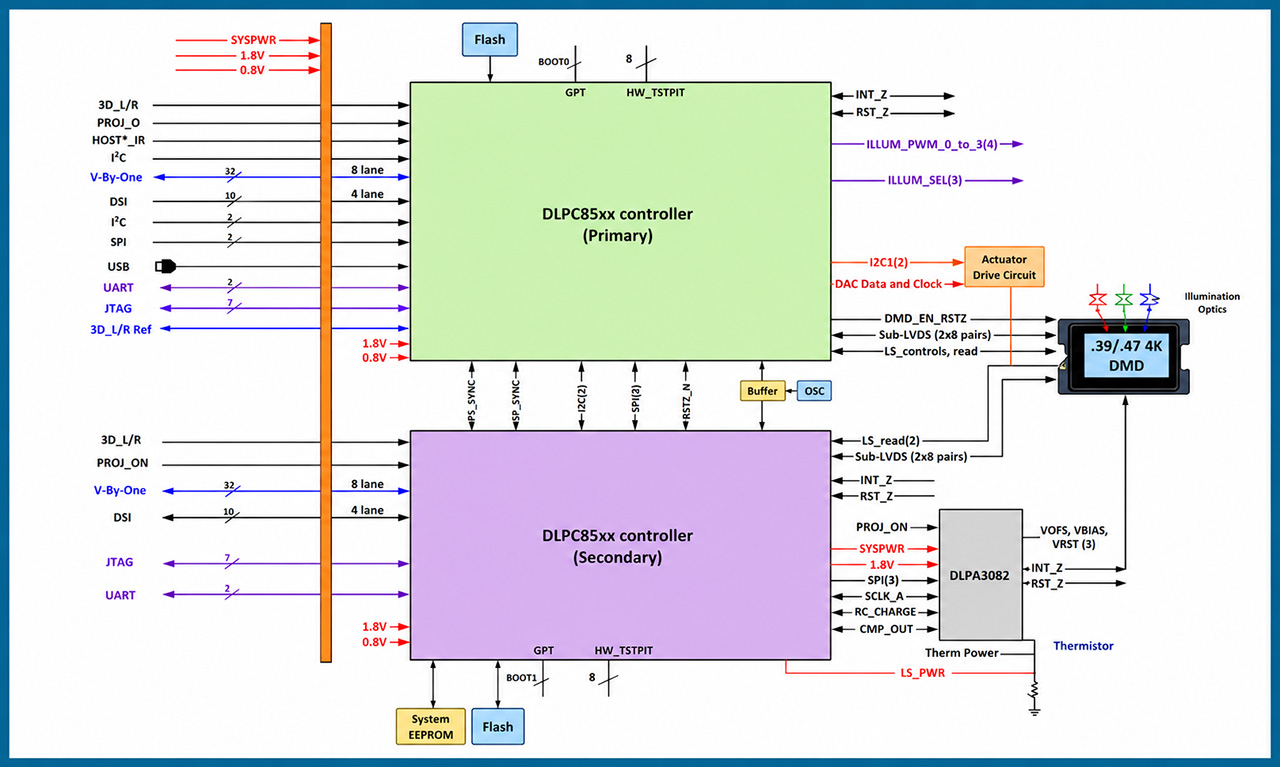
Lets clear this, the DLPC8545/8555 does not simply feed image data to the DMD. The controller controls DMD timing and also coordinates light-source signal timing with the DMD so that light output is synchronized with mirror movement.
This is especially important in modern RGB laser DLP projectors, where the timing of the red, green and blue laser output has to work together with DMD operation.
So when we say “dual controller,” we are talking about considerably more than splitting an HDMI image into two pieces.
The synchronization is real and surprisingly extensive
There is another nice detail buried much deeper in the datasheet. TI’s GPIO allocation tables explicitly identify multiple PS_SYNC signals as:
“Synchronization between primary and secondary controller”
and the Primary controller also contains numerous outputs specifically identified as:
“4 way XPR.”
The Secondary controller has corresponding synchronization inputs and additional SP_SYNC/SP_SSYNC connections.
This gives us a much clearer picture of what is happening internally. The two DLPC85x5 chips are not simply two independent image processors connected to different areas of the DMD. They operate as a coordinated pair inside one DLP display system.
Two controllers as one. One DMD. One final image.
And yes, this is real 4K120
This point deserves its own section because there will inevitably be some confusion around it.
Accepting a 4K120 HDMI signal and actually displaying 4K120 are two completely different things.
Until now, most DLP projectors could accept a 3840 × 2160 at 120Hz signal and internally convert it to 60Hz before displaying it. In that case, the HDMI 2.1 input was 4K120 compatible, but the actual DLP display engine was still operating at 60Hz.
That is now a thing of the past.
Texas Instruments officially specifies the dual DLPC85x5 controllers for up to 4K UHD at 120Hz, and its own system diagram shows a 3840 × 2160 @ 120Hz source being split into two 1936 × 2160 @ 120Hz streams before reaching the Primary and Secondary controllers.
So yes:
120 complete 4K UHD frames can now be displayed every second.
Let me make one important note here, especially for those who may confuse resolution with frame rate. This does not turn the DLP472TP or DLP473TE into native 3840 × 2160 mirror-array DMDs. XPR is still involved in generating the UHD image.
The accurate description is therefore:
Real 4K UHD output at 120Hz, generated using XPR.
The 120Hz refresh rate is real.
The 4K image is still generated through pixel shifting.
These are two completely separate “concepts”.
Good news for gamers: 4K120, VRR and Rolling Buffer
There is even more good news for gamers. Until now, high-refresh gaming on most 4K DLP projectors required a compromise. If you wanted maximum detail, you used 4K60. If you wanted 120Hz or 240Hz, you normally had to reduce the input resolution to 1080p.
With the new DLPC8545 and DLPC8555 architecture, that compromise is finally gone. We can now have full 4K resolution at 120Hz, together with VRR support and TI’s rolling-buffer architecture.
And that rolling buffer is particularly important for gaming. With a conventional full-frame buffer, the system has to wait for the complete frame before it can move forward with the display process. A rolling buffer works differently, allowing the DLP display pipeline to start working with the image progressively as the data arrives.
The result is significantly lower frame latency, something we have already seen with the previous generation of DLP controllers.
Here is where 120Hz makes a big difference. At 4K60, a complete frame lasts 16.67ms, and with the rolling-buffer architecture the average display latency is roughly half of that, around 8ms. At 4K120, the complete frame sequence lasts only 8.33ms, so the average latency is also cut in half, dropping to around 4ms.
Think about that for a moment. We are now talking about full 4K resolution, 120Hz, VRR and around 4ms of display latency. For gaming on a 100 or 120-inch screen, that is a huge step forward.
And for the record, at 1080p360, which this dual-controller architecture is capable of, we are looking at a display latency of around 1.5ms. That is simply phenomenal for a projector.
What else does 120Hz give us?
Gaming is obviously one of the biggest benefits of the new architecture, but it is certainly not the only one. Doubling the refresh rate can also affect motion, high-frame-rate content and even the way traditional 24fps movies are displayed.
Motion becomes cleaner
There is another advantage that cannot be demonstrated with a static screenshot: temporal resolution.
Imagine an object moving quickly from the left side of the screen to the right. At 60fps, we receive 60 different temporal samples of that movement every second. At 120fps, we receive 120. That means the object can move a smaller distance between consecutive frames, making its motion easier for our eyes to follow. Camera pans can contain more intermediate temporal positions, and fast-moving objects can appear smoother and clearer.
The important qualification is when the source actually contains the additional frames. Simply displaying a 60fps source at 120Hz by repeating each frame does not magically create the motion information of native 120fps material.
For native 120fps gaming, sports or other high-frame-rate content, however, the difference can be substantial.
24fps movies and the magic number 120
Here we arrive at something home cinema enthusiasts should find particularly interesting. Most movies are still produced at approximately 24 frames per second, while 60Hz is mathematically awkward for 24fps material:
60 / 24 = 2.5
Because 24 does not divide evenly into 60, traditional 60Hz presentation uses 3:2 pulldown, where alternating film frames remain on screen for three and two refresh intervals:
AAA → BB → CCC → DD → EEE → FF…
This uneven timing adds a characteristic cadence judder on top of the inherent motion characteristics of 24fps cinema, we call it “motion judder”.
At 120Hz:
120 / 24 = 5
Perfect.
Every original movie frame can be repeated exactly five times:
AAAAA → BBBBB → CCCCC → DDDDD…
This is 5:5 pulldown. Every original 24fps frame receives exactly the same display duration. There is no uneven 3:2 sequence and therefore no additional judder caused by fitting 24 frames into a 60Hz refresh cycle.
Of course, 5:5 pulldown does not turn a 24fps movie into 120fps. The inherent motion character of 24fps cinema remains completely intact.
And for me, that is exactly the point.
No frame interpolation. No soap-opera effect. No uneven 3:2 pulldown. Just the original 24fps motion with perfectly even frame repetition.
And what about 3D?
There is also something interesting for 3D fans. Although the new DLPC85x5 controllers can now run at 1080p up to 360Hz in 2D, Texas Instruments still limits 3D to 1080p120, exactly like the previous DLPC84x5 generation.
This means that in frame-sequential 3D we still have alternating left and right images at 120Hz, or 60Hz for each eye. So don’t expect smoother 120Hz-per-eye 3D just because we now have a much faster controller.
And there is a reason why 3D is more complicated than simply increasing the refresh rate. Left/right frame sequencing, DMD bit-plane timing, RGB or laser illumination timing and synchronization with the active glasses all have to work together.
The new controller may be much faster, but the whole 3D chain still has to remain perfectly synchronized.
What could change is the actual quality of the 3D implementation.
The extra processing power and the new architecture may give manufacturers more room to improve things like synchronization, crosstalk or brightness, but TI does not promise any of that in the datasheet. So for now, the important thing to remember is simple: 4K and 2D get a huge speed upgrade, while 3D remains at 120Hz.
How good that 3D actually looks? Well, that is something we will have to test ourselves, and fortunately, we won’t have to wait long. In just a few days we will have in our hands the first two new DLP projectors using this new dual-controller architecture from Texas Instruments. And of course, I am talking about the XGIMI AURA 3 Max and the AWOL Vision LuxVision.
We shall see…
120Hz and frame interpolation
The new controller officially supports Frame Rate Multiplication, which makes 120Hz particularly interesting for motion-processing implementations.
If a manufacturer chooses to use MEMC, a 120Hz output gives the motion processor more temporal positions in which to place interpolated frames. That can potentially produce smoother motion than a 60Hz output pipeline.
But the same rule applies as always:
120Hz cannot rescue bad MEMC.
The quality of the final result still depends on F.I algorithm, artifact control and generally the manufacturer’s implementation.
What about the Rainbow Effect?
This is another area I am particularly interested in testing. Single-chip DLP creates colors sequentially, which means that red, green and blue information are presented at slightly different moments in time. For people sensitive to the Rainbow Effect, rapid eye movement across bright objects against dark backgrounds can reveal brief flashes of color separation, the well-known rainbow effect.
A faster display architecture could potentially give manufacturers more freedom in temporal sequencing, but we need to be very careful here.
4K120 does not automatically mean less Rainbow Effect.
RBE depends on illumination sequencing, RGB cycle frequency, bit-plane timing and the way each manufacturer programs the DLP engine.
The much faster controller architecture does give manufacturers more room to experiment with higher sequencing speeds and different duty cycles in RGB laser engines, that is for sure. But neither Texas Instruments nor any projector manufacturer, at least so far, is claiming that this new architecture will actually reduce the Rainbow Effect.
So I am not going to make that claim either.
We will measure it and observe it on actual production projectors.
DLPC8545 vs DLPC8555
The two new controllers perform the same basic high-speed role but are intended for different DMDs.
DLPC8545 → DLP472TP / DLP391TP
DLPC8555 → DLP473TE
Both are used as dual-controller systems for the new high-frame-rate UHD architecture. TI describes the chipset itself as containing two display controllers, one matched DMD and the required power-management IC.
And both share a very interesting set of features: 4K120, 1080p360, VRR, rolling buffer, frame-rate multiplication, DynamicBlack, overlap color support, warping and integrated 3D support.
This is much bigger than HDMI 2.1
For the last few years we have seen projector specifications advertise HDMI 2.1 capable of 4k120hz input signal features, while the actual DLP display engine remained fundamentally limited to 4K60.
And this distinction is extremely important:
HDMI bandwidth and DMD display capability are not the same thing.
An HDMI receiver can accept a 4K120 signal while the display engine behind it still operates at 60Hz.
The new DLPC85x5 architecture changes the actual DLP display pipeline. TI’s diagram begins with a genuine 3840 × 2160 @ 120Hz video source and maintains 120Hz through the two 1936 × 2160 controller inputs.
This time, 4K120 doesn’t stop at the HDMI specification.
It reaches the DLP display engine.
And finally, our screen.
That is why I consider this development much more important than another HDMI 2.1 logo appearing on a projector specification page.
We are witnessing an important moment for DLP
DLP projection has changed enormously during the last few years, not because the basic principle of the DMD has suddenly changed, but because everything surrounding it has.
We now have RGB laser light sources, extremely wide color gamuts, far higher brightness, dynamic laser control, sophisticated HDR processing, Dolby Vision, HDR10+, variable apertures, VRR and very low gaming latency.
And now:
Real 4K UHD at 120Hz.
Texas Instruments deserves enormous credit for finally giving the DLP platform the controller architecture required to break through the 4K60 ceiling. But a controller sitting inside a TI datasheet does not change our home theaters by itself. Someone has to take that technology, build an optical engine around it, integrate the electronics, develop the firmware, solve the thermal problems and finally put the projector into production.
And this is where the new generation of Chinese projector manufacturers deserves recognition. Companies such as AWOL Vision, Valerion, XGIMI, JMGO and Nebula have been pushing consumer DLP projection at a speed of light.
Competition between these manufacturers has become fierce, and for projector enthusiasts this is probably the best thing that could have happened. Every generation now has to be brighter, quieter, faster, better in HDR, better in black level and better for gaming.
And now 4K120 is becoming the next battlefield.
Final thoughts
I have been testing DLP projectors for many years, and there are developments that look important in a press release but change very little when you actually sit down and watch a movie.
I don’t think 4K120 belongs in that category.
This is a genuine architectural change.
For gamers, the benefit is obvious: 4K resolution, 120fps and low input lag no longer have to be mutually exclusive. You just need to buy an RTX 5090, add some more RAM to your PC… OK guys, I’ll stop here. I think you get the point. 😛
And for cinema fans, a 120Hz display pipeline creates the ideal mathematical relationship with 24fps material, allowing 5:5 pulldown instead of the uneven 3:2 pulldown required at 60Hz.
But perhaps the most interesting part is what is happening underneath all of this.
We still have a pixel-shifting DMD. We still have XPR. But now we have two high-speed DLP controllers working together, each driving half of the same DMD, receiving overlapping portions of a 4K120 image, synchronizing with each other, controlling the DMD and coordinating the illumination timing while the XPR system completes the final UHD image.
Think about that for a moment.
Ten years ago, this would have sounded almost ridiculous for a consumer DLP projector.
Today, Texas Instruments has documented the entire architecture in a production datasheet.
So yes, I think we can say it.
We are living through a small historic moment in the DLP world.
Texas Instruments has finally given DLP the architecture required to break through the 4K60 barrier, and the aggressive competition between today’s projector manufacturers is making sure that this technology will not remain inside an engineering datasheet for long.
4K120 DLP is finally here.
And I cannot wait to put the first production units on my test bench and find out what they can really do.
Until our next article, take care everyone.
Nikos Tsolas