

XGIMI Titan Noir MaxIn‑depth Review
Honestly, I could come up with dozens of titles for this article, like “when XGIMI decided to wipe out the competition”, or “forget the XGIMI you knew”, or even “say goodbye to the old XGIMI, welcome to the new one”, and many more. But I chose a more classic title, mainly for Google SEO reasons, because this review needs to reach as many people as possible.
Here at Projectorjunkies, we are witnessing something truly unprecedented, something we couldn’t even imagine not long ago. For the first time, using our own measurement equipment, and backed by what we clearly see with our own eyes, we measured native on/off contrast on a DLP projector close to 10,000:1.
This is a historic moment for us, a major milestone for the global projector market, and great news for you.
Yes, ladies and gentlemen, XGIMI actually did it.
If you’re a big screen enthusiast, stop whatever you’re doing, put your phone on airplane mode, grab your favorite drink, sit back, and let me tell you the story of the new XGIMI Titan Noir Max.
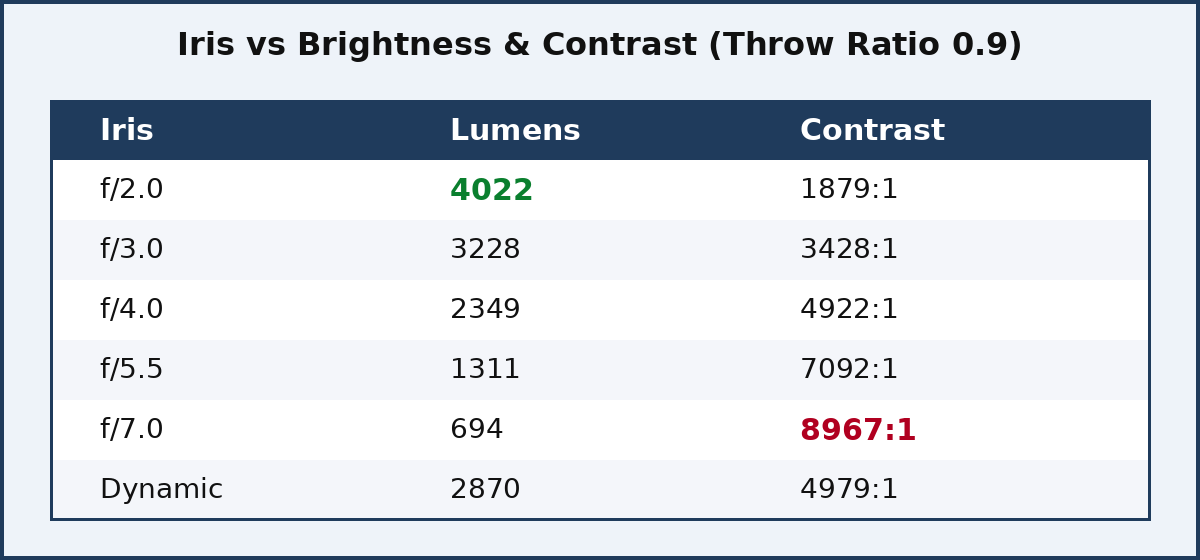
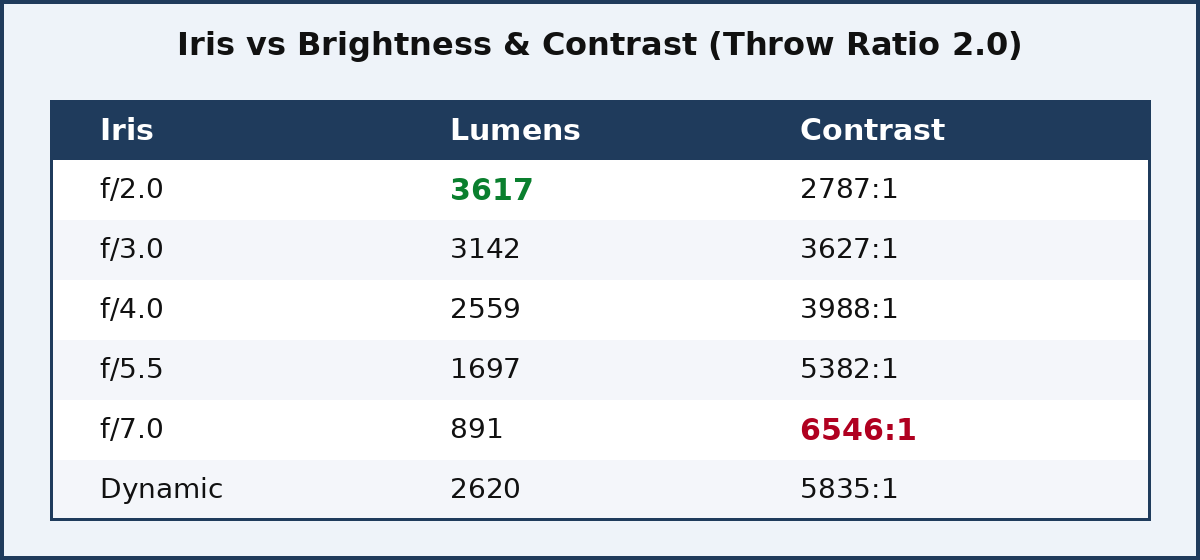
What is really surprising is that at the f/7.0 iris position, where we would normally expect even higher contrast with the lens at the tele position, we actually see a 27% drop instead. A very strange behavior.
If you look carefully at the measurements, you will notice that they are not linear and do not fully follow the rule we usually expect, where brightness drops progressively as throw ratio increases, while contrast rises accordingly.
In the case of the XGIMI Titan Noir Max, this is not exactly what happens. For example, at the f/4.0 iris position, we actually get higher brightness and lower contrast at a 2.0 throw ratio compared to a 0.9 throw ratio, while theoretically it should be the opposite.
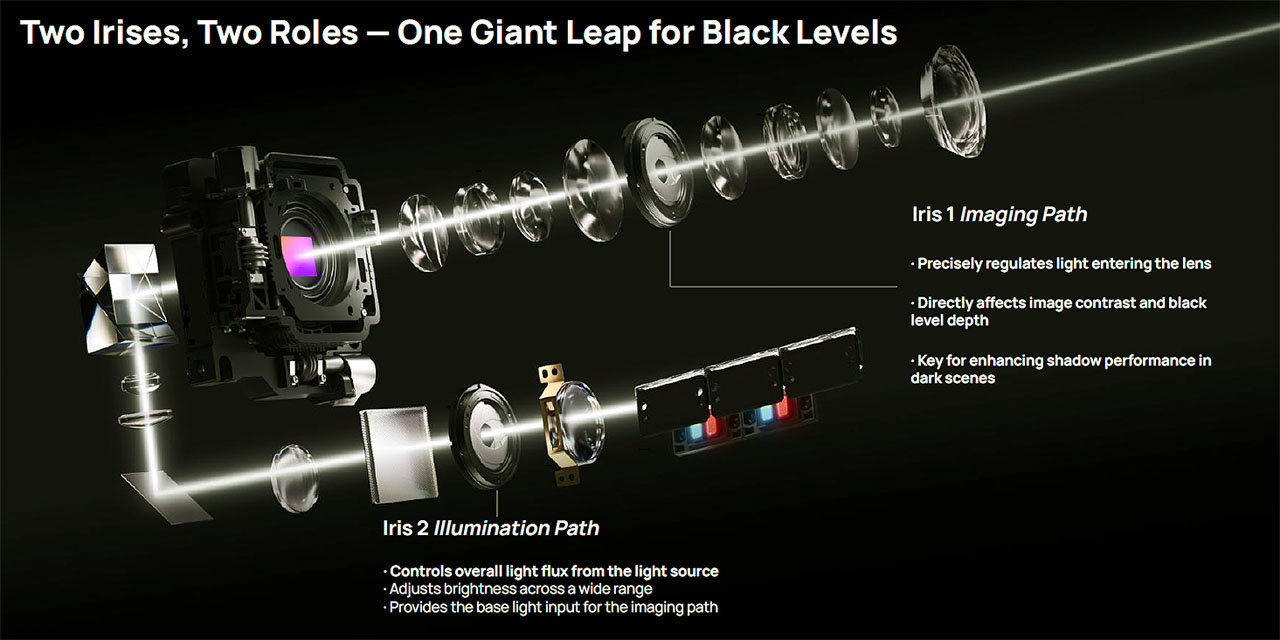
This behavior is most likely related to the dual iris system and the massive zoom lens used in the Titan Noir Max.
The XGIMI Titan Noir Max includes a picture mode that XGIMI calls Performance Mode, and once selected, the power of the green laser increases dramatically. Power consumption shoots up to 350W, the image becomes heavily green-tinted, and the cooling system starts running at full speed.
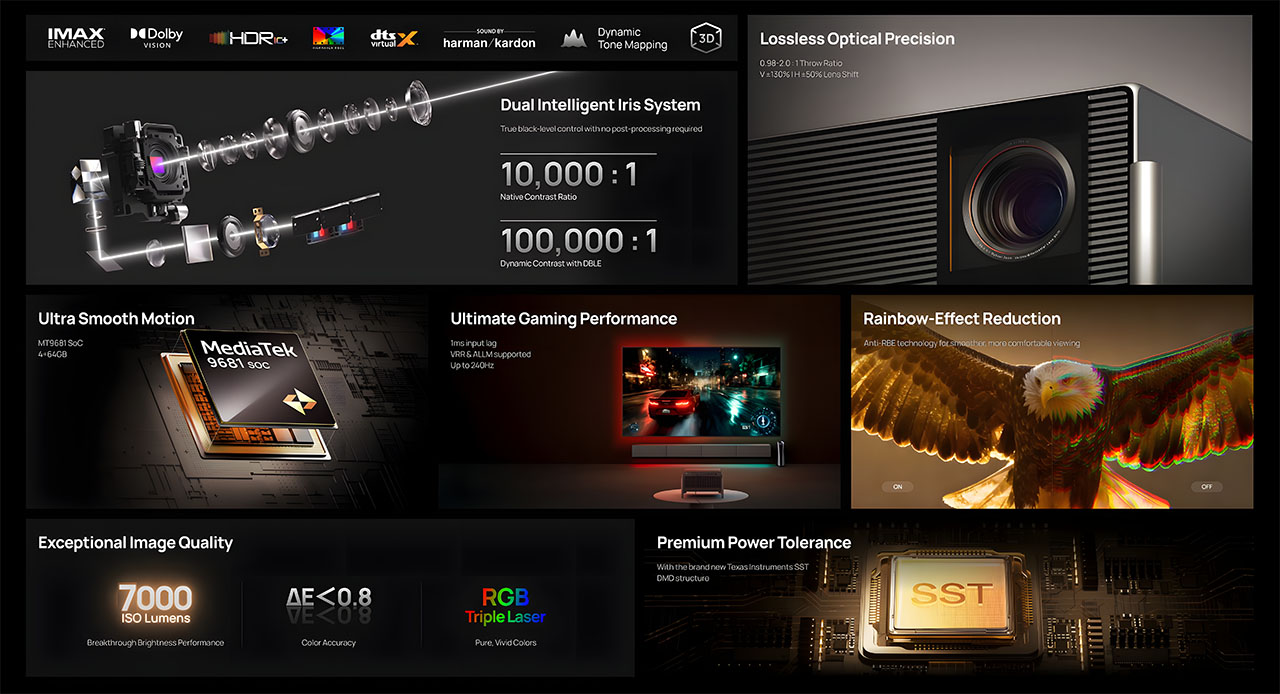
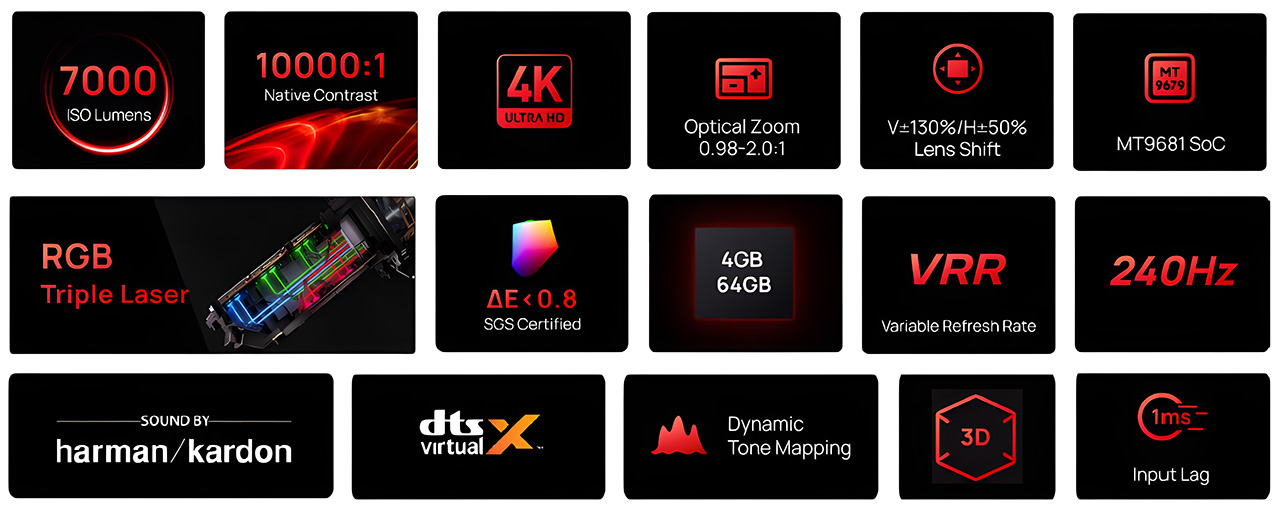
We are talking about a completely useless mode, whose existence serves only one purpose, allowing XGIMI to advertise 7000 ISO lumens without anyone being able to sue them over it.
A smart move, but one that concerns the competition and marketing, not me and you, the actual users of the projector.
For reference, I measured more than 7500 ANSI lumens in this mode.
I should also mention that all measurements were taken with the laser power set to 10. The Titan Noir Max also includes an additional 10+ laser power setting, which increases brightness considerably, delivering 4470 ANSI lumens at a 2.0 throw ratio and 5020 ANSI lumens at a 0.9 throw ratio.
It increases power consumption by around 50W, but unlike the “Performance Mode,” it does not destroy the projector’s color accuracy, nor does it significantly increase fan noise. It is actually a very usable setting if someone needs maximum brightness for a specific projection scenario.
The drawback is that with 10+ enabled, you cannot use the dual iris system. So this is more of a laser power setting for special occasions, when the user of the XGIMI Titan Noir Max simply needs some raw power from the projector.
One very important thing: the Titan Noir Max does not use any secondary color boosting techniques in any of its white balance modes in order to achieve its high brightness levels. It reaches these brightness levels using pure RGB laser drive only.
This is extremely important, because it means that despite its very high brightness output, it does not sacrifice color accuracy, as would happen for example if yellow or cyan were artificially added between the RGB laser pulses to increase brightness output.
White balance & Colors
I will show you measurements only in Standard mode, changing only the white balance setting, since most picture modes simply use different white balance presets and do not differ significantly from each other.
The following measurement was taken in SDR Standard mode with the Standard white balance selected.
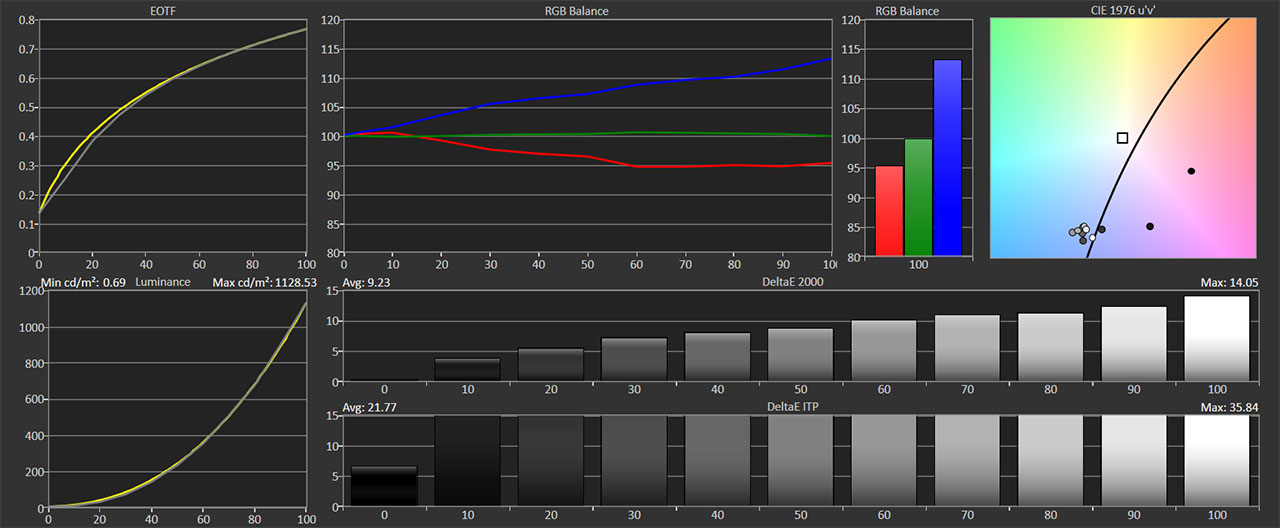
Here, with the Movie white balance selected, which also gives the best result, with a DeltaE 2000 error of only 2.29.
Do not be confused by the large fluctuations you see in the graph. The scale has changed compared to the previous chart, so we are talking about deviations of only around 1%.
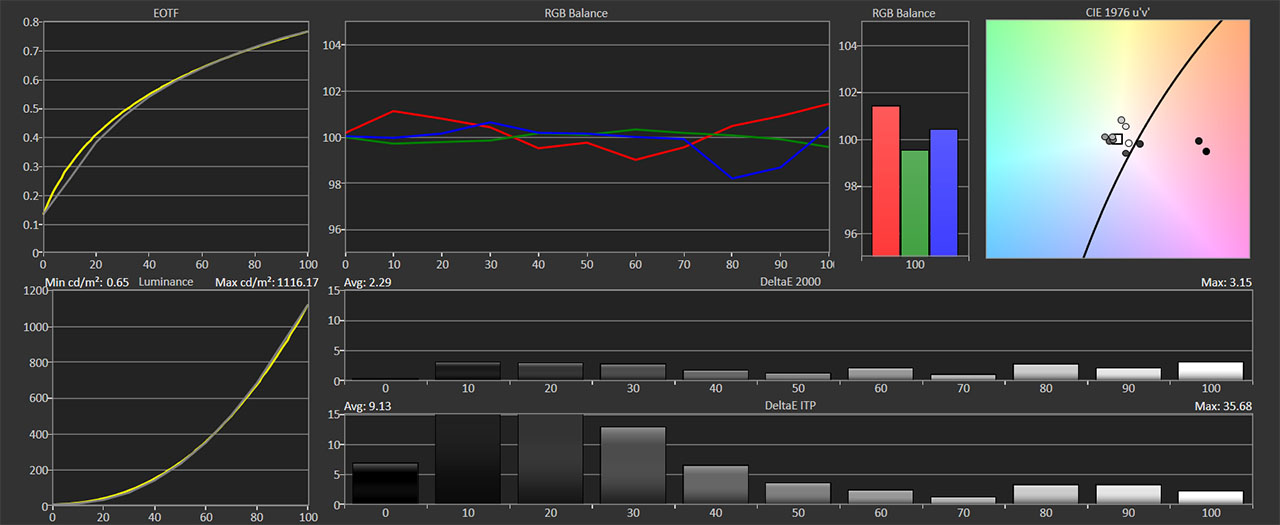
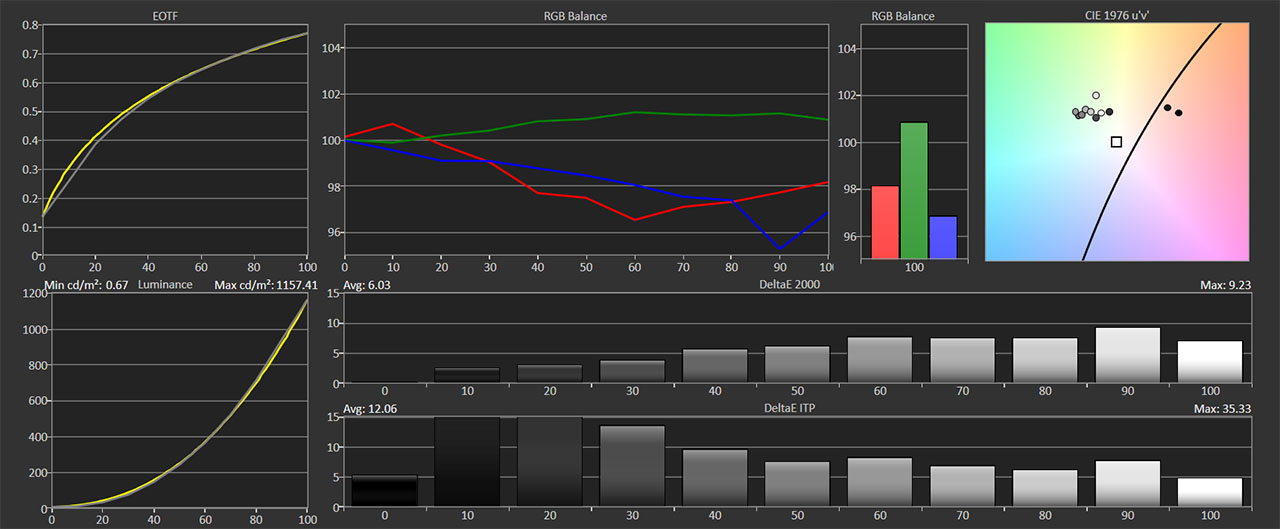
I selected the Standard white balance for calibration, and here is the result. It is not far from the default Movie white balance setting, with a DeltaE 2000 error of 2.36.
The XGIMI Titan Noir Max is a very difficult projector when it comes to calibration, and I will explain this in more detail later on.
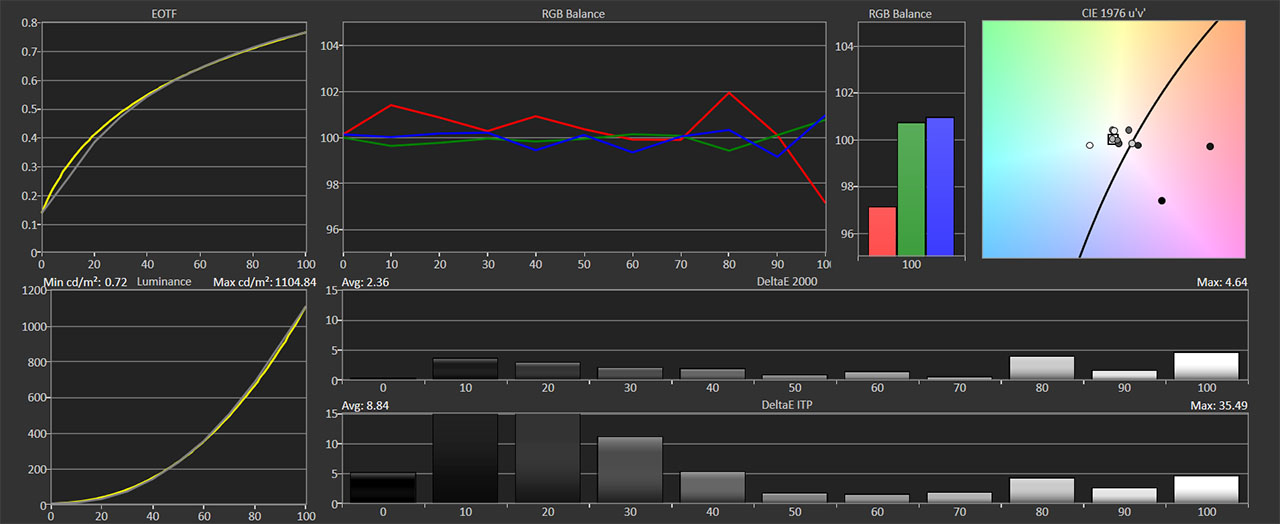
Let’s move on to HDR now, with Dynamic Tone Mapping enabled, to see how the XGIMI Titan Noir Max performs there as well.
Here you can see the Standard HDR mode with the Standard white balance selected. The behavior is similar to the SDR Standard mode I showed earlier above.
Excellent EOTF performance, of course!
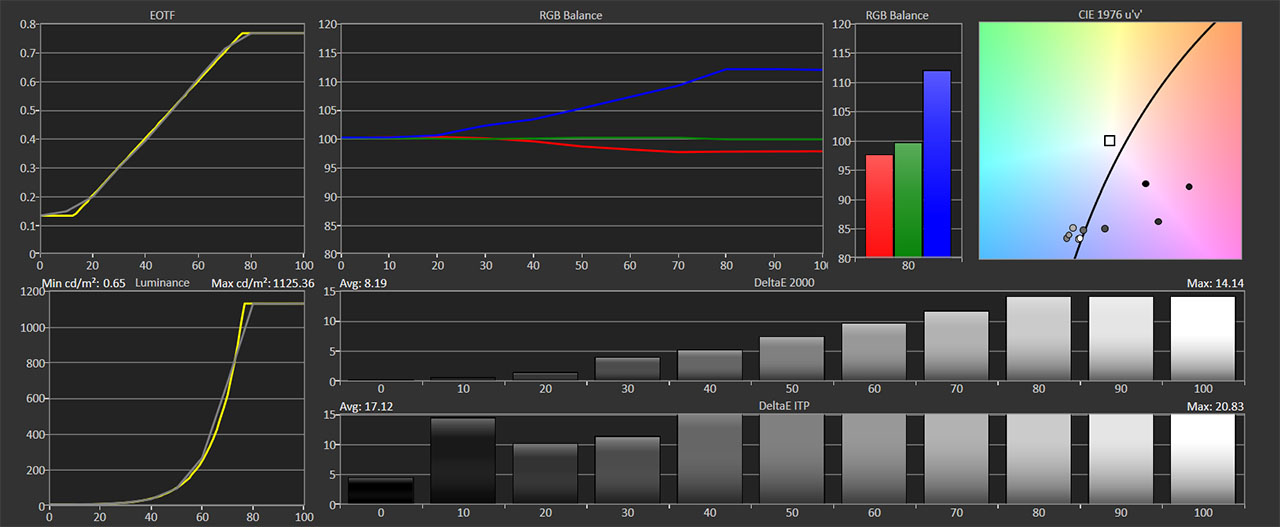
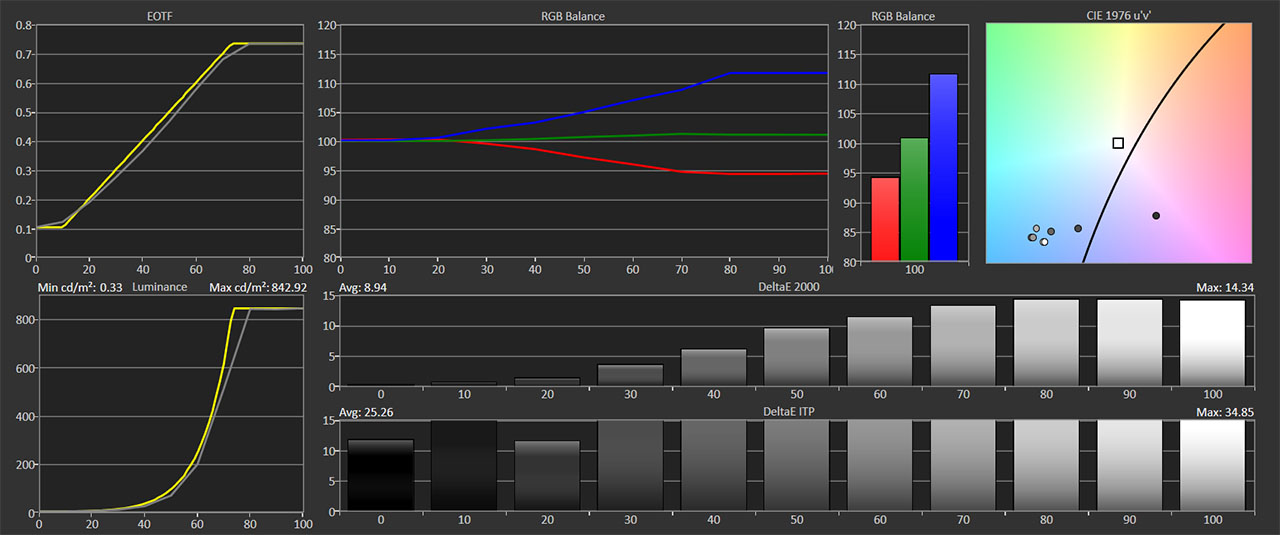
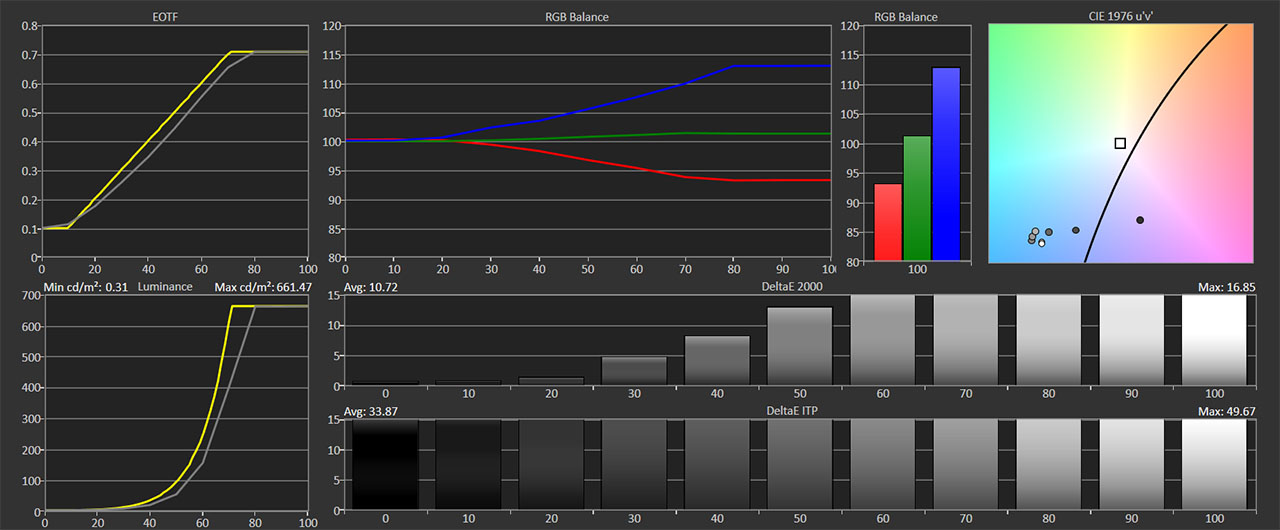
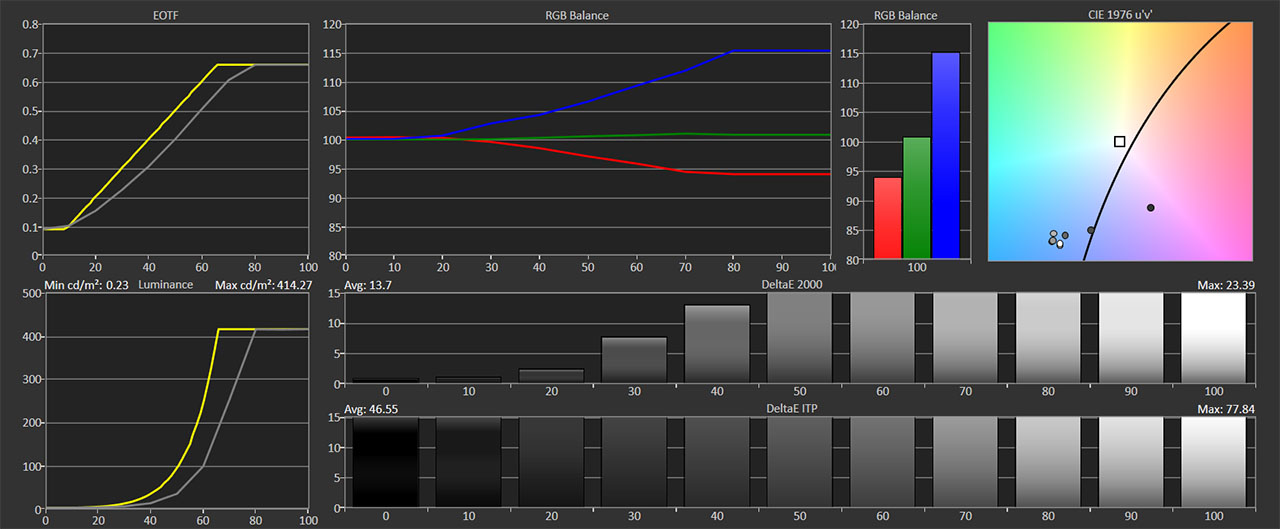
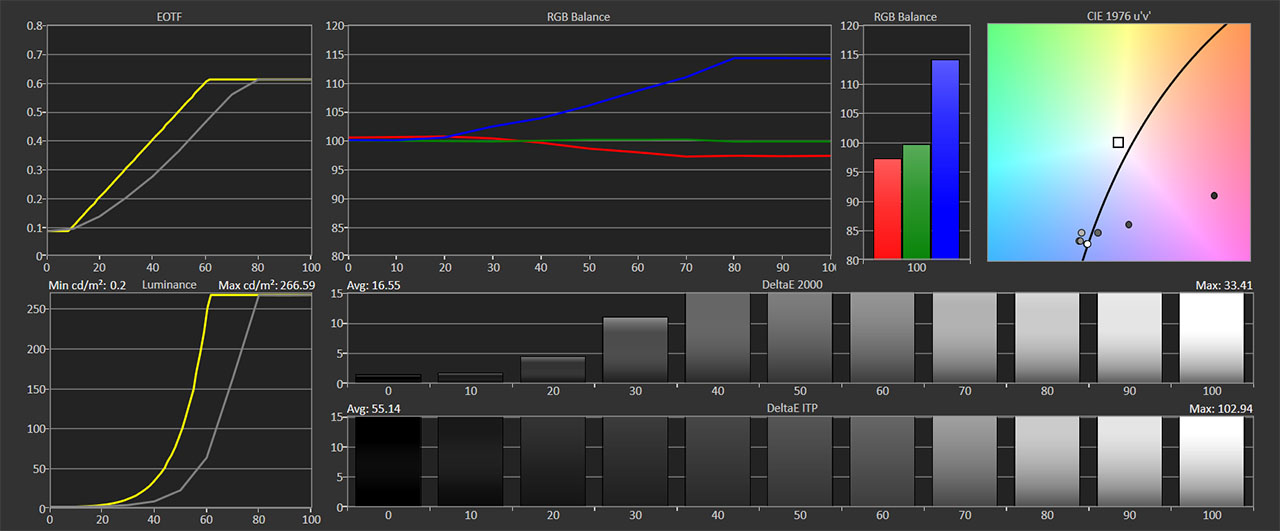
The white balance behavior across all iris positions is excellent, showing a level of linearity that I have never seen before on another RGB laser projector using an iris system. Here, the dual iris system truly shines.
And here we have the same Standard HDR mode after calibration. The XGIMI Titan Noir Max clearly performs better in HDR, at least regarding white balance behavior, with a DeltaE 2000 error below 2.
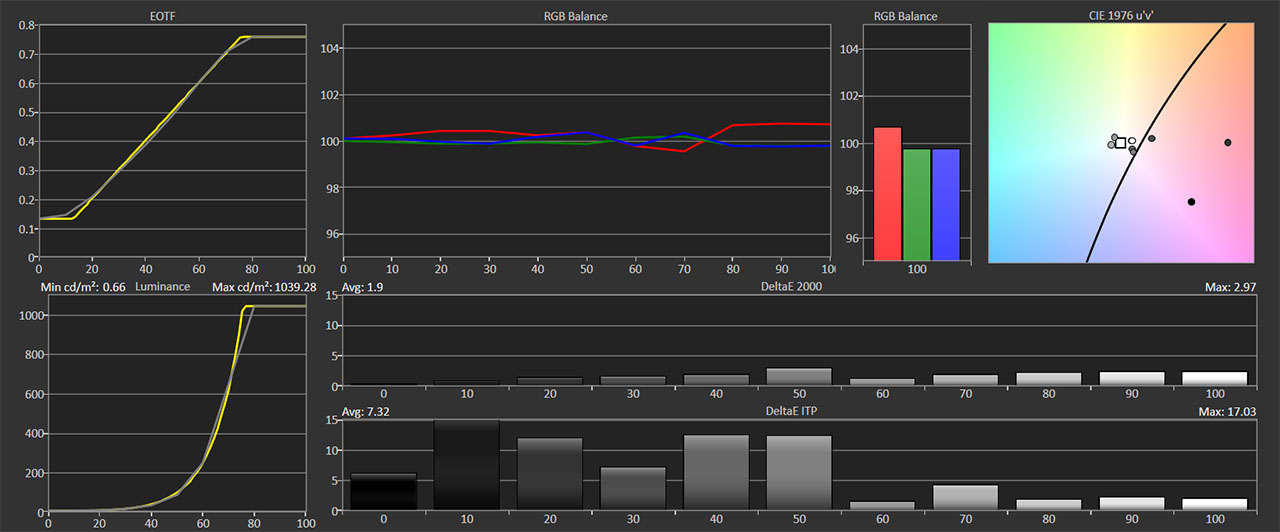
In general, I would say that the XGIMI Titan Noir Max did not leave me completely satisfied with its factory calibration. I expected better behavior. On the other hand, it is not disappointing either, and it can easily be used as it is, even if the user never touches a single setting.
The real problem I discovered, and the one that kept me struggling for many hours, is that the white balance controls behave far from linearly if you decide to proceed with a full calibration.
You may get correct measurements every 10 IRE, but once you start checking the intermediate grayscale steps, it becomes frustrating. For example, you adjust the red gain, and suddenly you end up with excessive red at 83 IRE, too much green at 76 and 75 IRE, and blue shifts at 50 and 51 IRE.
You make a single click adjustment to one of the three primary color gains, and the entire grayscale behavior changes dramatically once again across the whole range.
You do not even need measurement equipment to notice it. Just display a grayscale pattern, and the effect is so visible that even a nearsighted person without their glasses could spot it immediately.
I hope XGIMI fixes this bug in a future firmware update.
As for color gamut performance, my measurements showed that the XGIMI Titan Noir Max covers 163% of Rec.709, 100% of DCI-P3, and 95% of BT.2020, which are also typical values for an RGB laser projector.
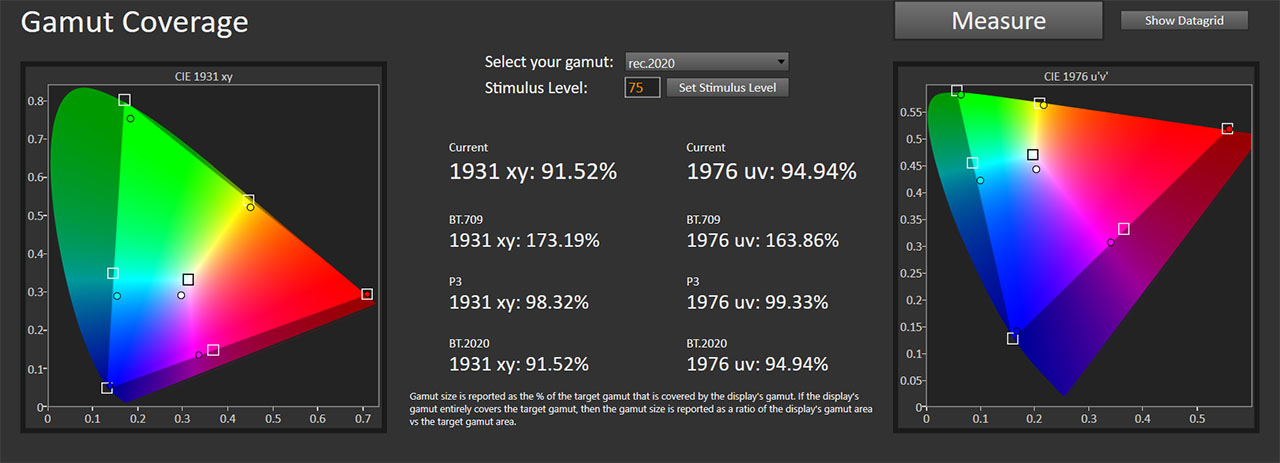
Now, regarding the measurements of the primary and secondary colors, the XGIMI Titan Noir Max did not leave me fully satisfied here either.
To be honest, I expected better hue and saturation accuracy from a latest-generation RGB laser projector.
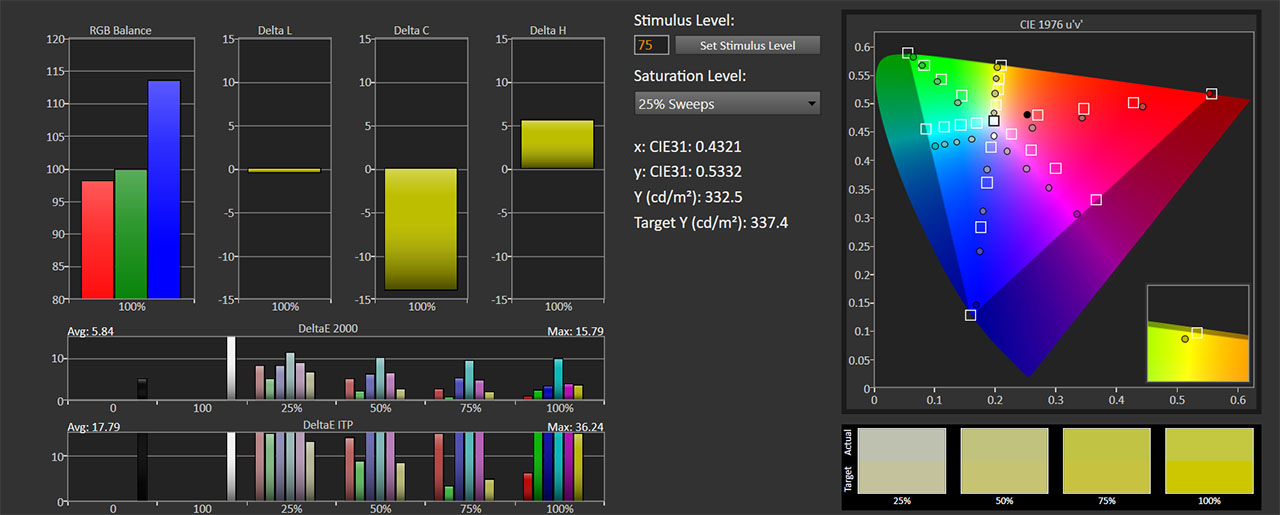
What can I say, maybe I got spoiled by the out-of-the-box measurements I got from the AWOL Vision Aetherion MAX, and now everything else feels disappointing to me? Maybe!
But just look at the Aetherion’s chart, and call me crazy if you want, I will not mind!
AWOL Vision Aetherion MAX
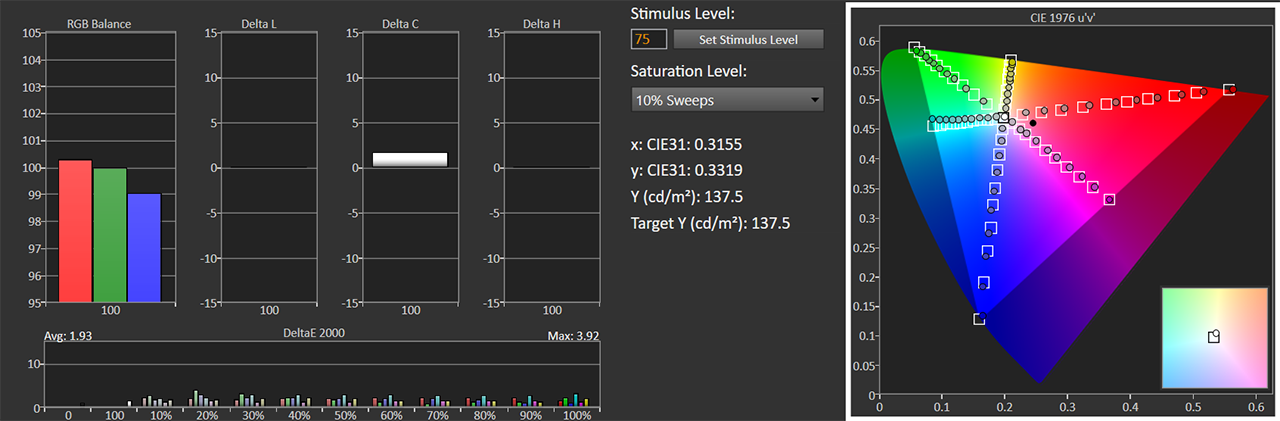
Here as well, I should mention that the CMS of the XGIMI Titan Noir Max, through which we can adjust the colors, also does not behave linearly, turning color calibration into a real headache.
The white balance behavior is really strange, and there are serious color differences across the grayscale levels that become obvious when you actually spend real time testing the projector, and not just simply showing off your “expensive” measurement equipment like a lot of “reviewers” do these days.
But this is exactly why Projectorjunkies exists, to provide proper, objective information only after fully testing and understanding each model.
I will show you the issue through screenshots, and more importantly, I have already discovered the actual source of the problem, which I will analyze further below.
Notice that almost every grayscale step has a slightly different color tint.
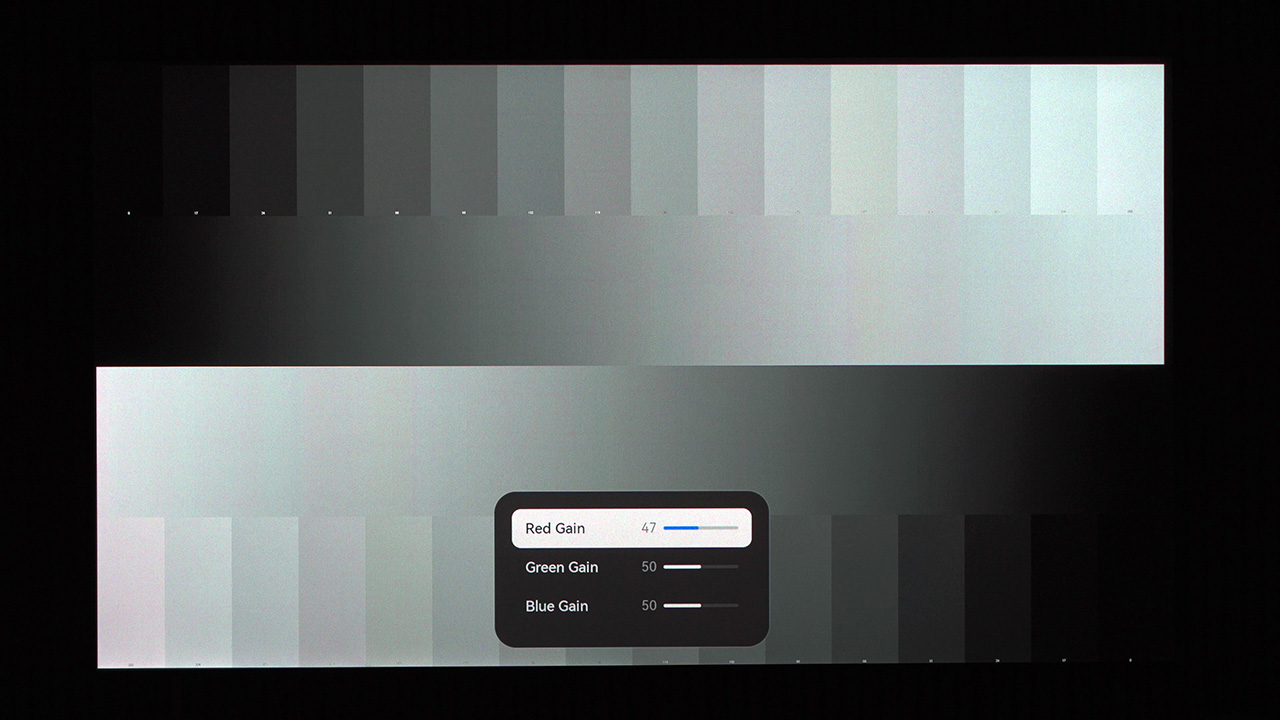
While trying to adjust the grayscale through the classic 2-point white balance adjustment menu, you quickly realize that there is absolutely no linearity, at least not like what I am used to seeing on recent RGB laser projectors such as the Nebula X1 and X1 Pro, the Valerion VisionMaster series, the Aetherion MAX, or even XGIMI’s own Horizon 20 Max.
Instead, what we see here is that even the smallest adjustment can lead to complete instability across the grayscale, something that remains true even when using the much more advanced 11-point white balance adjustment system.
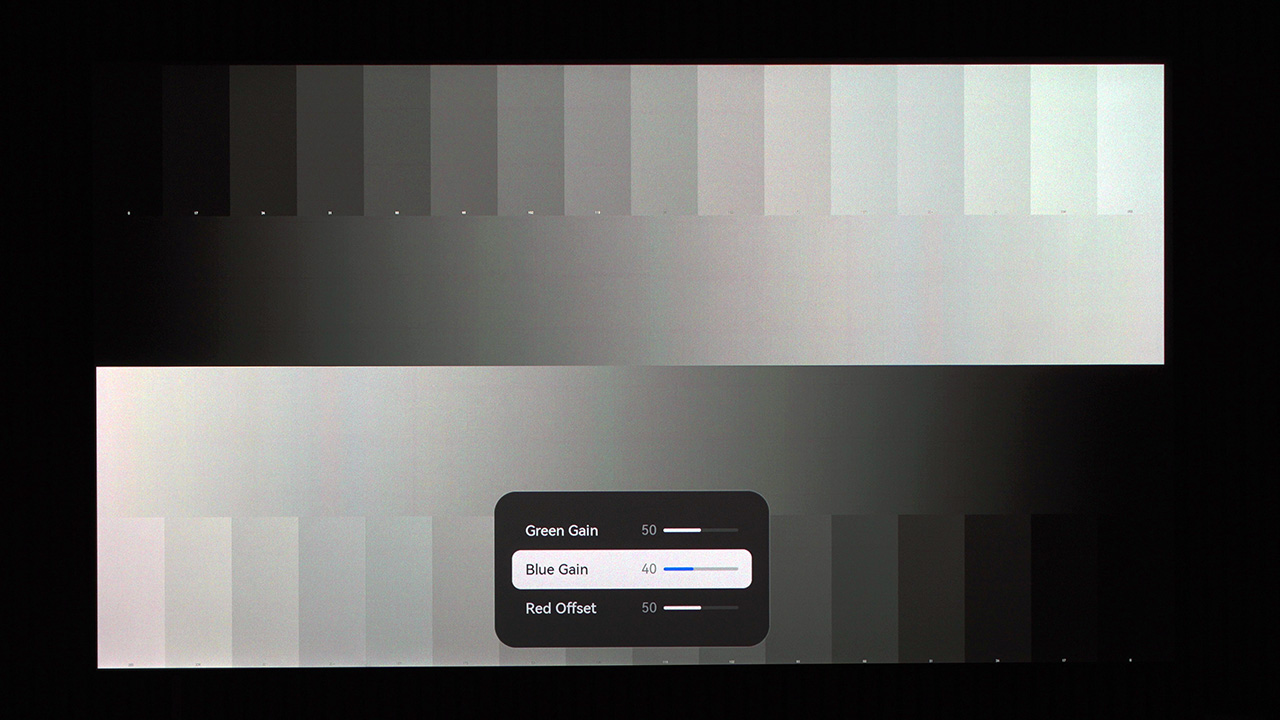
In general, the Titan Noir Max is a rather difficult projector when it comes to calibration. With patience and persistence, you can achieve very good results, but I am talking about a LOT of patience and persistence here.
Νoise, Temperature & Power Consumption
The XGIMI Titan Noir Max is the quietest projector that has ever passed through my living room.
Even if you sit right next to it, you hear absolutely nothing. The cooling system feels like it is not even running. There is no high-pitched noise from the XPR module, nor when enabling the ultra-fast PWM through the RBE Reduction setting. Absolutely nothing, complete silence.
I measured only 28 dB, which is practically just the room noise itself. Unbelievable.
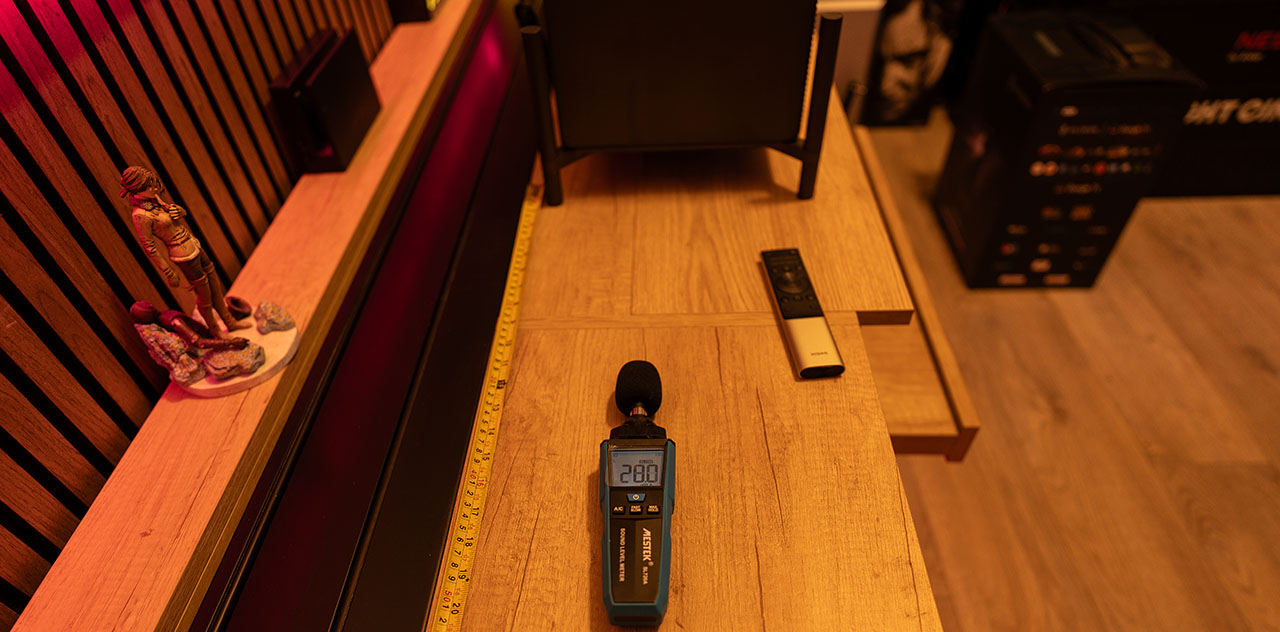
I do not know about you, but for me, having such a bright projector in your personal home cinema while being completely silent is a huge plus, HUGE! Honestly, this alone is already a serious reason to buy the Titan Noir Max.
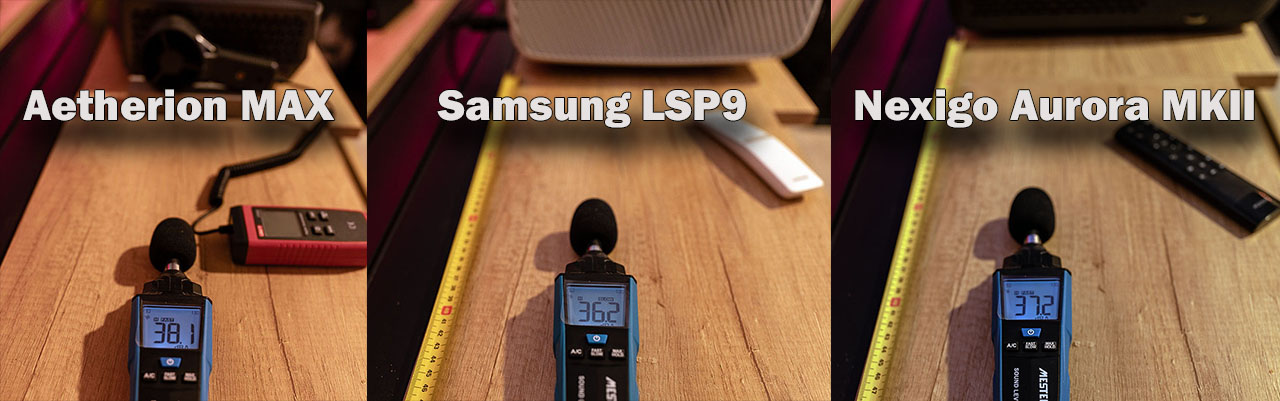
Just for comparison, the XGIMI Titan Noir Max is around ~2 times quieter than the AWOL Vision Aetherion MAX, the NexiGo Aurora Pro MKII, and the Samsung Premiere LSP9T.
The cooling system of the Titan Noir Max uses a rather unusual design, with fresh air intake located at the top, while hot air is exhausted from the bottom of the chassis. So if you install it upside down on the ceiling, you need to be careful not to accidentally restrict or block the exhaust airflow.
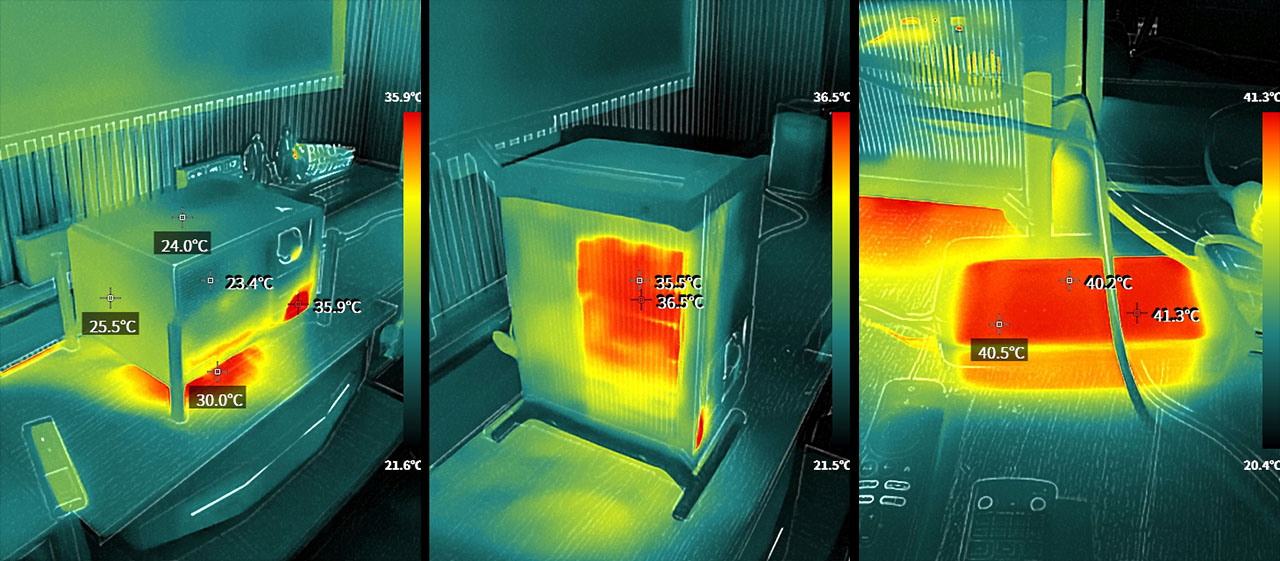
The air velocity at the exhaust of the cooling system on the XGIMI Titan Noir Max ranges from 0.32 m/s to 0.45 m/s, while the exhaust air temperature never rises above 31–32°C.
To put that into perspective, the airflow velocity on the AWOL Vision Aetherion MAX was measured at 1.91 m/s, more than 6 times higher! Higher air speed meaning one thing, higher operation noise!
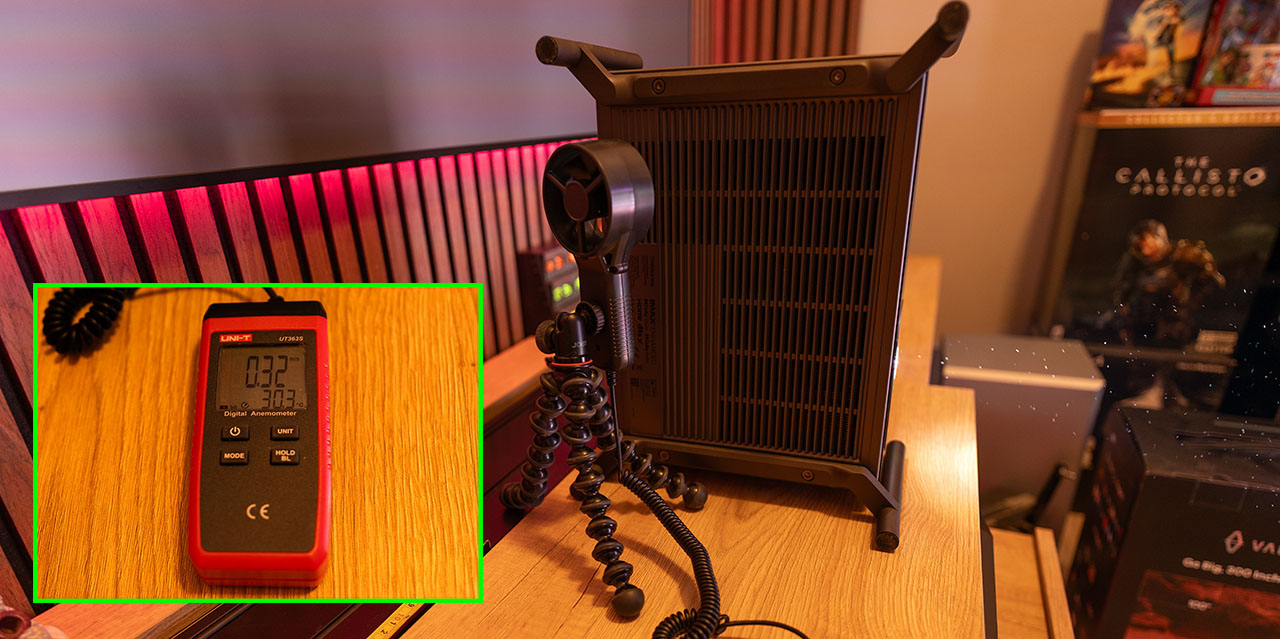
Operating temperatures are extremely low. The chassis of the Titan Noir Max remains completely cool, even after a long projection session with the laser power set to the maximum level of 10 of course.
Come on XGIMI, we asked for a high-quality external power supply, but you seriously overdid it!!!
The power supply of the Titan Noir Max is impossible to ignore because of its massive size. Not only is it difficult to hide, honestly I cannot even imagine it in a ceiling installation, but it also gets quite hot.
Here is the thermal profile of the Titan Noir Max and its power supply, based on my thermal camera measurements.
Finally, let’s take a look at the power consumption of the Titan Noir Max. All measurements were taken while projecting a 100% white pattern on the screen.
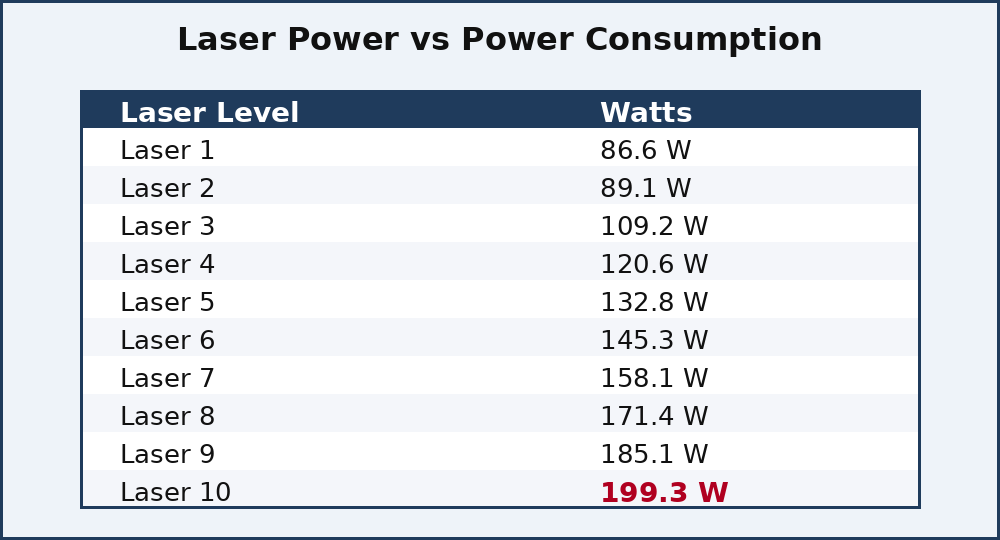
During real-world projection, power consumption with the laser set to 10 rises to around 217W, while selecting 10+ increases it to approximately 265W. In Performance Mode, however, it shoots all the way up to 342W.
One very interesting detail is that if the DBLE dynamic dimming algorithm from XGIMI is enabled, the average power consumption during a 2-hour movie , yes, I actually sat down and measured it , stays around 120W, with the laser still set to its maximum level 10.
RBE (Rainbow Effect) Reduction
XGIMI is the third manufacturer, after Valerion and AWOL Vision, to introduce a high-speed laser pulse mode in one of its projectors, aiming to reduce the well-known Rainbow Effect found in single-chip DLP projectors.
In essence, the RBE Reduction function increases the pulse frequency of the laser system, so the rapid R-G-B color transitions become far less visible to our eyes and, consequently, to our brain.
What is particularly important here is that, in the case of the Titan Noir Max, unlike the implementations from Valerion and AWOL Vision, enabling the RBE Reduction mode does not introduce any annoying high-frequency sound. The projector operation remains completely silent.
In RGB laser projectors, the image you see on your screen is not created by a continuous beam of light emitted by the projector, but by rapid sequential pulses of the three primary RGB colors. The speed and duration of these pulses, always perfectly synchronized with the movement of the mirrors inside the DMD chip, create the entire color palette and all the grayscale gradations that you finally perceive as the image on your screen.
There is only one way to accurately measure and truly visualize, through numbers and mathematics, the performance of an RBE Reduction system and, more generally, the behavior of the PWM (Pulse Width Modulation) laser systems used by today’s RGB laser DLP projectors, and this is exactly the method I used.
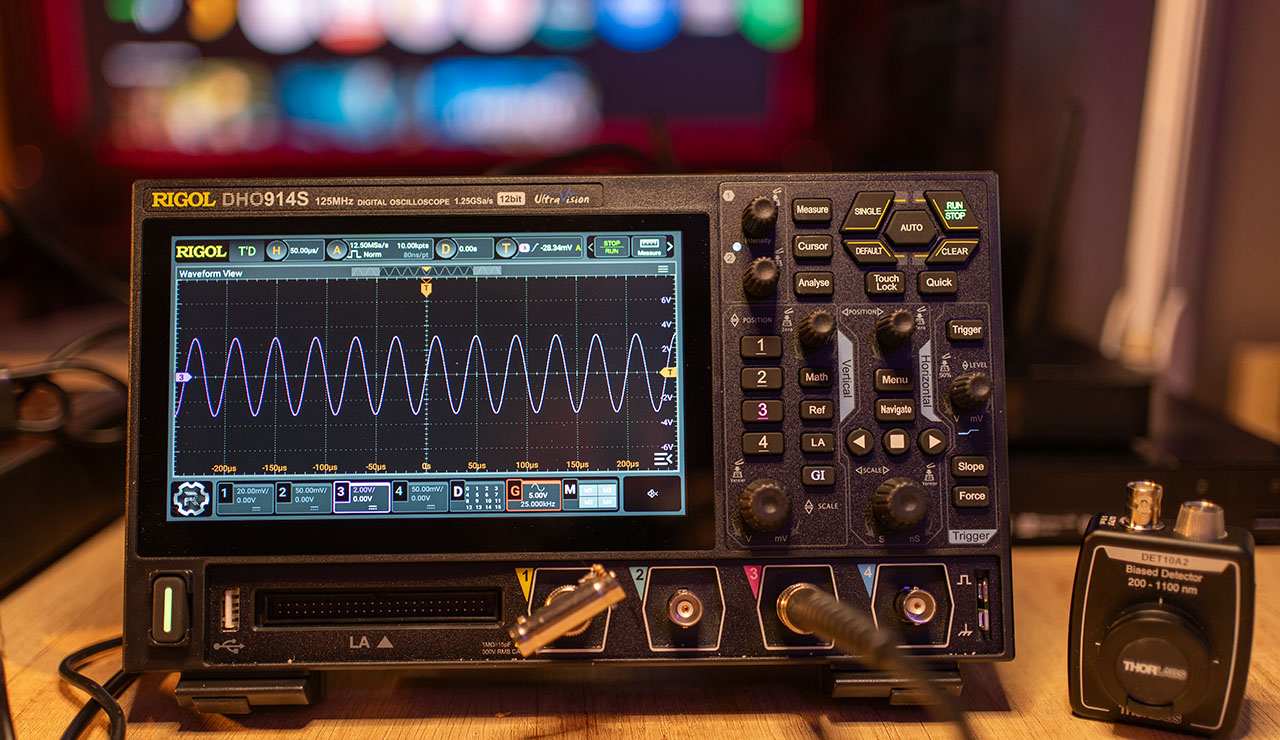
As a measurement instrument, I used a specialized silicon (Si) photodiode from Thorlabs, a company widely regarded as one of the leading manufacturers of professional laboratory equipment related to laser technology, and personally one of my favorites as well (thank you guys for the goodies).
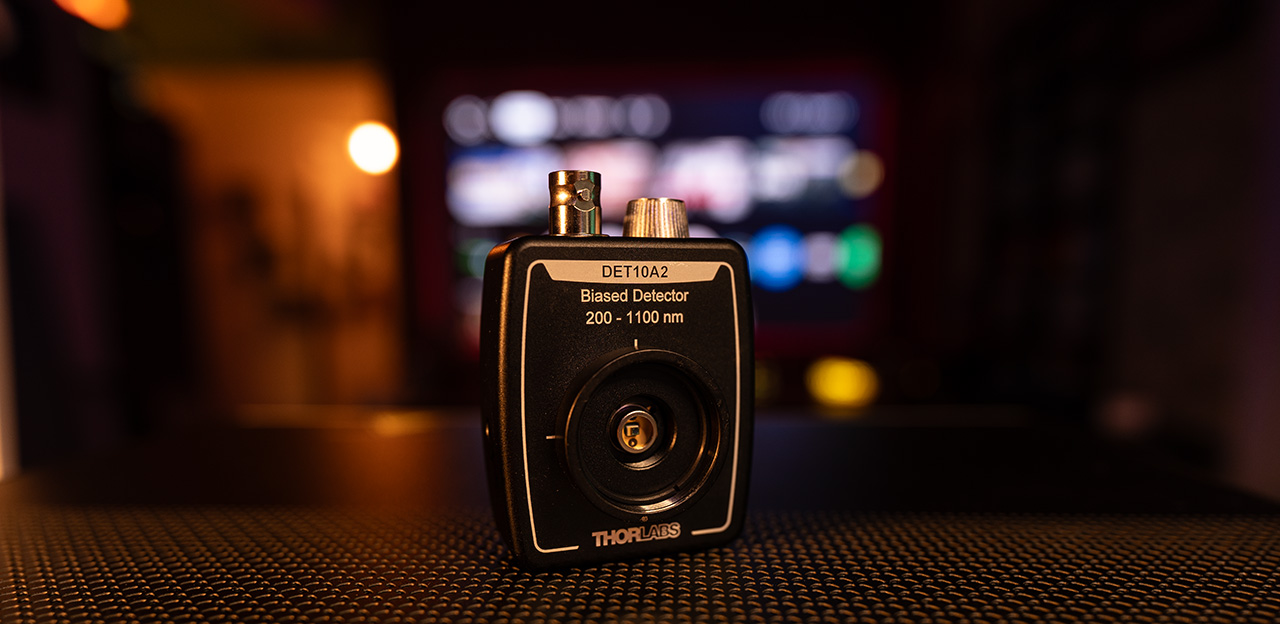
Thanks to this specialized equipment, I was able to accurately measure the operating frequencies of XGIMI’s RBE Reduction system, and perhaps for the first time worldwide, we are presenting these results to you.
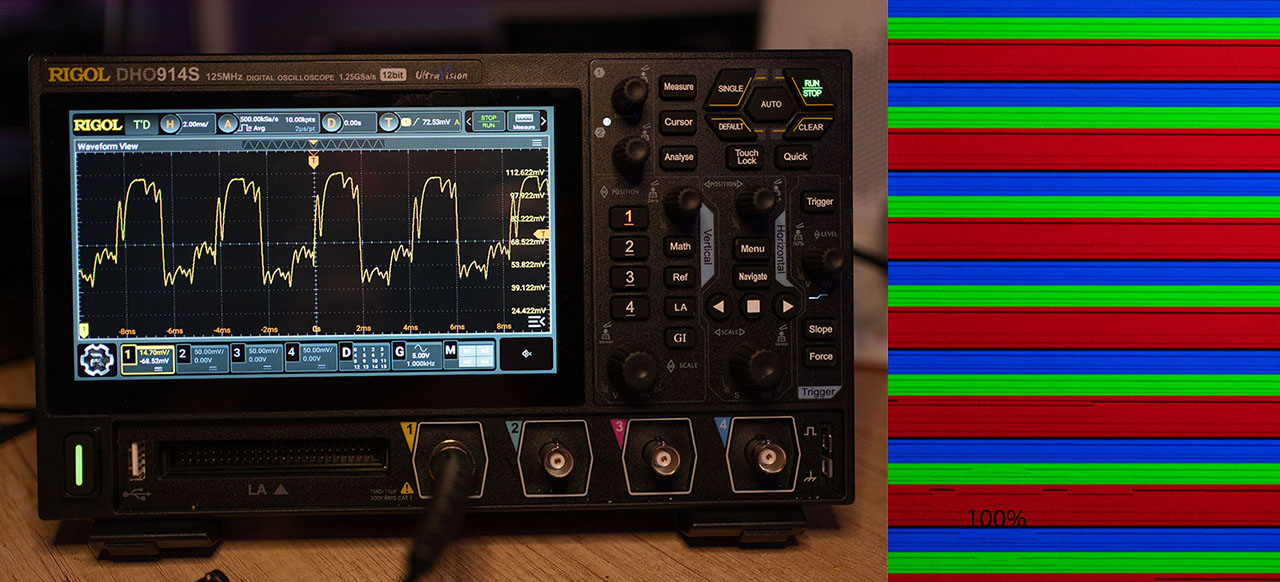
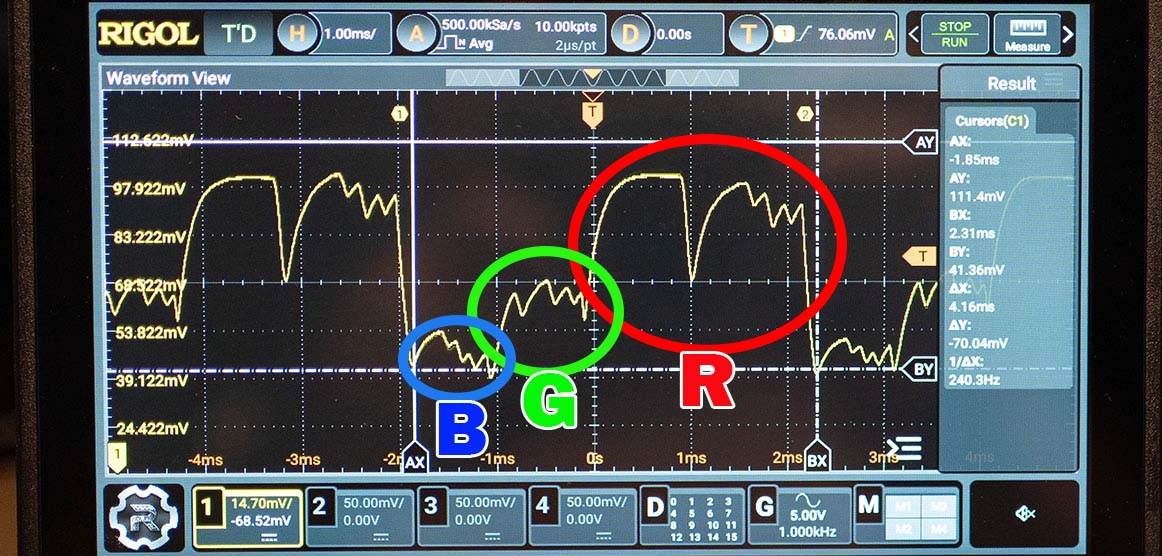
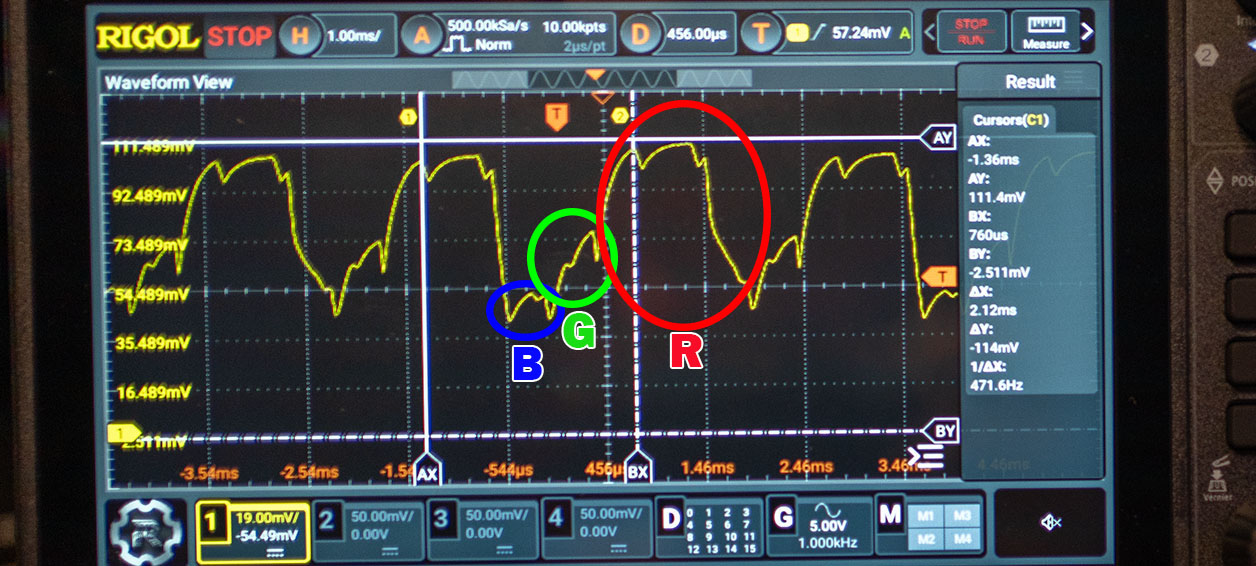
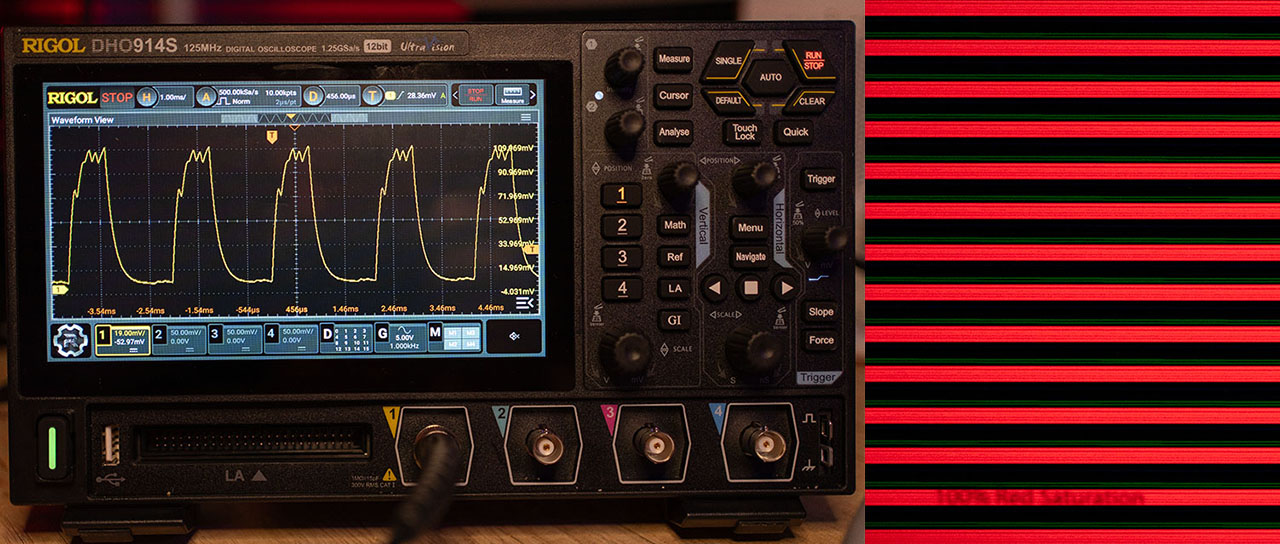
I have circled the pulses of the three primary RGB colors to make the waveform easier to understand. The highest waveform corresponds to the red color, the middle one to green, and the lowest one to blue.
This difference exists because the sensitivity of the photodiode changes depending on the wavelength range of the electromagnetic spectrum, in our case, the visible light spectrum. At the same time, the energy levels of the three RGB lasers used to create white are also completely different.
You can clearly see that each color consists of four sub-pulses, each with a different duration and a different pulse behavior pattern.
For the more observant readers, you will notice that these sub-pulses perfectly match the pattern I captured with my camera. Just look carefully and compare the two.
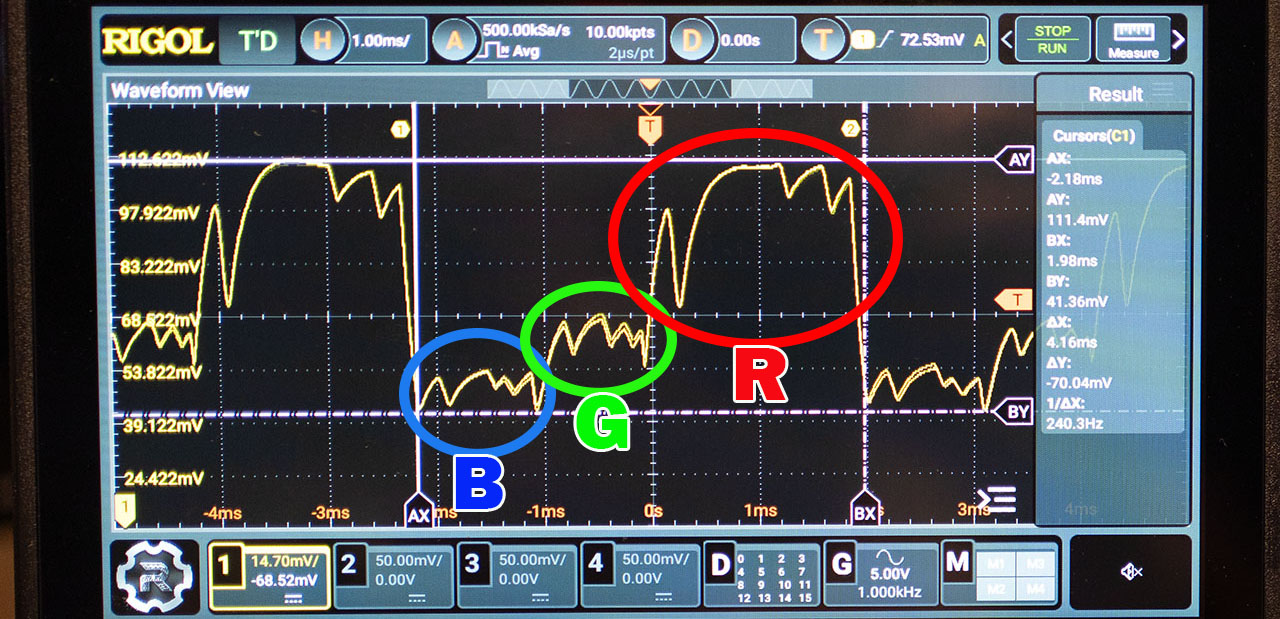
So, what conclusions can we draw from this measurement? I will analyze them in a very simple way so everyone can understand them.
First of all, the RGB sequence frequency is 240 Hz. In simple terms, this means that the three RGB colors appear 240 times per second, one after the other.
However, the duty cycle of the three colors, meaning the amount of time each color actually remains active, is different. The red laser has a duty cycle of approximately 48%, followed by blue at around 26%, and finally green at approximately 24%.
To make this even easier to understand, if we divide one second into 240 segments, each segment has a duration of 4.16 ms. This is the duration of one complete RGB sequence here.
Within these 4.16 milliseconds, the red laser occupies almost half of the total time, around 2 ms, while the blue laser remains active for approximately 1.1 ms, and the green laser for roughly 1 ms.
If we go into a deeper level of analysis, we can see that each color, during its active pulse window, does not appear as a single pulse, but instead as four individual sub-pulses. These are the four peaks you can see inside each color section of the measurement waveform.
So, within every RGB sequence, which as we already explained lasts 4.16 ms, we actually have a total of 12 pulses, four for each color.
This means that each individual color effectively appears 960 times per second, which corresponds to a frequency of 960 Hz. At the same time, all three colors combined appear 12 times within those 4.16 ms, resulting in a total pulse frequency of 2880 pulses per second.
In other words, the actual pulse operating frequency of the RGB laser engine inside the Titan Noir Max is 2,880 Hz, or approximately 2.88 kHz.
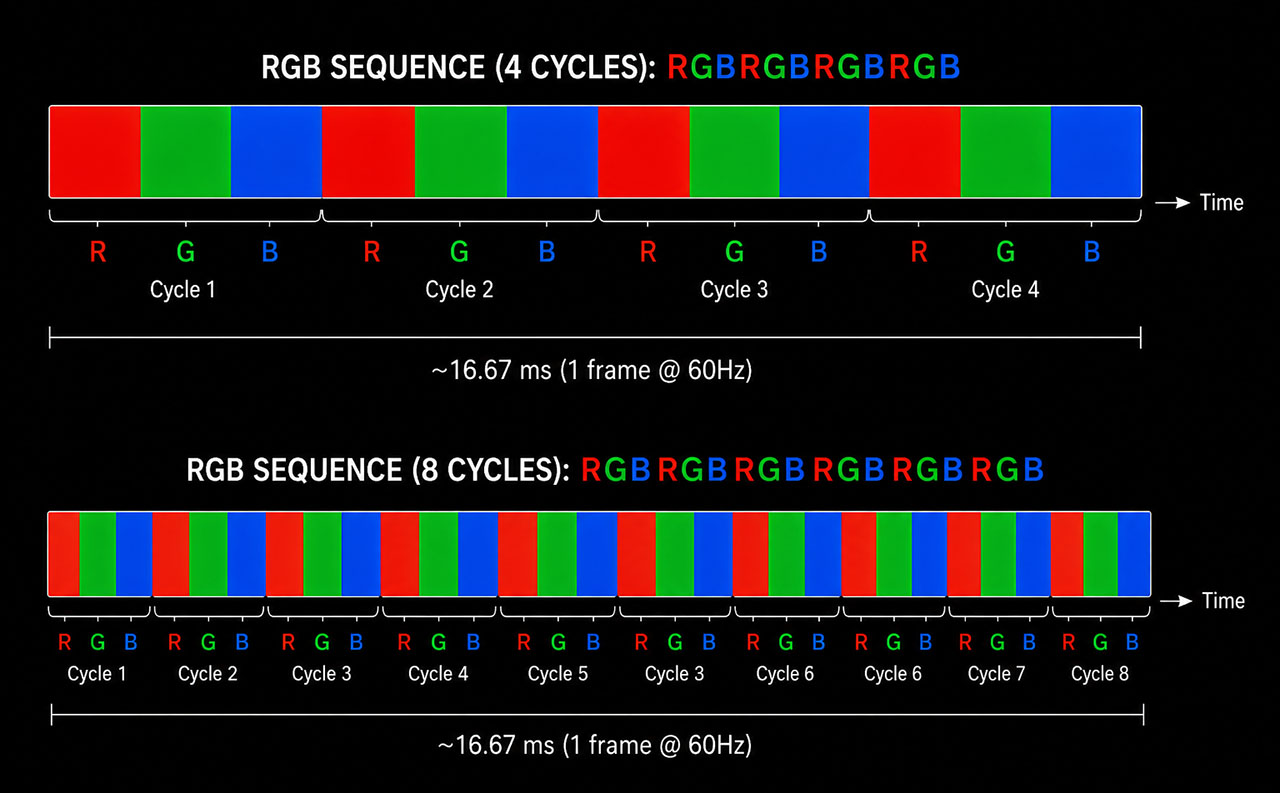
So, in every frame we see on our screen, which has a duration of 16.67 ms at 60 frames per second, we actually have four complete RGB sequences.
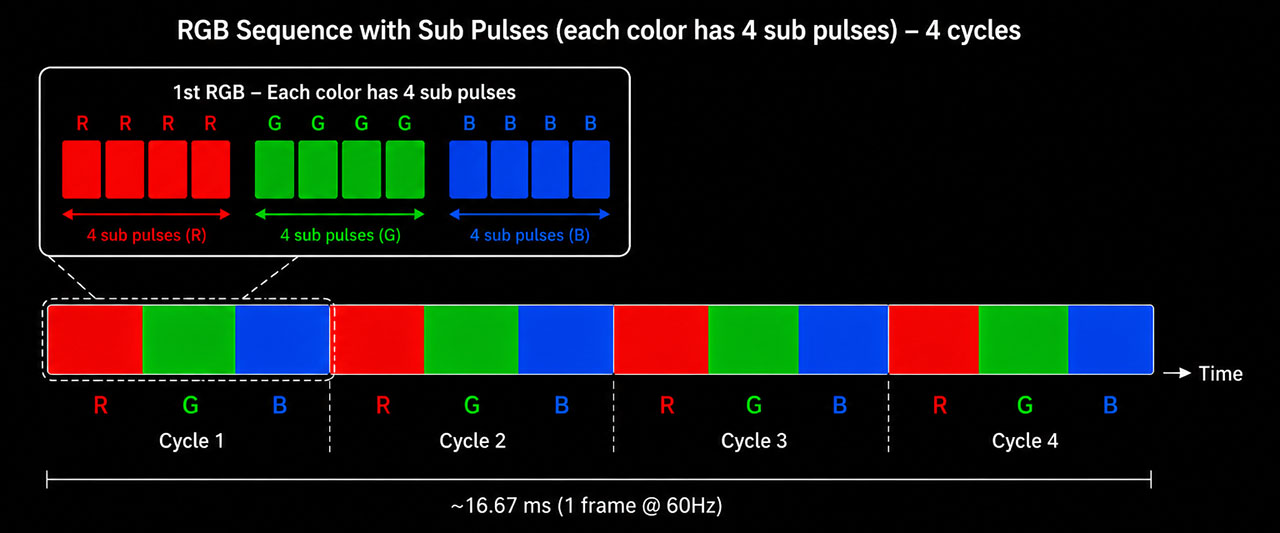
And if we want to calculate the real number of laser pulses, we must multiply these 4 RGB sequences by the 12 sub-pulses contained inside each sequence, four for each color.
This leads us to the conclusion that, in reality, we have 48 laser pulses per frame.
So the actual RGB laser sequence is not simply operating in a basic RGBRGBRGB pattern as many people assume, but rather in a much more complex structure closer to RRRRGGGGBBBB. And not only that, but each sub-pulse also appears with a different intensity level.
In practice, the pattern behaves more like: RrRrGgGgBbBb. This is what is known as multi-level modulation.
But what happens if we change the white balance setting?
For example, if we switch from Standard to the Movie setting, which as we already saw in the measurements section is noticeably warmer than the Standard mode, let’s see what happens.
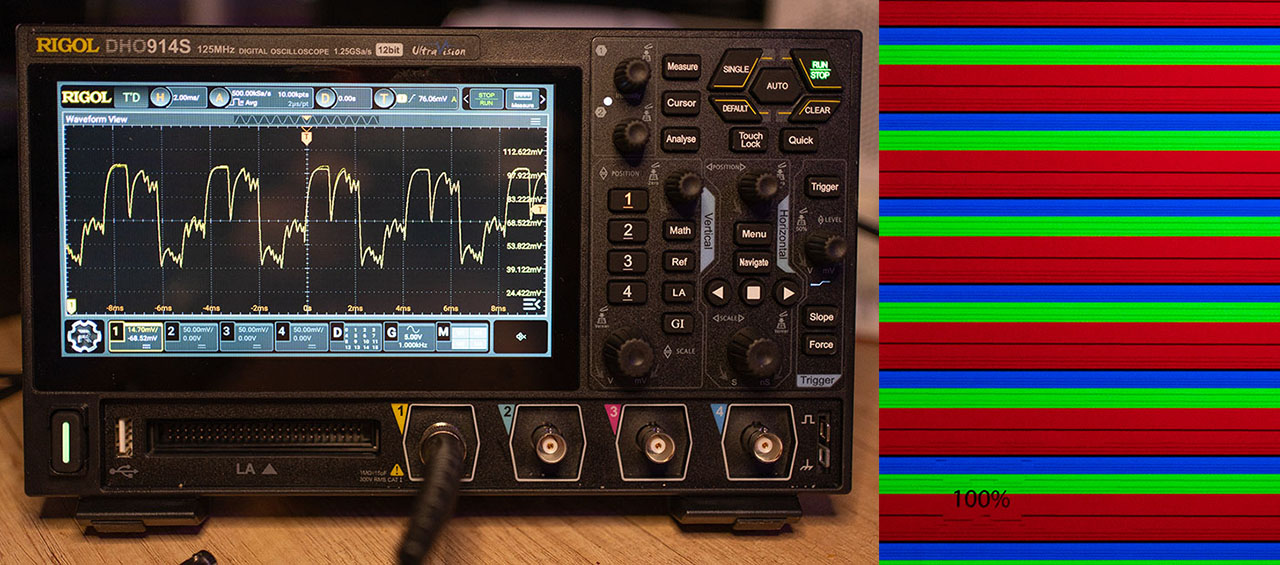
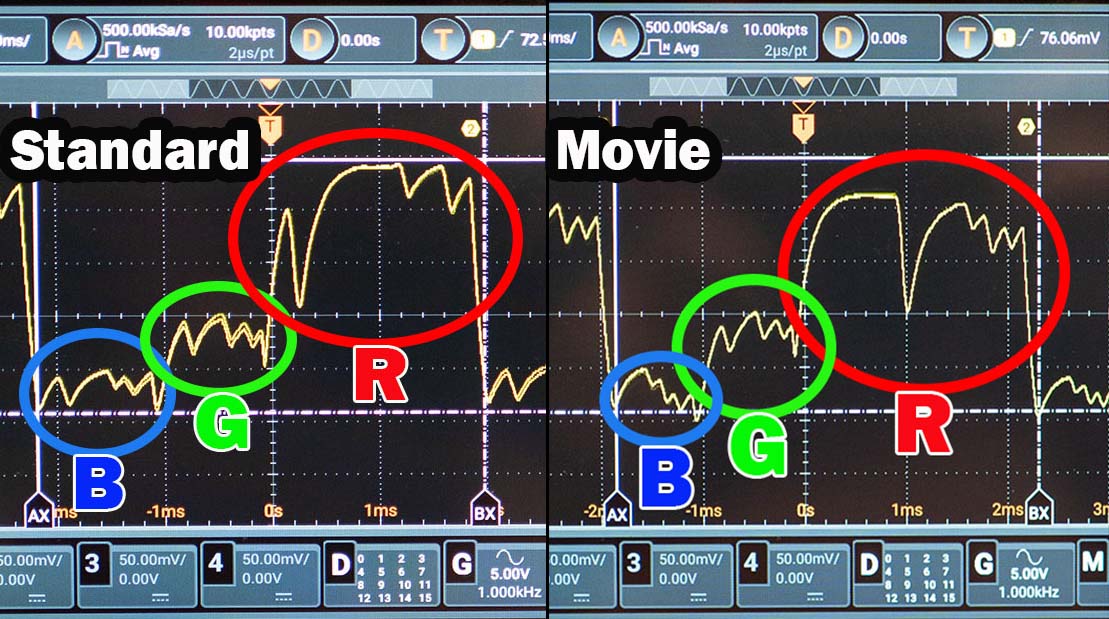
Here we can see that the red color now occupies more than half of the total 4.16 ms RGB sequence duration, and as you can clearly see, an additional fifth massive sub-pulse has been added.
This means that while the blue and green channels remain at 960 Hz, the red channel has now increased to 1200 Hz, or 1.2 kHz.
This now gives us a total laser pulse frequency of 3.12 kHz, compared to the 2.88 kHz we measured with the Standard White Balance setting.
Just look at the differences between these two white balance configurations.
With the Movie White Balance selected, I enabled the RBE Reduction mode, and the measurement I obtained is the following.
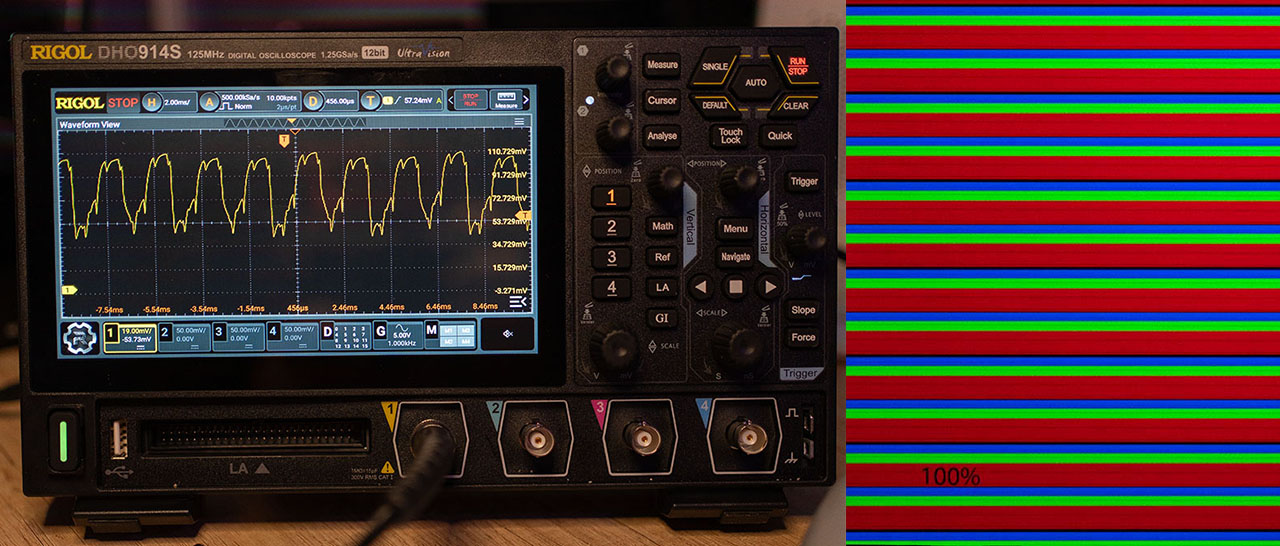
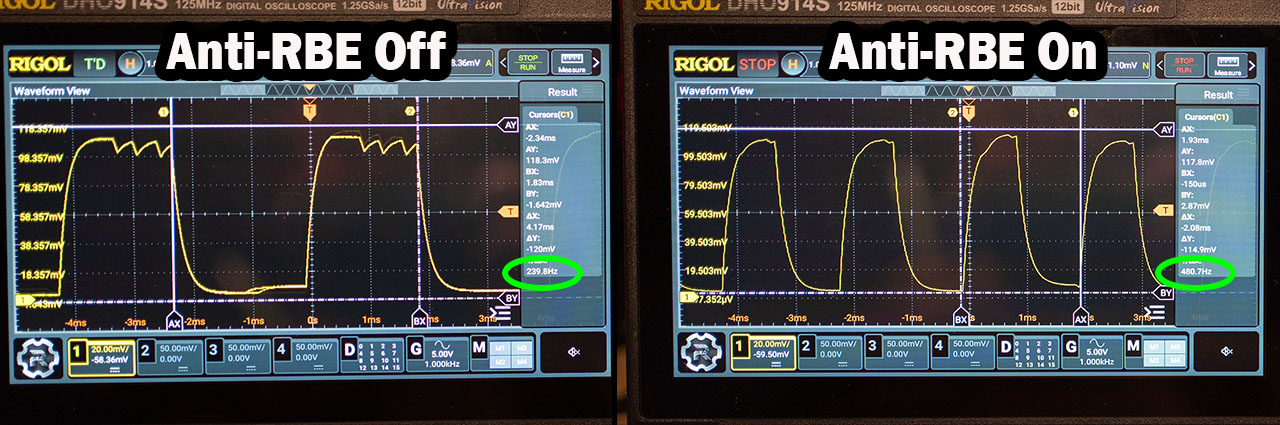
We now have a doubling of the RGB sequence frequency, with the operating speed increasing from 240 Hz to 480 Hz. This means that we now get one complete RGB pulse sequence every 2.13 ms, instead of every 4.16 ms as we had with the RBE Reduction disabled.
However, the number of sub-pulses has been reduced. We now have 3 sub-pulses for red, 2 for green, and 2 for blue.
This gives us a total of 7 sub-pulses per RGB sequence, and after doing the calculations, the overall pulse operating frequency reaches approximately 3.36 kHz.
So, by enabling the RBE Reduction mode we get a doubling of the RGB sequence frequency, from 240 Hz to 480 Hz, but not a doubling of the total pulse frequency.
Instead, we see a much smaller increase in the overall laser pulse frequency, rising from 3.12 kHz to 3.36 kHz.
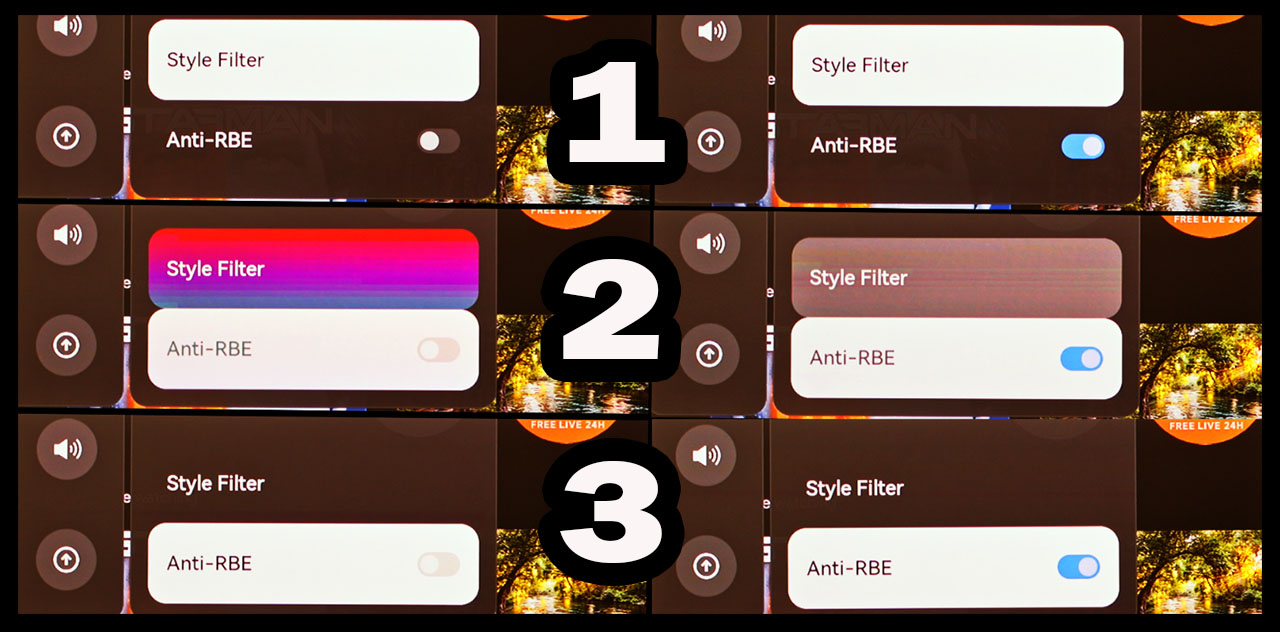
But does XGIMI’s Anti-RBE system actually work in practice? Yes, it absolutely does. It reduces the Rainbow Effect to a tremendous degree.
In the screenshot below, you will see three consecutive frames with the Anti-RBE mode enabled and disabled. I think the difference is clearly visible.
Now let’s enable the Anti-RBE mode and see what exactly happens.
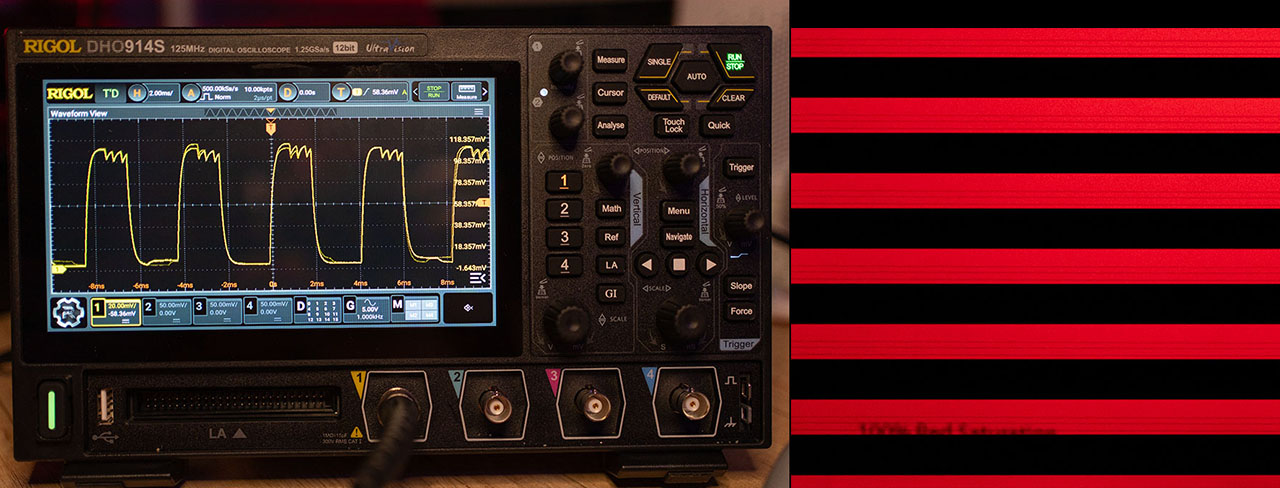
The frequency of the red laser pulses doubles, from 240 Hz to 480 Hz, and this is also clearly visible in the photo on the right, which was captured directly from the screen with my camera.
The pulses, which previously had a duration of around 2 ms each, now have a duration of approximately 1 ms.
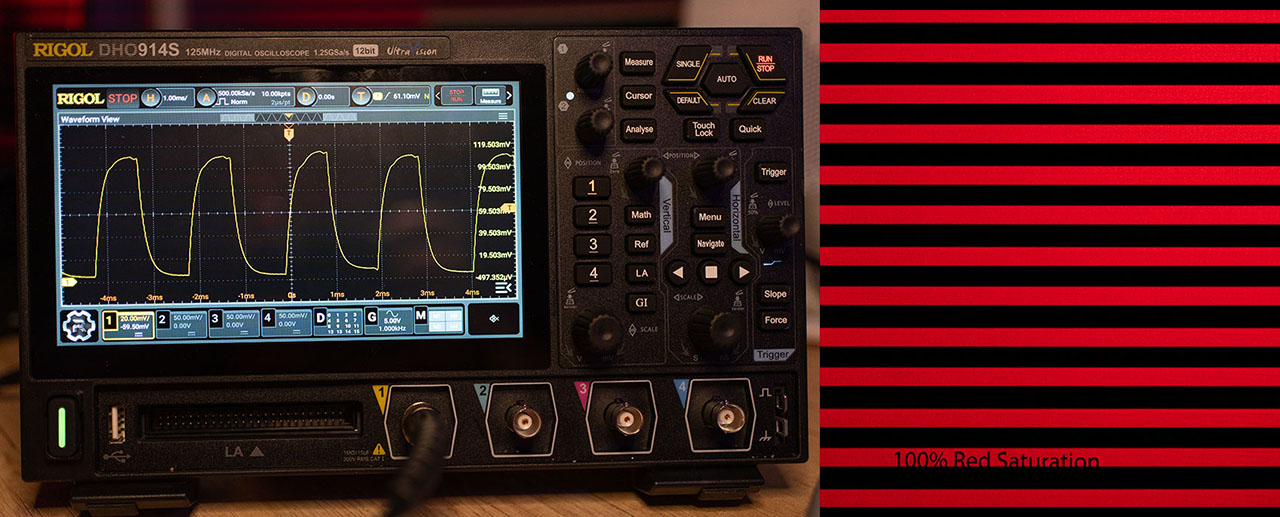
If you are observant, you will notice that with Anti-RBE enabled, there are no longer 4 sub-pulses inside the main pulse, but only a single one.
Now let’s look at the equivalent red laser measurement from the Aetherion, with RBE Reduction enabled as well. We can see that the frequency here is also the same, at 480Hz, but in this case we clearly still have 4 sub-pulses, exactly like we do with RBE Reduction disabled.
We can also spot two almost imperceptible pulses from the green laser, visible very low at the base of the waveform.
Here, in a direct comparison, we can clearly see the difference in sub-pulses. The Aetherion, despite the doubled frequency, continues to “break” the main pulse into 4 sub-pulses, while on the Titan Noir Max we see only a single main pulse, perhaps with a slight indication at the top of an attempt to split it into two sub-pulses. See for yourselves.
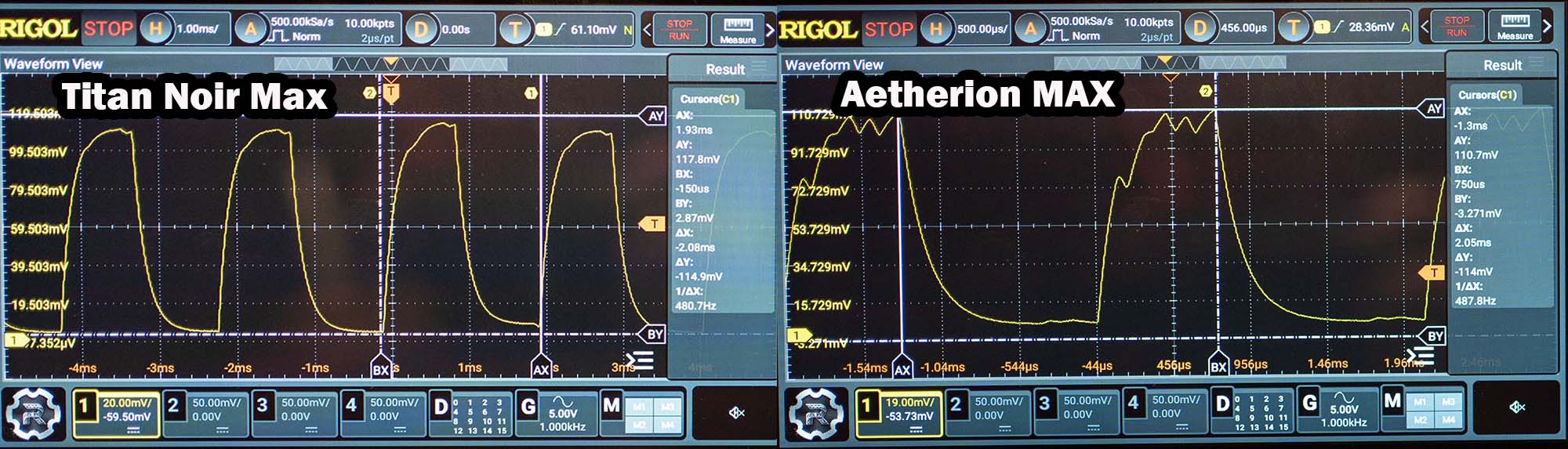
This practically means that, if we also take these sub-pulses into account in our calculations, then the real operating frequency of the red laser on the Aetherion reaches 1.92 kHz, while on the Titan Noir Max it effectively remains at 480 Hz.
To put it simply, with a duty cycle of approximately 50% on both projectors, a higher pulse frequency means only one thing: greater reduction of the Rainbow Effect.
This behavior of the Anti-RBE system on the Titan Noir Max, meaning the reduction of the number of sub-pulses when Anti-RBE is enabled, was consistently present in every measurement I performed, across all colors, both primary and secondary, as well as throughout the entire grayscale range.
In practice, at least to my eyes during real movie viewing, both RBE reduction systems work extremely well, and honestly I cannot see any meaningful difference in rainbow effect reduction between the two projectors.
However, the Titan Noir Max shows a specific behavior that I would never have understood if I had not measured the RGB laser pulse behavior with microsecond precision.
Also, the RGB laser pulse waveform of the Titan Noir Max, when the Anti-RBE mode is enabled, is noticeably unstable compared to the Aetherion. We can see random spikes appearing in areas where theoretically there should be no light output at all.
What we basically have here is a small mismatch between the laser timing and the DMD timing, something that clearly comes from the instability of the laser pulses themselves and not from the DMD chip or the controller.
This slight desynchronization creates some visible artifacts, such as dithering, image noise, and grayscale instability (the grayscale uniformity issue I mentioned earlier in the measurements section), especially in dark scenes where the laser pulses become shorter and the duty cycle smaller.
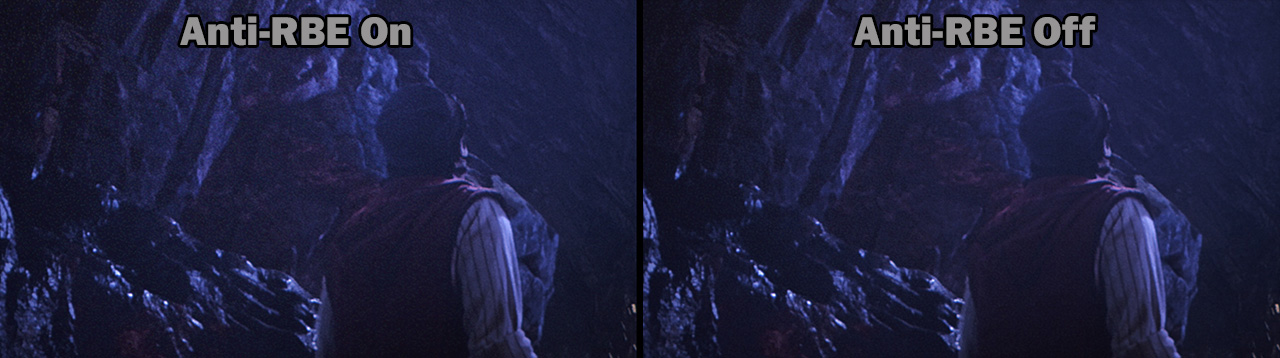
You can clearly see that some pixels (DMD mirrors) reflect light that is not supposed to be there at all. This is the result of the unstable PWM behavior, especially at low IRE levels and when the Anti-RBE mode is enabled.
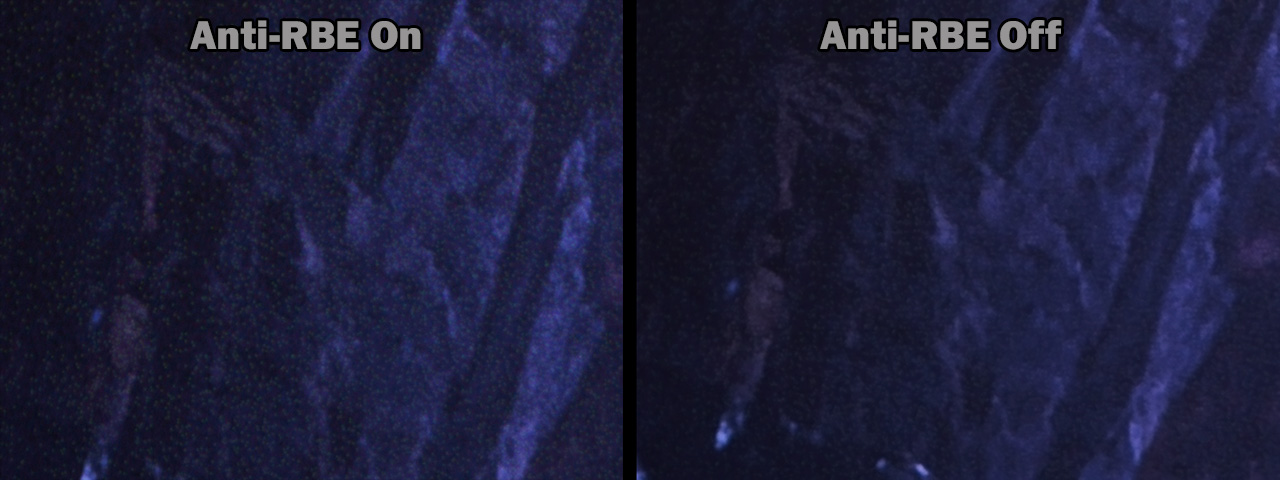
Considering that the Hz and kHz frequencies we are measuring in this section are actually very low for modern PWM systems, systems that can easily operate at much much higher pulse speeds, I personally believe this is not a hardware limitation but mostly a software issue.
My guess is that future firmware updates will improve the stability of the laser pulses and probably add more sub-pulses when the Anti-RBE mode is enabled.
At the moment though, the Anti-RBE system is fully usable, and users sensitive to the rainbow effect can safely enable it. The artifacts I described are not strong enough during normal movie viewing to ruin the overall experience.
Just to make this clear, this instability in the PWM behavior of the laser engine also exists even with the Anti-RBE mode disabled, at least compared to the Aetherion MAX and the Valerion MAX, from which I performed exactly the same oscilloscope measurements.
It simply becomes significantly worse, and much more visible as a phenomenon, once the fast PWM mode is activated through the Anti-RBE function. Just an important clarification.
Performance
Lens
Even though the Titan Noir Max is not a smart projector, it features a fully integrated triple TOF system consisting of infrared sensors, laser sensors, and a CCD sensor. We are talking about a complete sensor package that allows the Titan Noir Max to perform auto focus, auto keystone correction, and virtually every type of automatic image adjustment with excellent accuracy.
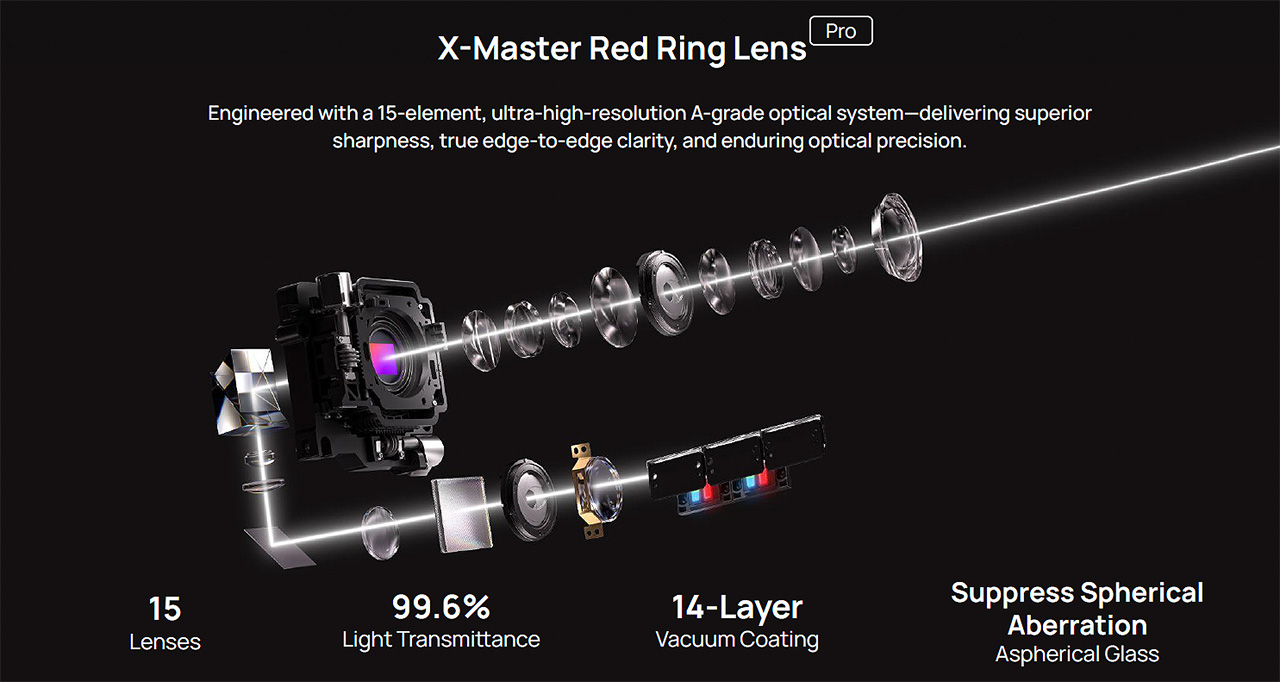
Let’s start with the lens of the Titan Noir Max. Despite the massive zoom range of this lens, combined with both vertical and horizontal lens shift, its sharpness and focus performance remain at a very high level. In terms of image clarity, I would personally rate it a 9/10, sitting only slightly below what is, for me, the absolute reference, the Horizon 20 Max from the same company that I tested a few months ago.
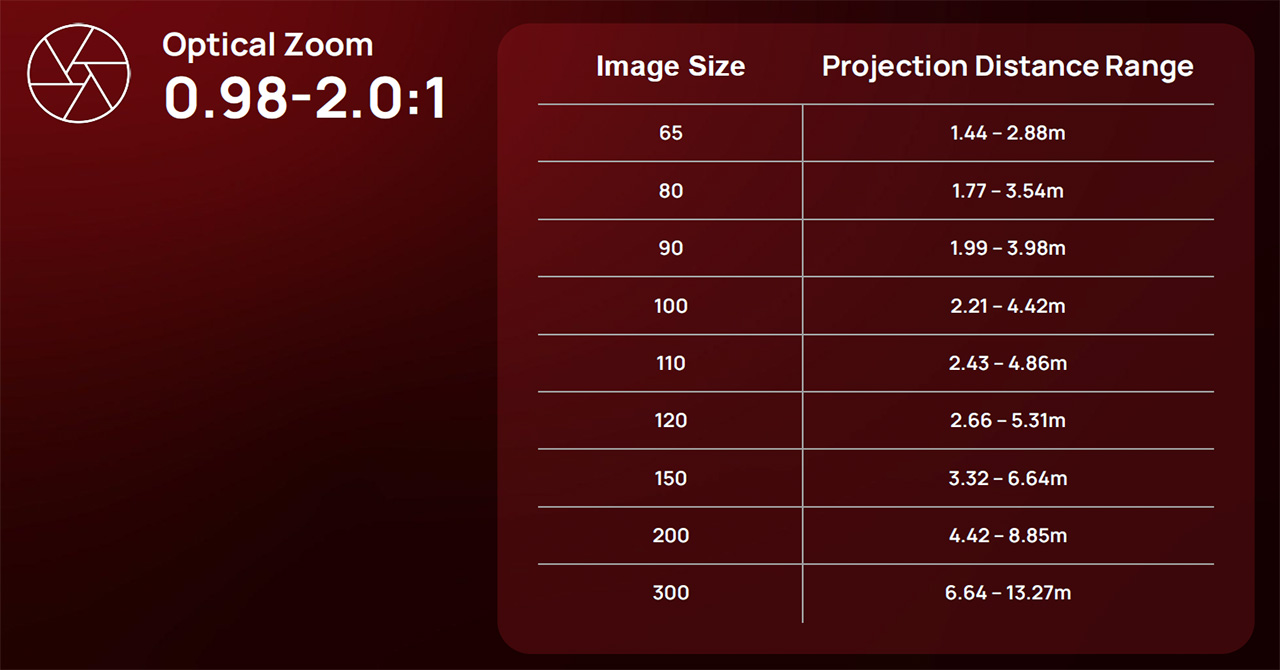
XGIMI has done an outstanding job with this lens, and anyone with even basic knowledge of photographic lenses will immediately understand what I mean. Designing a lens with a variable throw ratio from 0.98 to 2.0 for a DLP projector, while at the same time maintaining such impressive sharpness consistency across the entire zoom range corner to corner, is already an achievement on its own. (The horizontal color lines are not actually visible in real life and are simply related to the shutter speed of the camera used to capture this screenshot, so just ignore them).
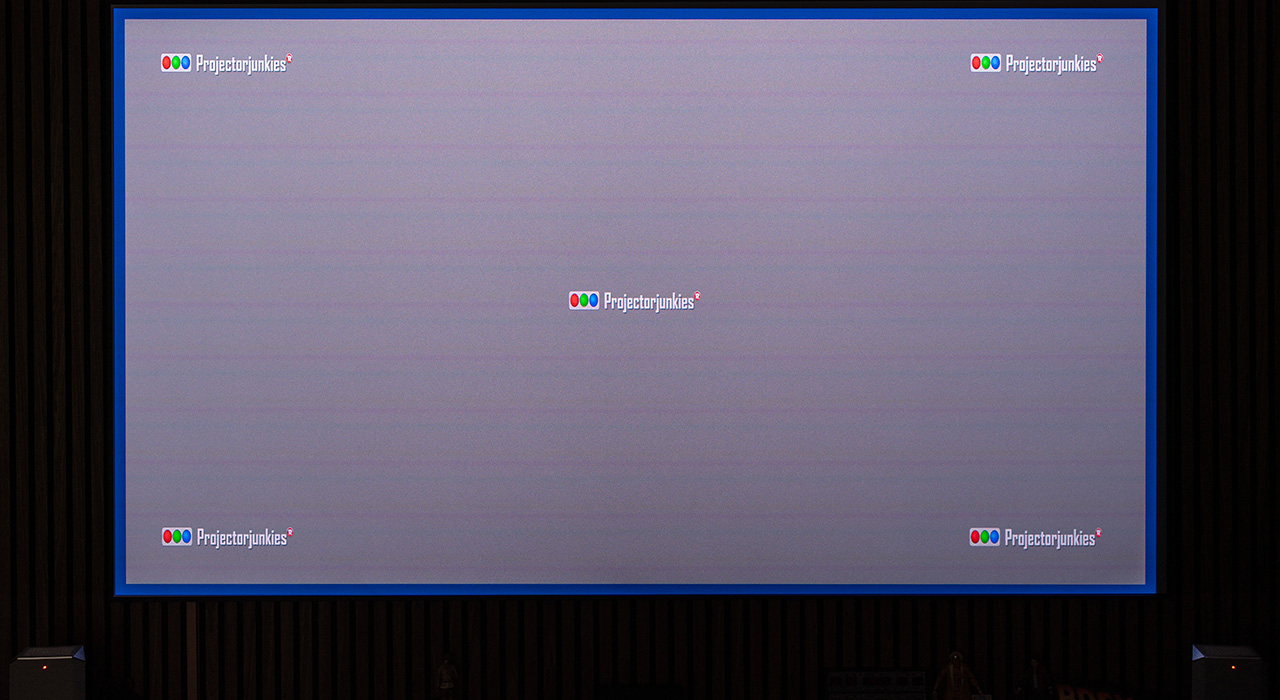
And if we also consider that this lens includes an integrated iris system between its optical elements, allowing the user to affect the f-stop values, while at the same time supporting both vertical and horizontal movement through lens shift, yet still maintaining remarkable optical stability, then we are no longer talking about just another projector lens, but about a genuine engineering achievement from XGIMI.
While testing the projector at different throw ratios and various lens shift positions, I fully expected, and quite naturally, to observe focus inconsistencies from corner to corner, variations in color aberration, and of course significant changes in brightness uniformity. Yet almost none of this happens with the Titan Noir Max lens, or more accurately, it happens to such a small and subtle degree that it becomes practically insignificant. Honestly, this is something that pleasantly surprises even experienced users like myself.
If this lens were a piece of clothing, it would definitely belong to a high-fashion Italian luxury brand.
For me, the lens of the Titan Noir Max is one of the best lenses ever used in a commercial home cinema DLP projector.
Bravo XGIMI, bravo. A lens with such a wide throw ratio range, such extensive lens shift capabilities, and performance at this level, honestly, even with nearly 30 years of experience in home cinema and DCP digital cinema projectors, I could never have imagined that we would eventually see something like this.
If I really want to become a little grumpy here, I would say that the zoom function operates in relatively large motor steps, and there is no micro-adjustment available for precise screen fitting. Consider this also as a small message to XGIMI for a possible improvement in a future firmware update.
Also, let me stay in “grumpy mode” for just a little longer and say that the auto focus system… hmm… once you go beyond roughly 3 meters from the screen, it starts struggling a bit. In most cases, the user will still need to make a small manual adjustment afterward.
Grumpy mode off. Let’s move on.
Motion
The Titan Noir Max, with the latest beta firmware, and I should mention here that I am testing a beta testing sample and not a final production unit, now fully supports 24p playback.
Here you can see the classic RTINGS 24p test clip, which as you can clearly see, the Titan Noir Max passes with complete success.
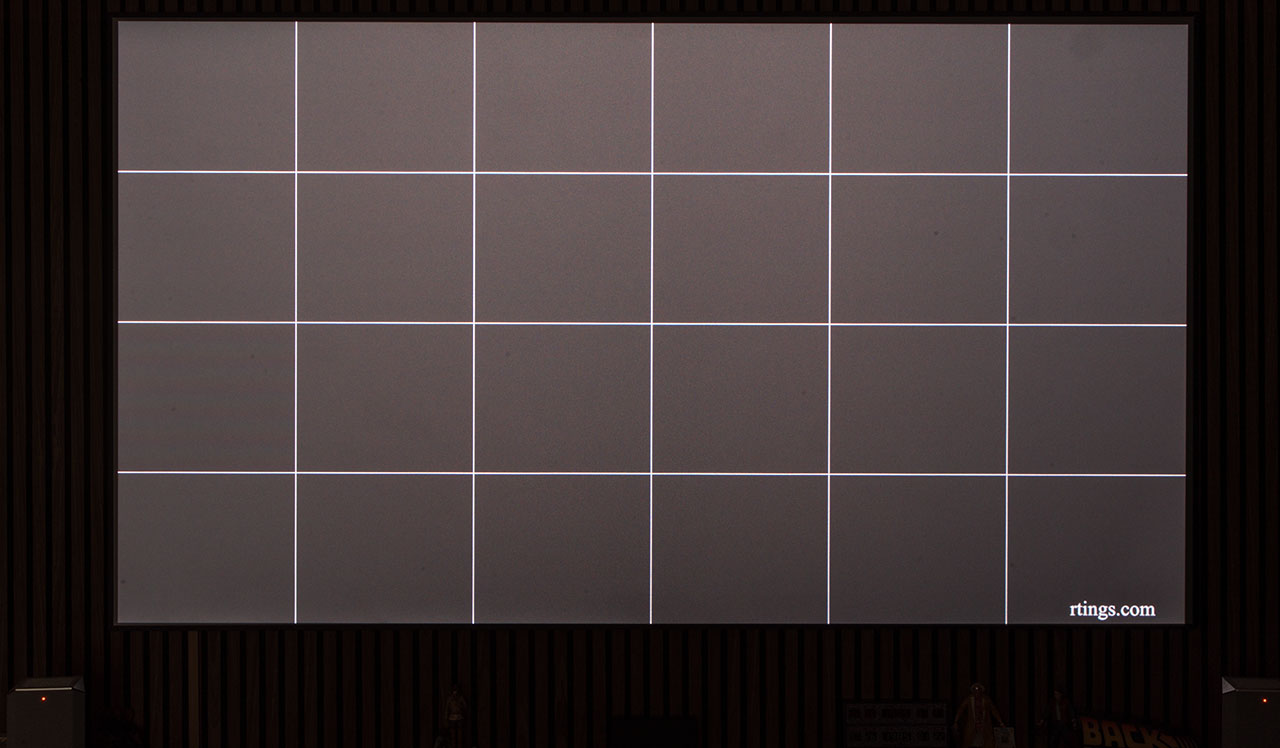
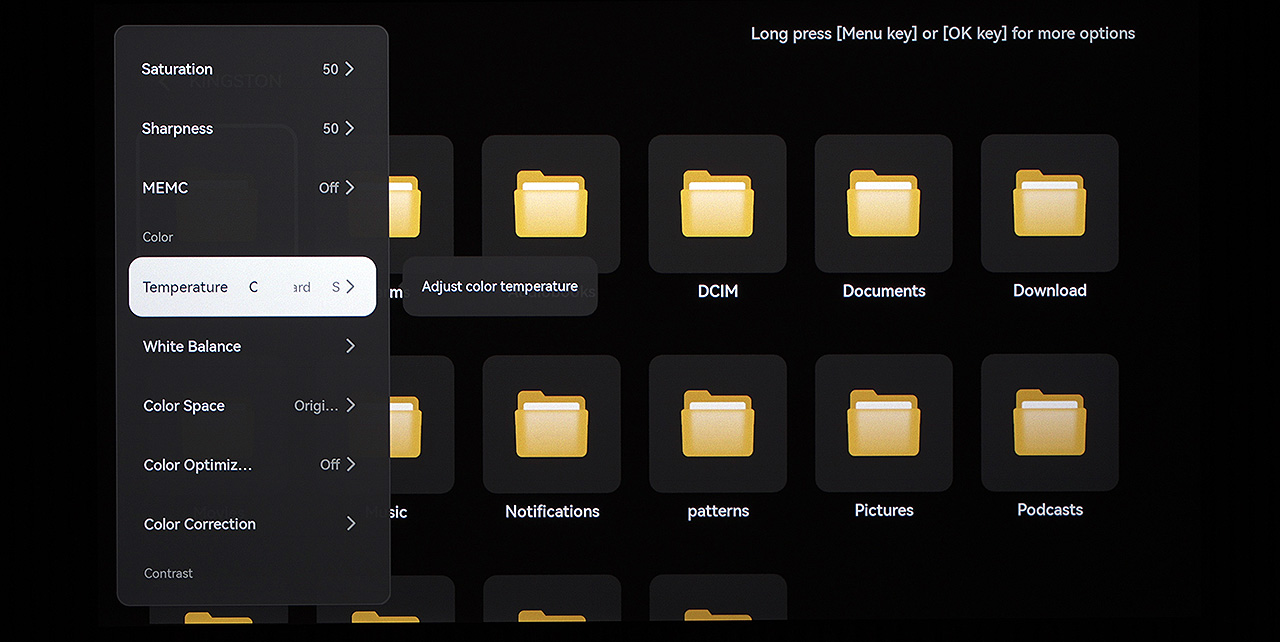
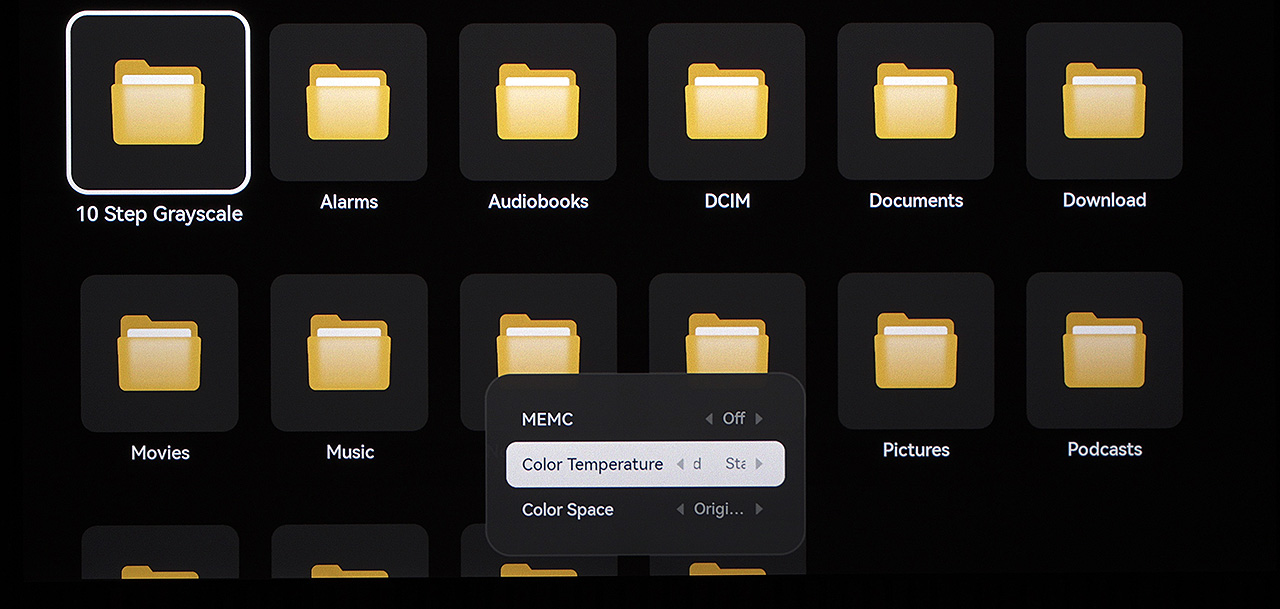
The projector offers four MEMC options inside its menu: Weak, Medium, Strong, and finally the Original Frame mode, where the Titan Noir Max reproduces the content at its native frame rate, even if that content is encoded at 24p.
I should also mention that even in the Strong setting, the well-known soap opera effect, which many people hate, is almost completely absent.
I would still recommend using the MEMC up to the Medium setting, and of course the Original Frame mode, because in the Strong mode I frequently notice some ghosting, especially around fast-moving objects.
Dual Iris
The biggest highlight, and probably the hottest feature of the Titan Noir Max, is its dual iris system, something that I personally see for the first time on a DLP home cinema projector. Honestly, I was really excited to see how it behaves in real use.
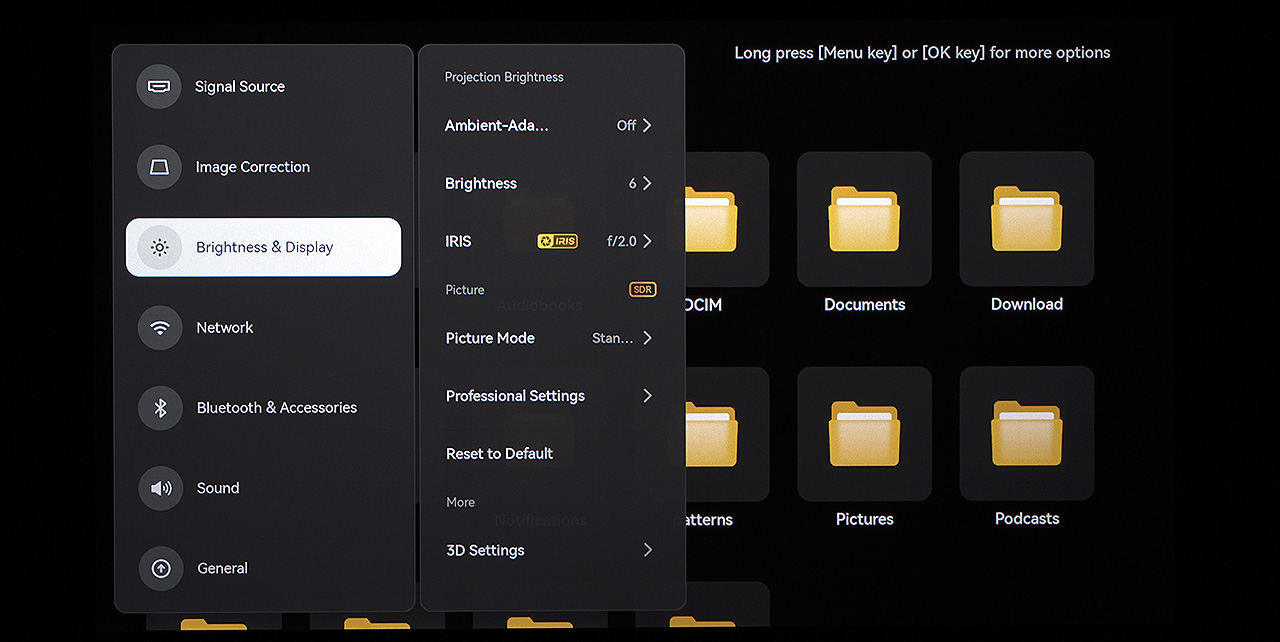
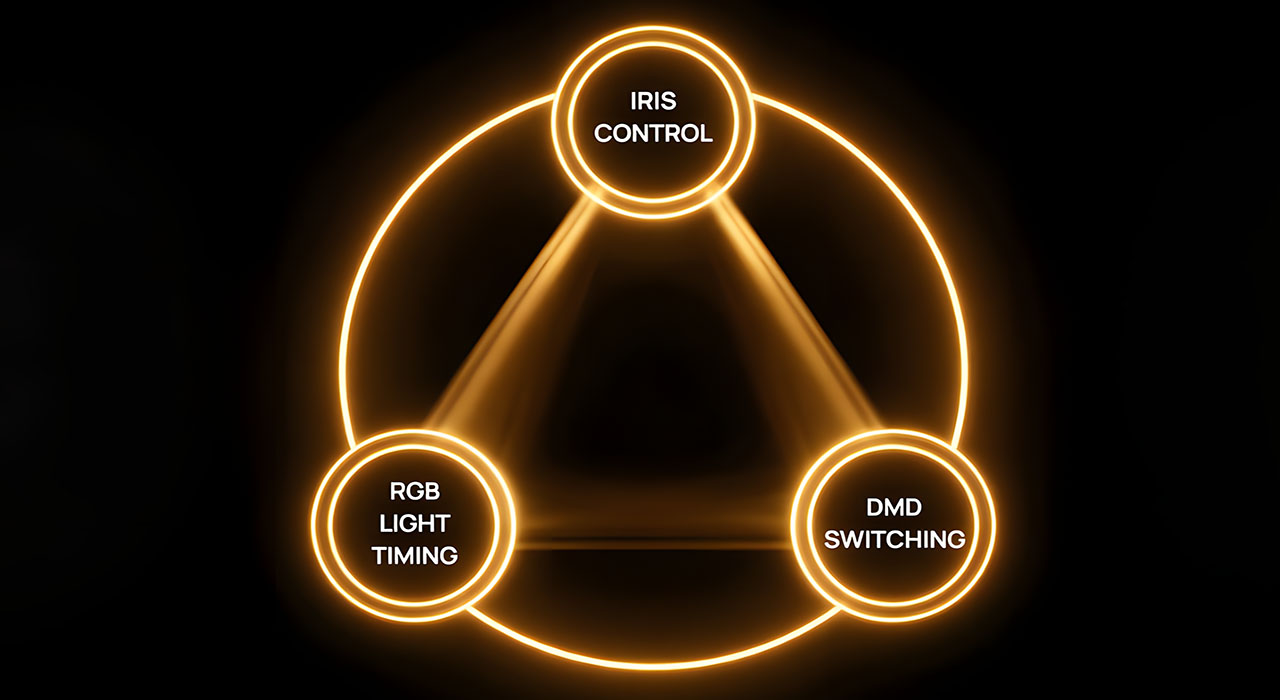
The Titan Noir Max gives you five fixed iris positions inside the menu, plus one extra mode that turns the iris system into a dynamic one. The two irises clearly work together, but it is impossible to know exactly how much each one contributes at every iris setting or during dynamic operation.
To help you better understand the brightness drop between the five fixed iris positions available in the menu, below you can see photographic comparisons against the fully open f/2.0 position.
F/3.0
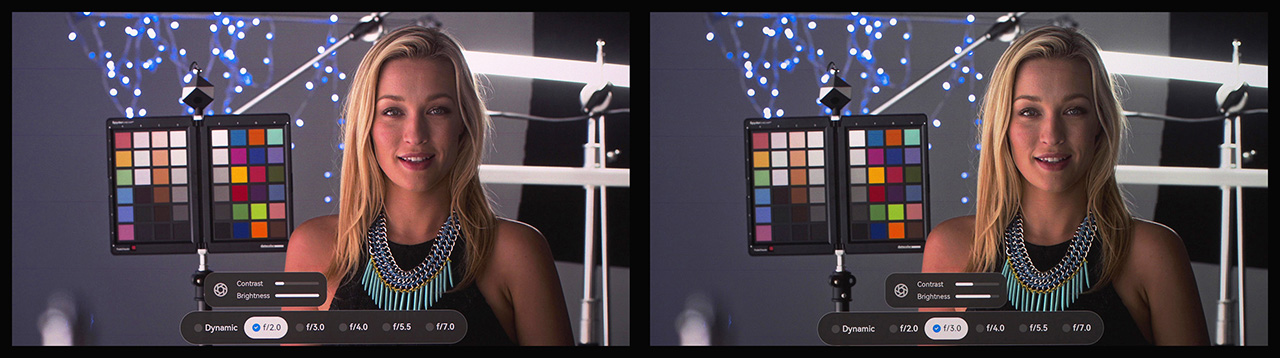
F/4.0
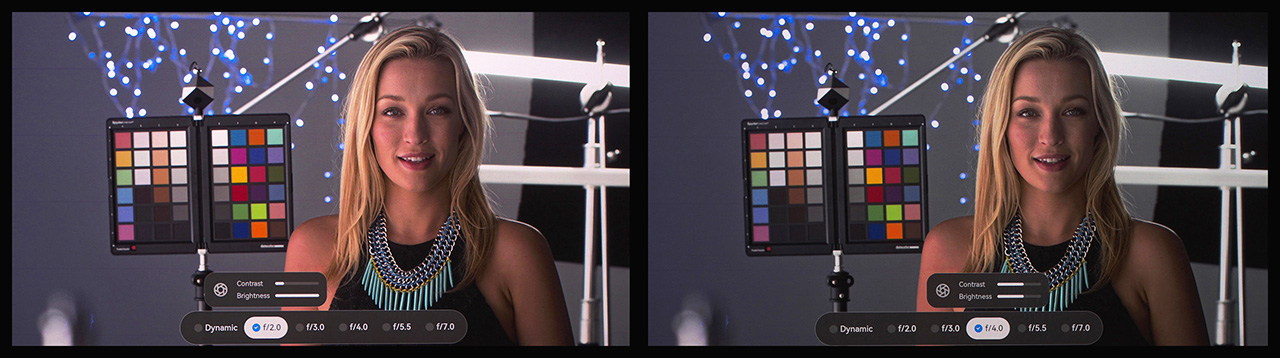
F/5.5
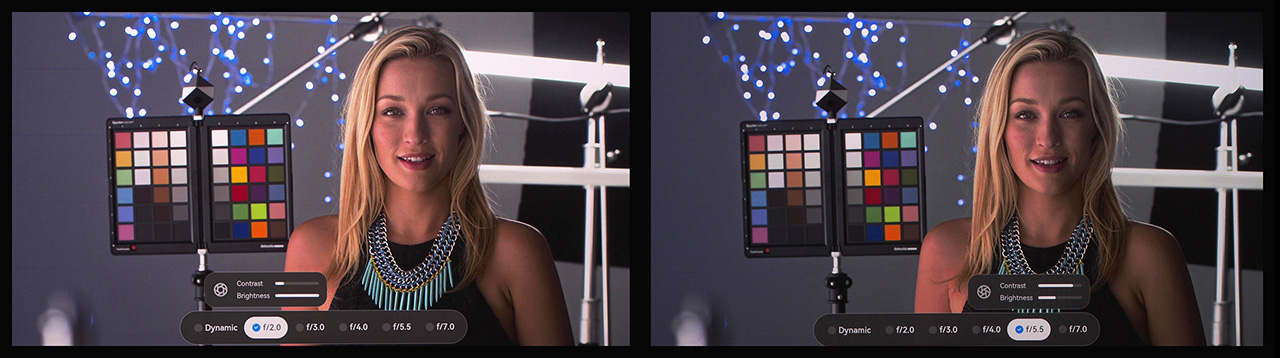
F/7.0
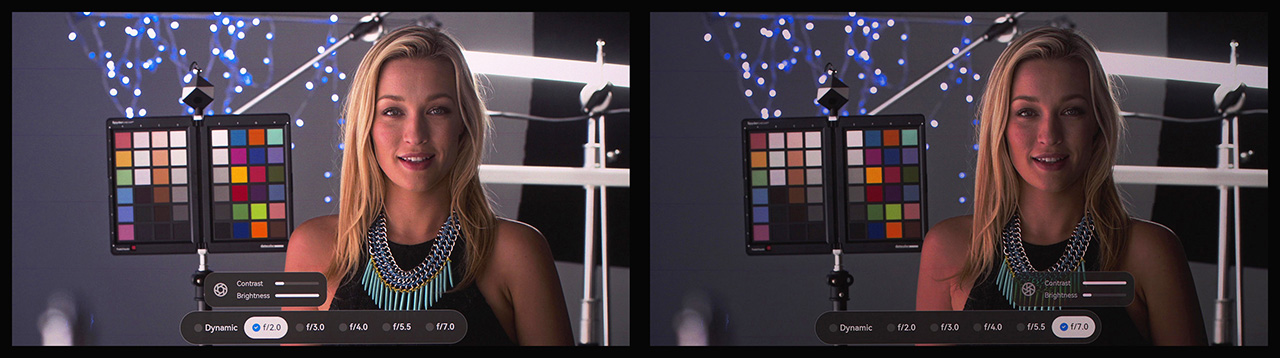
XGIMI has done an excellent job with the color and white balance management across all positions of the dual iris system.
When we reduce the iris opening in a system where electromagnetic waves of different wavelengths pass through, we are not simply controlling brightness. In reality, the iris also starts behaving like an electromagnetic wave spatial filter.
Besides the beneficial filtering of stray and scattered light, the iris also affects the phase relationships between the three RGB lasers. The result is that by reducing the iris diameter, the white balance of the image can also change, sometimes even quite dramatically.
This is where XGIMI has done a very good job. All iris positions remain almost fully usable without the user needing to make any additional color or white balance adjustments on the Titan Noir Max.
I would even say that, in my opinion, the engineers managed to find a very good balance between all the individual parts that make up the laser optical block of the Titan Noir Max.
The contrast increase when using the dual iris system is remarkable. As soon as you start closing the iris, the result becomes immediately visible and highly impressive.
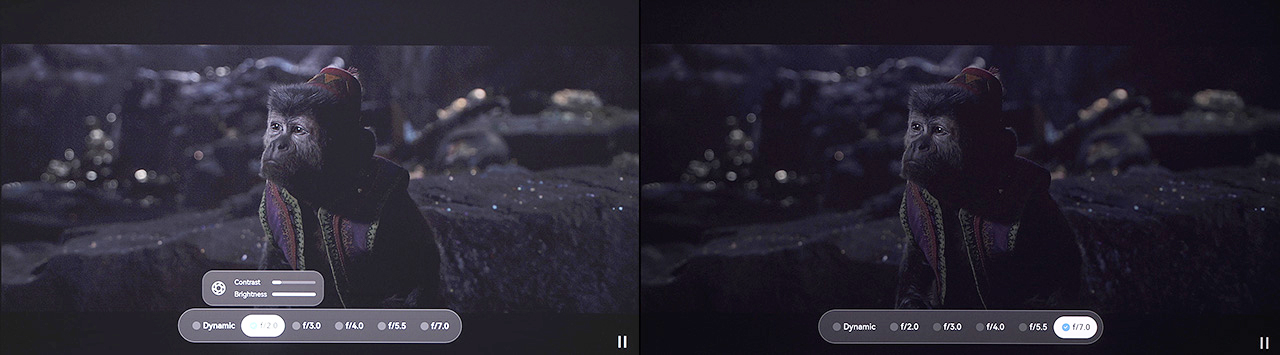
At the f/2.0, f/3.0, and f/4.0 iris positions, the Titan Noir Max still allows you to adjust the laser power manually, except for the 10+ mode, which only works with the iris fully open at f/2.0.
At the last two positions, f/5.5 and f/7.0, the laser power becomes locked somewhere around 9 and 8 respectively, and the user can no longer change it manually.
Regardless of the brightness measurements you saw earlier depending on the iris position, I will simply say that all iris positions are fully usable. Each user can choose the setting that offers the best image performance for their own room and screen setup.
For example, do not be scared by the roughly 800-900 ANSI lumens measured at the f/7.0 position. With native contrast approaching 9000:1 and such deep black levels, the perceived brightness loss feels far smaller than what a simple 100% white pattern measurement suggests.
Finally, I should mention that this dual iris implementation on the Titan Noir Max does not only massively improve the native on/off contrast and dramatically improve the black level, but also brings a huge improvement in in-scene contrast, the so-called ANSI contrast.
To what extent? Honestly, to the highest level my eyes have seen so far, and yours too once you get this projector in your hands, trust me, on any projector of any price category.
In some scenes, the result is soooooooo good..
Iris : F/5.5

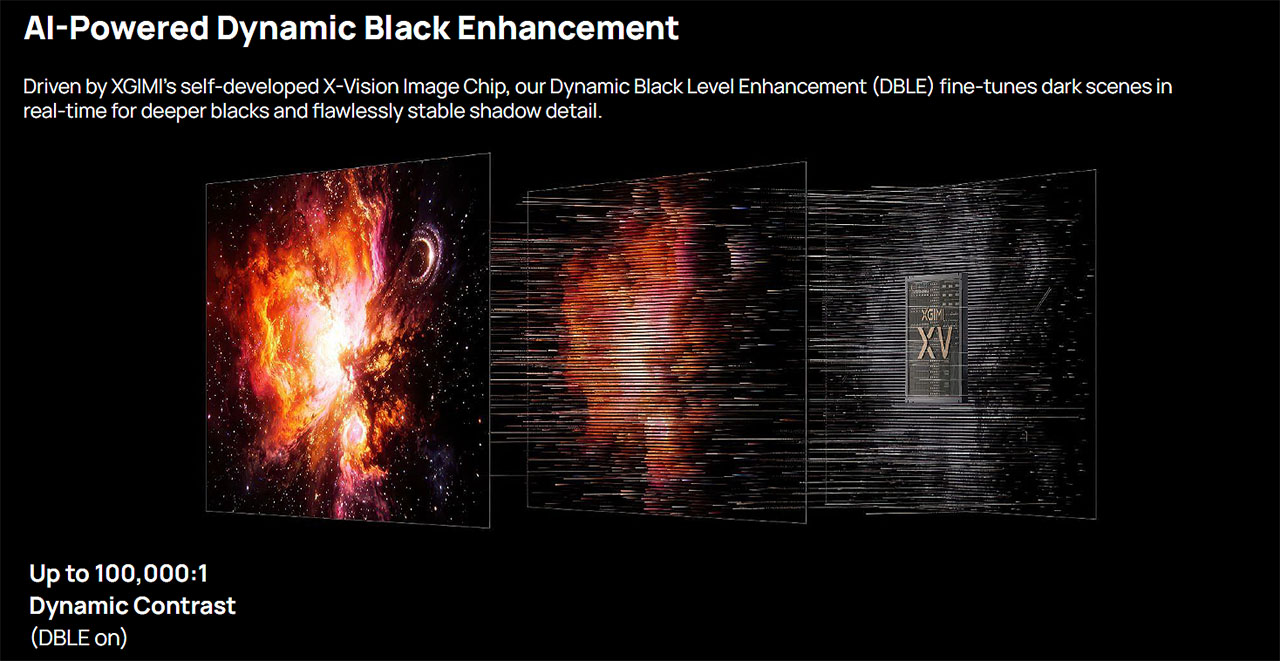
DBLE is XGIMI’s algorithm for dynamic laser dimming, similar to the EBL implementation found on projectors from Valerion and AWOL Vision.
In the case of the Titan Noir Max, besides simply enabling or disabling it, XGIMI also equipped the projector with an extremely useful adjustment control that essentially allows the user to improve, or more accurately correct, the white balance behavior of the projector while DBLE is active.
The more observant users will notice that the menu displayed inside the Dynamic Black Level Tuning setting is intentionally darker in appearance than the rest of the menu, so that it does not affect the DBLE behavior while we adjust it.
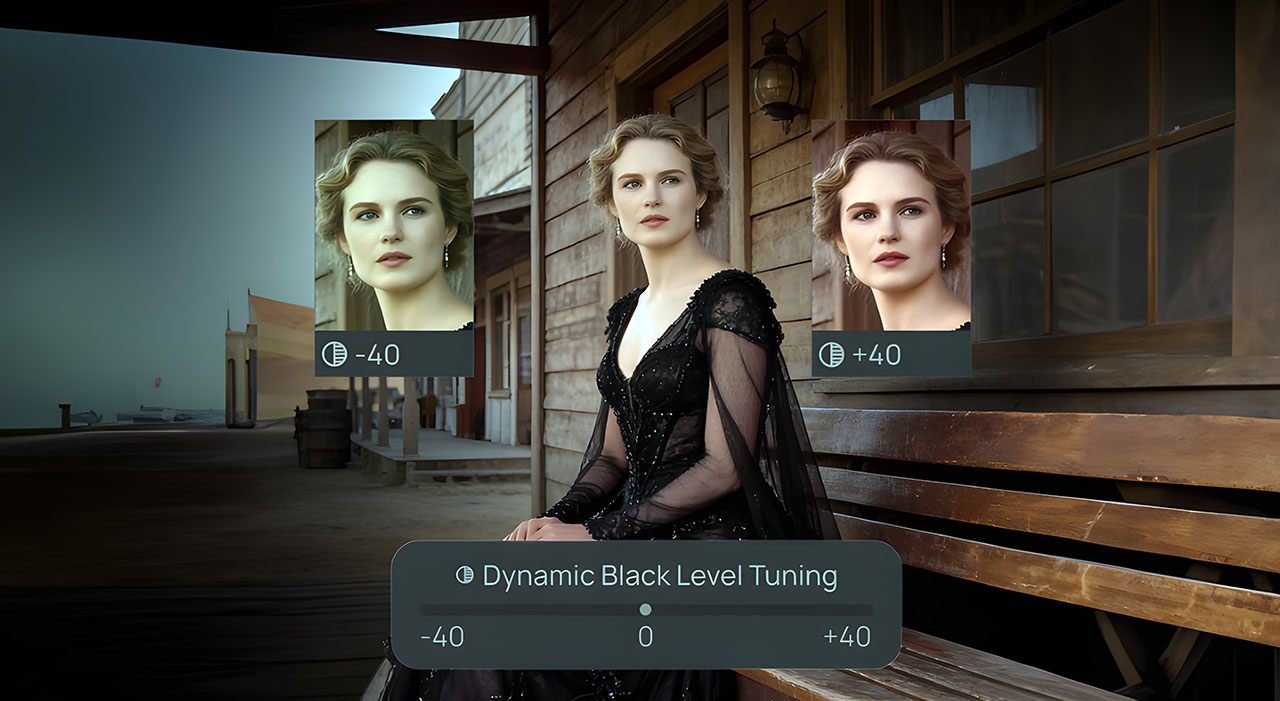
As I already mentioned earlier, XGIMI developed its own AI-driven image controller, the X-Vision chip, in order to control the DBLE system. This chip genuinely has AI capabilities, and honestly, it is very interesting to watch it operate in real time.
When you enable it, the projector needs around 3–4 seconds while the movie is playing to analyze the scene data and decide both the level and the method of its intervention. If you then disable it and re-enable it on the exact same scene, it reacts instantly, since it has already stored the scene data, unless in the meantime you changed image parameters such as the laser power or the iris position.
I should also mention that the DBLE implementation on the Titan Noir Max has absolutely nothing to do with what we previously saw on the Horizon 20 Max. Nothing, it is day and night difference.
On the Titan Noir Max, DBLE works exceptionally well. It is subtle, subtitles do not confuse it, and it operates properly in virtually every scene, whether bright or dark.
Its purpose? Of course, to increase the contrast, and honestly, it achieves this in a very impressive way.
It is almost funny to watch a dark scene maintain virtually 100% of its brightness, while at the same time the contrast skyrockets, the black levels become dramatically deeper, and the power consumption drops significantly.
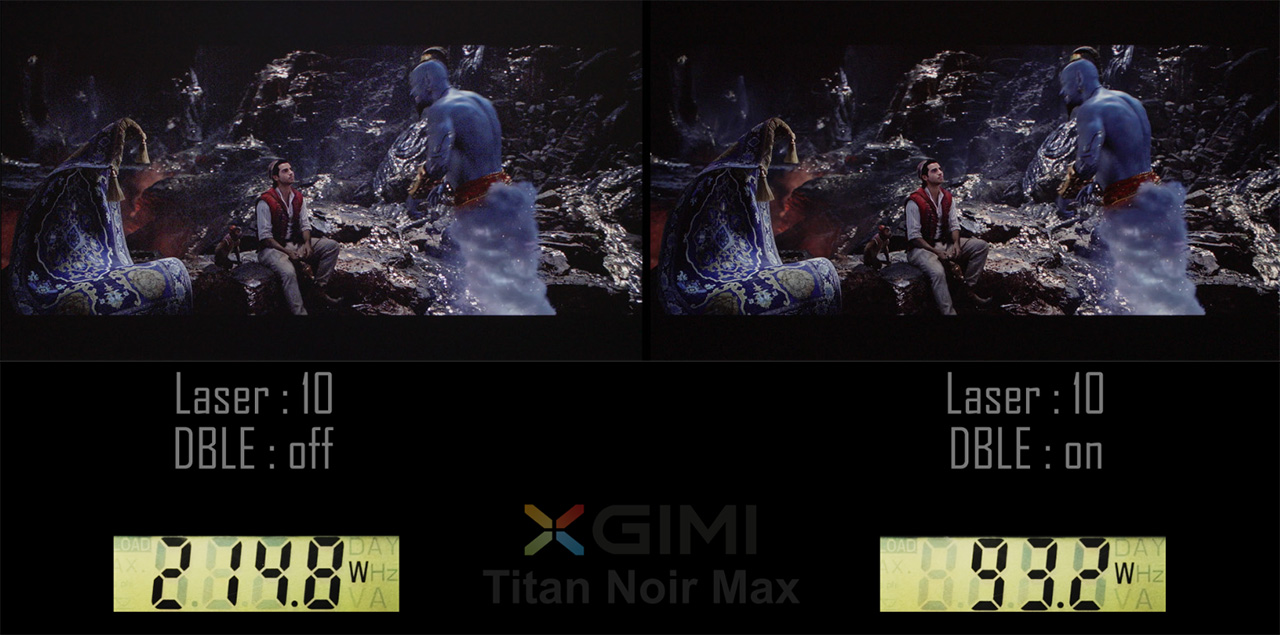
There are no limitations like the ones we have seen on the Valerion projectors regarding which laser power setting you can use while DBLE is enabled.
Of course, the lower you set the laser power, the smaller the operating range available for the DBLE system becomes. For example, if you set the laser power to its minimum level, there is practically no remaining room for DBLE to further reduce the laser output, so in reality you have almost neutralized its intervention capability.
XGIMI has genuinely done an outstanding job regarding the overall cooperation between the iris system, whether dynamic or step-based, and the DBLE algorithm. Depending on the combination you choose, the DBLE automatically adapts its behavior and decides whether it needs to operate more aggressively or more subtly.
For example, if you select the iris at f/7.0, the DBLE behavior automatically becomes much softer, simply because there is no need for heavy intervention anymore. Also, if you enable both the dynamic iris and DBLE together, then DBLE operates very lightly, or sometimes almost not at all, in most scenes.
Overall, there is a really impressive balance here. The number of possible combinations is huge, and the Dynamic Black Level Tuning adjustment that I mentioned earlier does an excellent job if we notice that a specific combination tends to make the image or skin tones appear slightly cooler or warmer.
One combination that I personally liked a lot was using the iris at f/4.0, which still allows full manual control over the laser power, combined with DBLE enabled.
If you really want to get shocked and see contrast and black levels that in some dark scenes can feel even better than a JVC projector, then the combination of iris f/7.0 + DBLE ON is an absolute killer setup for dark scene performance.
This is the fully open f/2.0 iris compared to f/7.0 + DBLE ON. The difference is really impressive.
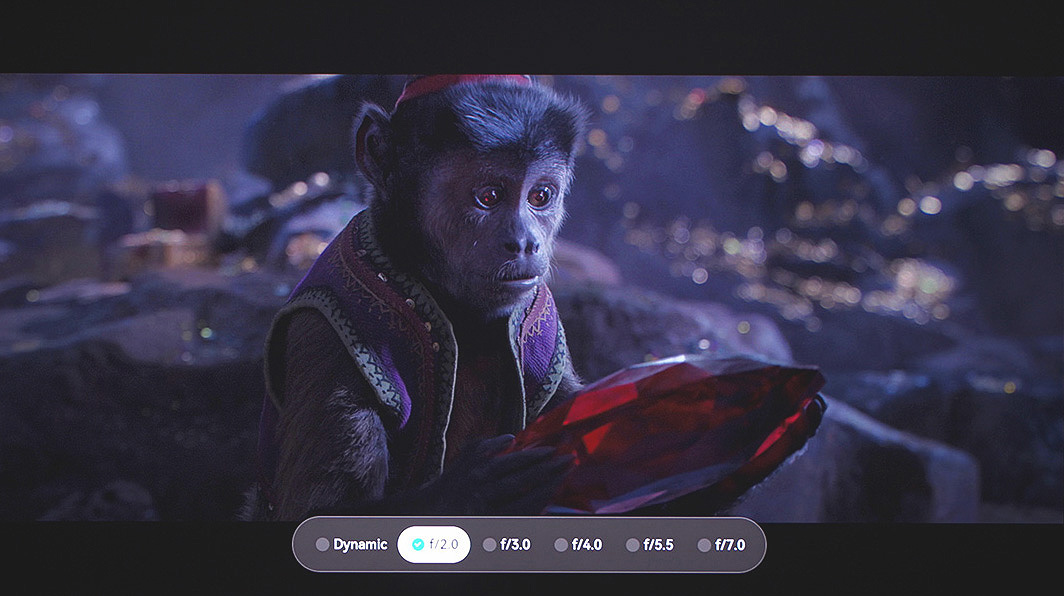
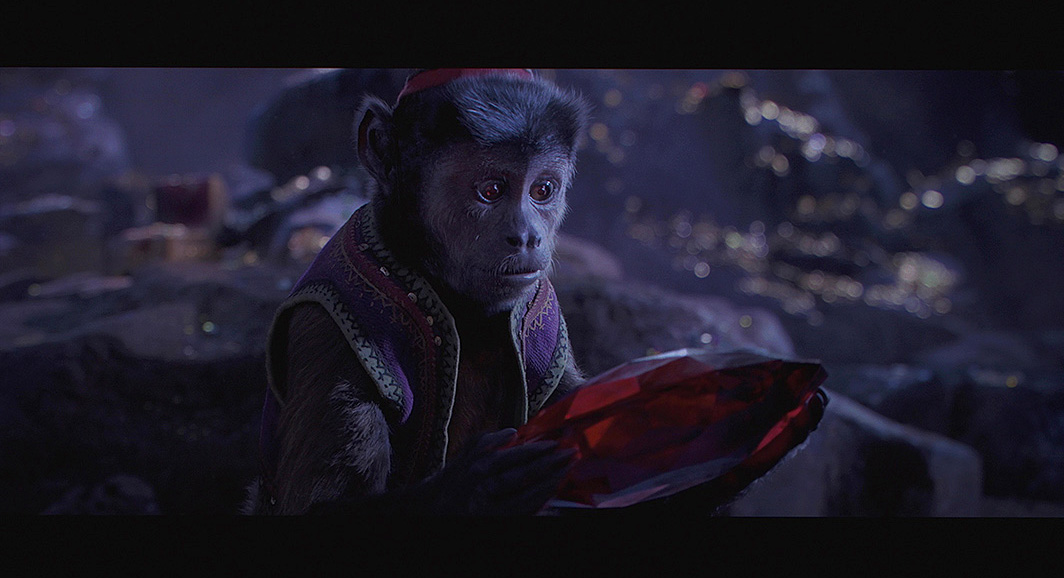
Are there artifacts while DBLE is working? Yes, of course. Some occasional color drifting and a bit of highlight clipping will appear here and there, and if you are very observant, you will notice them.
Also, in some rare occasions, horizontal flashing lines can appear, almost as if something strange is happening with the horizontal resolution and the rolling buffer frame refresh behavior.
But honestly, nothing serious. For me, this algorithm works surprisingly well overall.
How does it compare to the EBL implementations from Valerion and AWOL Vision?
I would say that the DBLE system is slightly behind them, not in terms of how well it controls the laser behavior or how much it increases the contrast, but simply because the artifacts are definitely more frequent and more visible compared to what someone will encounter on Valerion and AWOL Vision.
That is my honest opinion. Here is a shootout video between the Titan Noir Max and the Aetherion MAX, just to give you an idea of how DBLE and the iris improve image contrast.

The only real drawback appears when we use DBLE together with the Anti-RBE mode. Interestingly, when enabling Anti-RBE, a pop-up appears saying that DBLE was automatically enabled as well for a “better viewing experience.” Kind of weird, right?
With this combination active, we can sometimes see some pretty strong artifacts, usually in scenes with very large brightness gradations.
Can you see the pink posterized sky in the background? Anti-RBE enabled on the right.
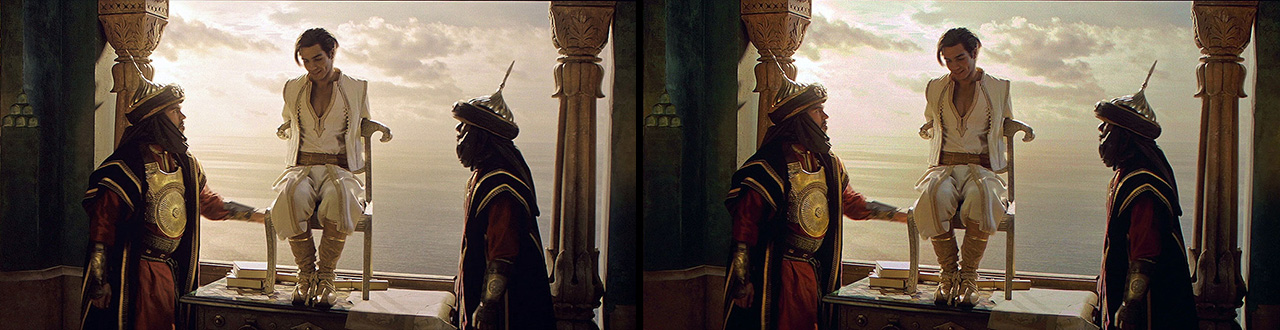
If not, here is a magnified view where you can probably see this phenomenon much more clearly. This artifact appears quite often with this specific combination enabled.
So, conclusion: DBLE together with Anti-RBE is something you should absolutely avoid.

I believe that most of the bugs I mention here will probably be solved in the final production units you will receive, which I assume will also come with the final firmware version installed.
As a general conclusion, I would say that with its dual iris system and this specific DBLE implementation, the Titan Noir Max has all the tools needed to officially become the new contrast king of the DLP category.
Back in my village, they say that HDR and Dolby Vision need three basic ingredients in order to become a successful recipe for movie playback.
Brightness, contrast, and good dynamic tone mapping.
Guess which of these the Titan Noir Max has. Come on, it is not difficult. Of course, all three.
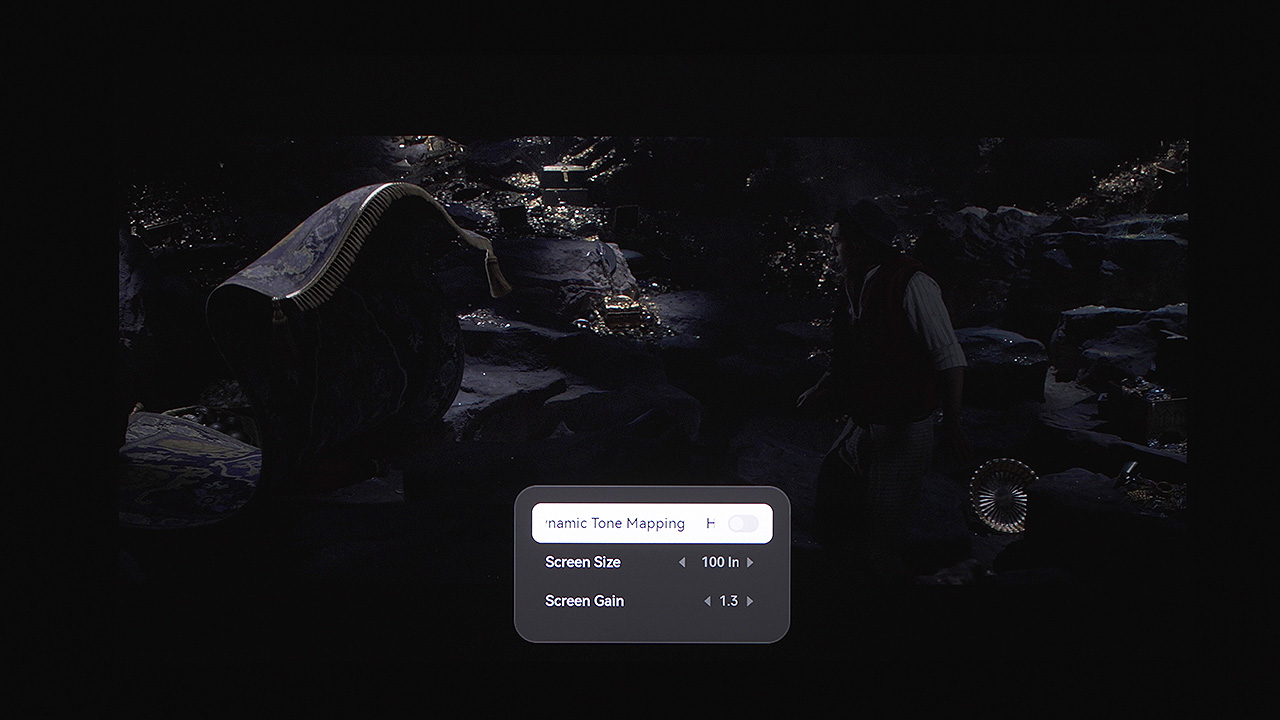
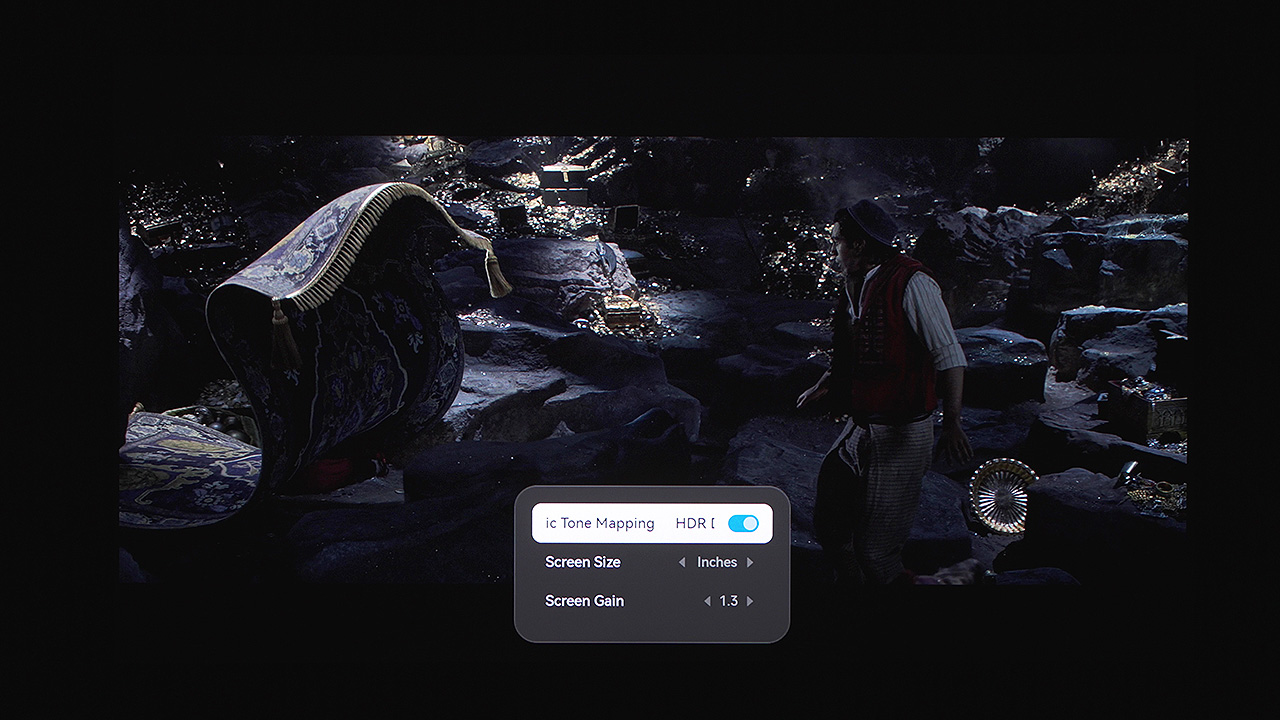
The HDR dynamic tone mapping of the Titan Noir Max works well and corrects the EOTF nicely.
Unfortunately, just like on the Horizon 20 Max that I tested recently, it is also quite aggressive when it comes to very bright gradations. I do not know, perhaps this is done intentionally in order to impress the viewer? Who knows.
Some highlight gradations at the top end appear compressed, and as a result, some fine detail that could otherwise be visible ends up getting lost.
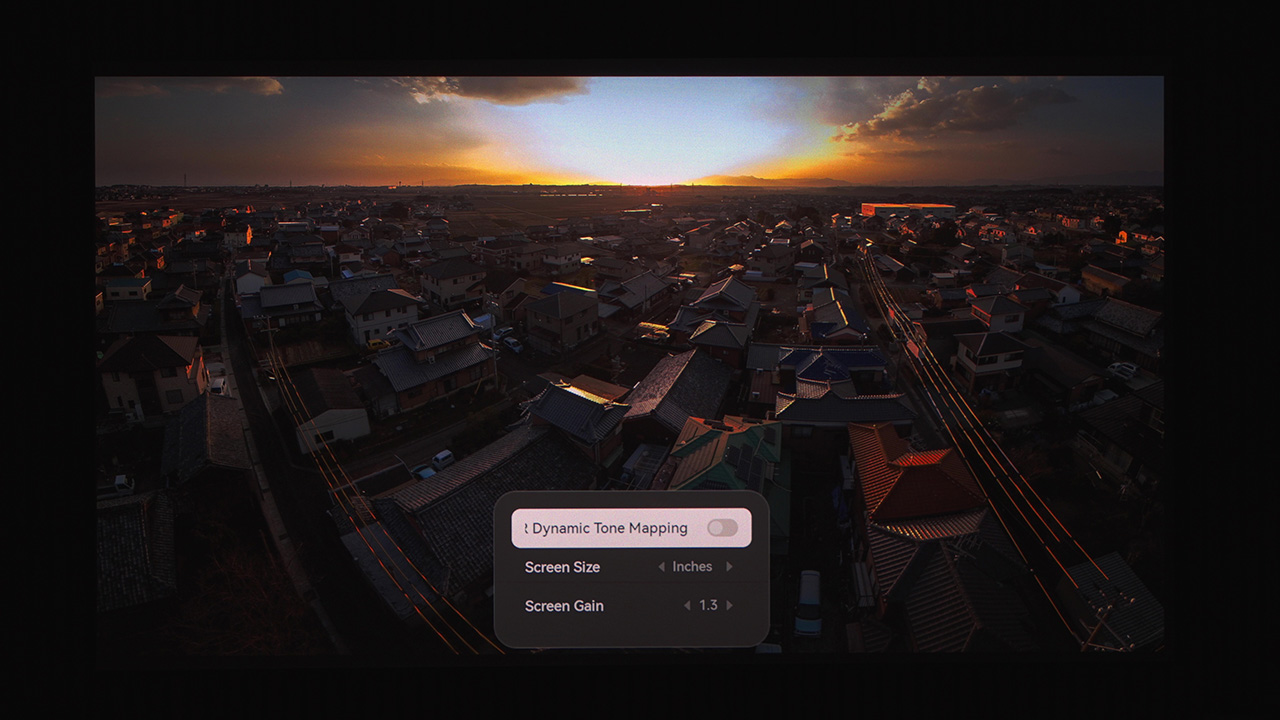
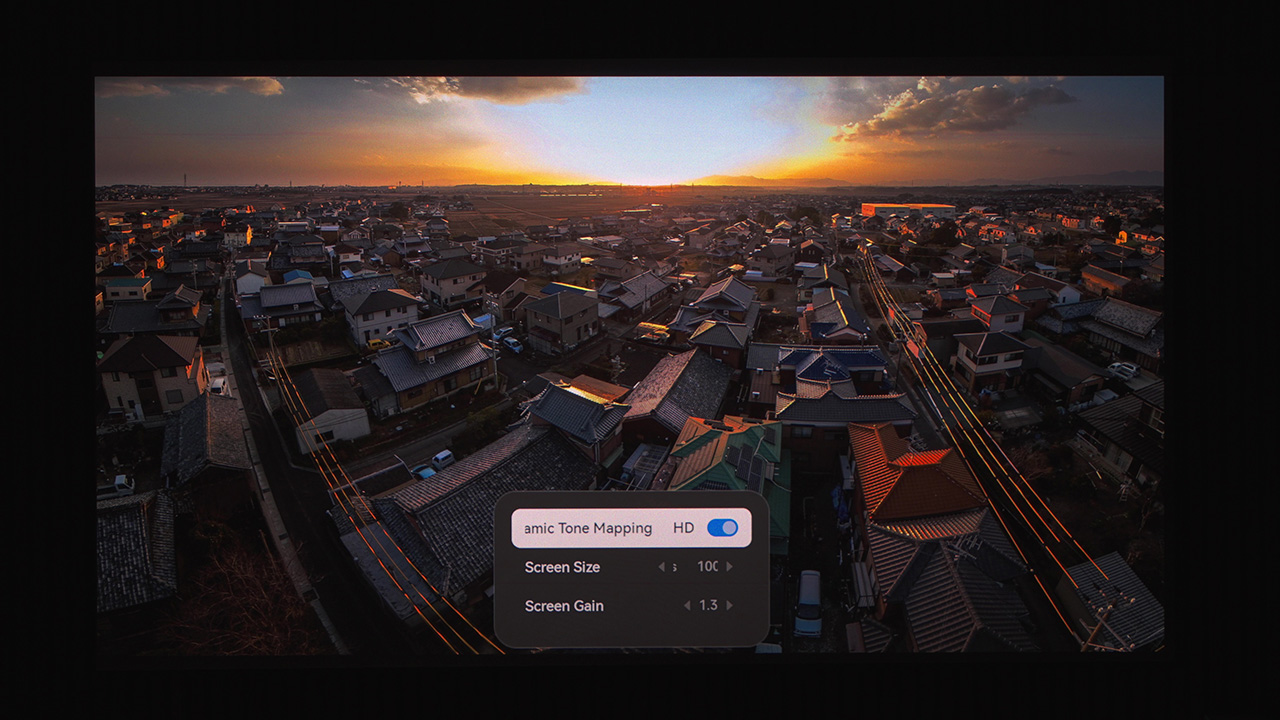
On the other hand, there are scenes where it really shines. The gamma and overall scene brightness are adjusted extremely well, while it does not affect the colors and the white balance, which remain completely neutral.
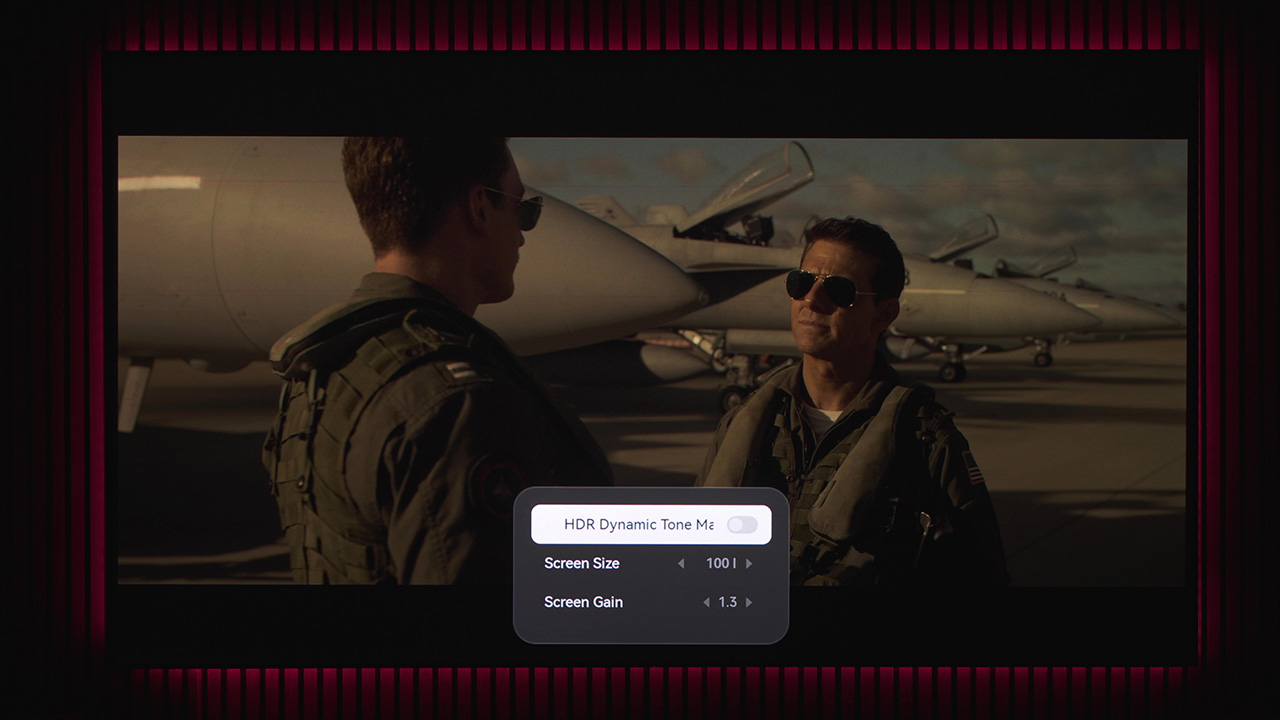
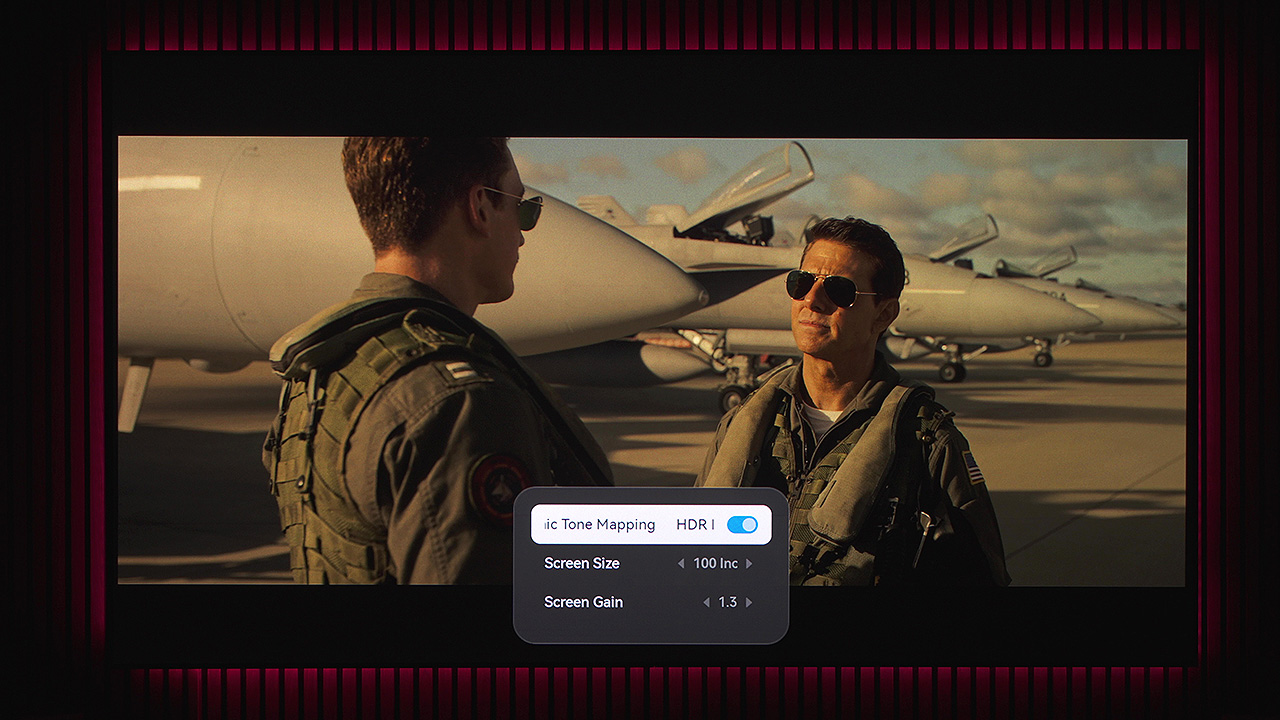
I will be honest, the dynamic tone mapping of the Titan Noir Max is nowhere near as refined and polished as the one on the Aetherion MAX, which as I said in my review, is probably the best HDR tone mapping implementation I have ever seen on a projector.
That said, the tone mapping of the Titan Noir Max is absolutely not bad, nor does it create any serious issue during movie viewing. I am talking mostly about medium and very bright scenes, where the strongest compression takes place.
In dark scenes though, it works extremely well. It makes dark scenes look very impressive while still keeping fine details intact with impressive accuracy.
As for the performance of the Titan Noir Max with Dolby Vision content, I will simply say that everything I tested left me completely satisfied.
Where it really seemed to gain the upper hand after multiple side-by-side comparisons with other projector models was with Dolby Vision Profile 5 content, and more specifically with Netflix Dolby Vision streaming.
Using the exact same player across several projectors I own, the Titan Noir Max was consistently brighter, with a more extended EOTF and a noticeably more impressive image overall.
I believe that because of the Titan Noir Max’s high contrast and high brightness capabilities, there is more available space for the translation of the metadata and generally a wider dynamic range, and honestly, this becomes obvious from the very first second you hear the familiar sound of the streaming platform starting.
SDR
Watching old SDR movies on the Titan Noir Max is an absolute pleasure. The brightness, contrast, sharpness, and all these AI tools create a really unique experience.
Honestly, during the time I had the Titan Noir Max in my hands, I watched more 1080p SDR movies than 4K HDR content, that is for sure.
But let me talk to all you AI fans out there, yes, I am talking to the future Titan Noir Max owners.
Let me tell you about some very interesting AI tools you will find on the Titan Noir Max, tools that will definitely upgrade your viewing experience.
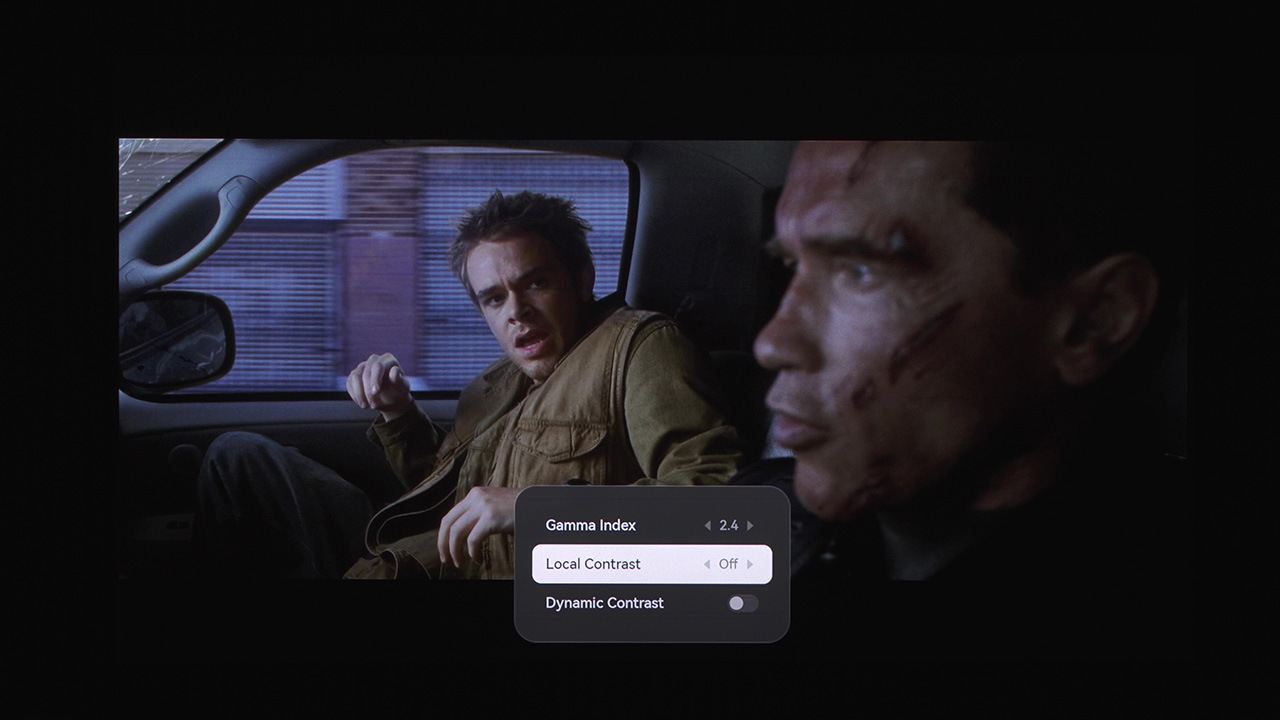
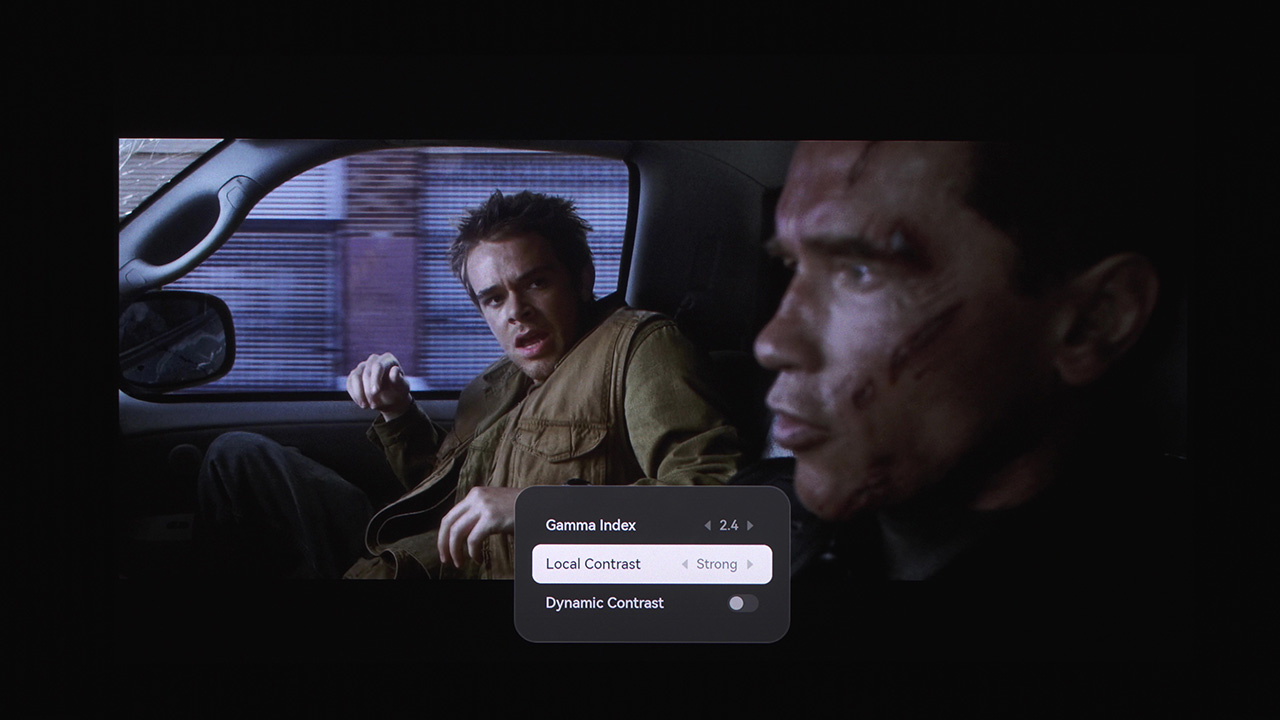
Local Contrast: we are talking about an excellent AI-based tool that you really need to spend many hours with in order to fully appreciate. It selectively adjusts the local gamma in different parts of the image, making the scene look more three-dimensional and visually impressive.
In my personal opinion, it works flawlessly, without exaggeration, and always feels on point.
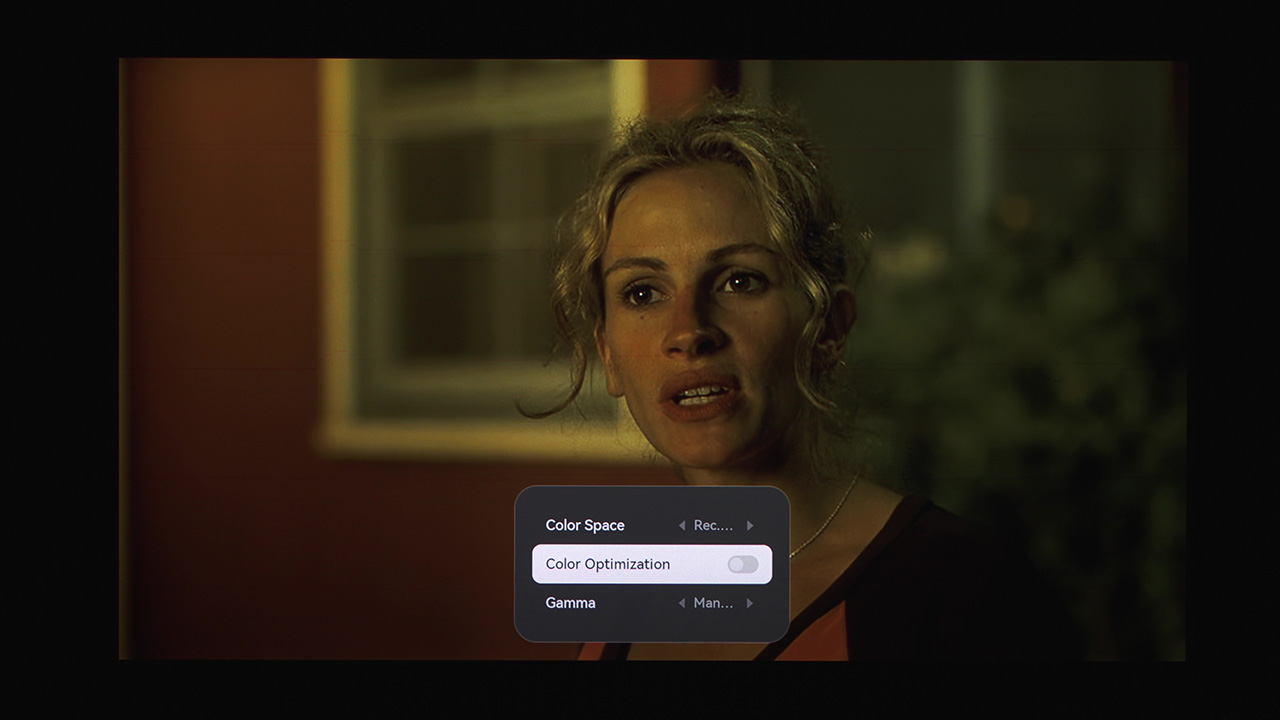
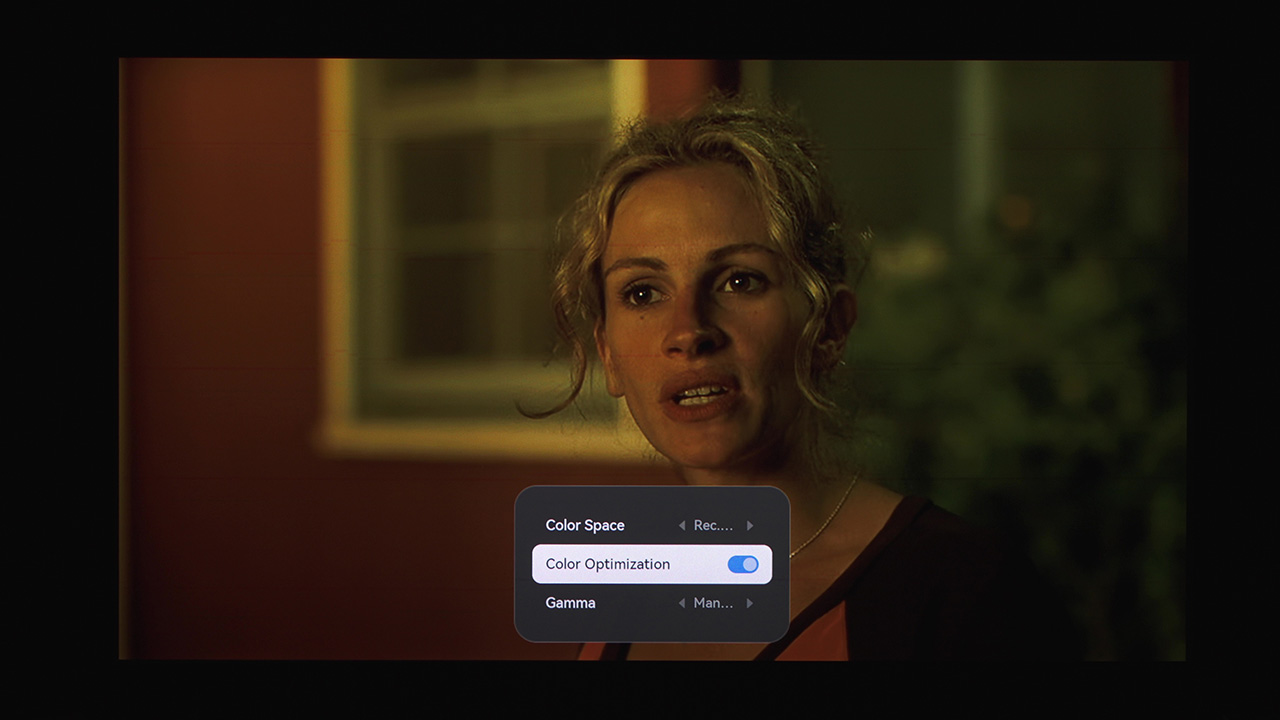
Color Optimization: I simply loved this AI tool. It feels like having an automatic calibration-on-the-fly system constantly fine-tuning your projector while you sit back eating your chips and enjoying the movie.
It works exceptionally well with SDR content, and personally I keep it enabled all the time.
There are a few rare moments where it slightly overdoes things, but we are talking about maybe 2–3 scenes per movie, honestly not even worth mentioning.
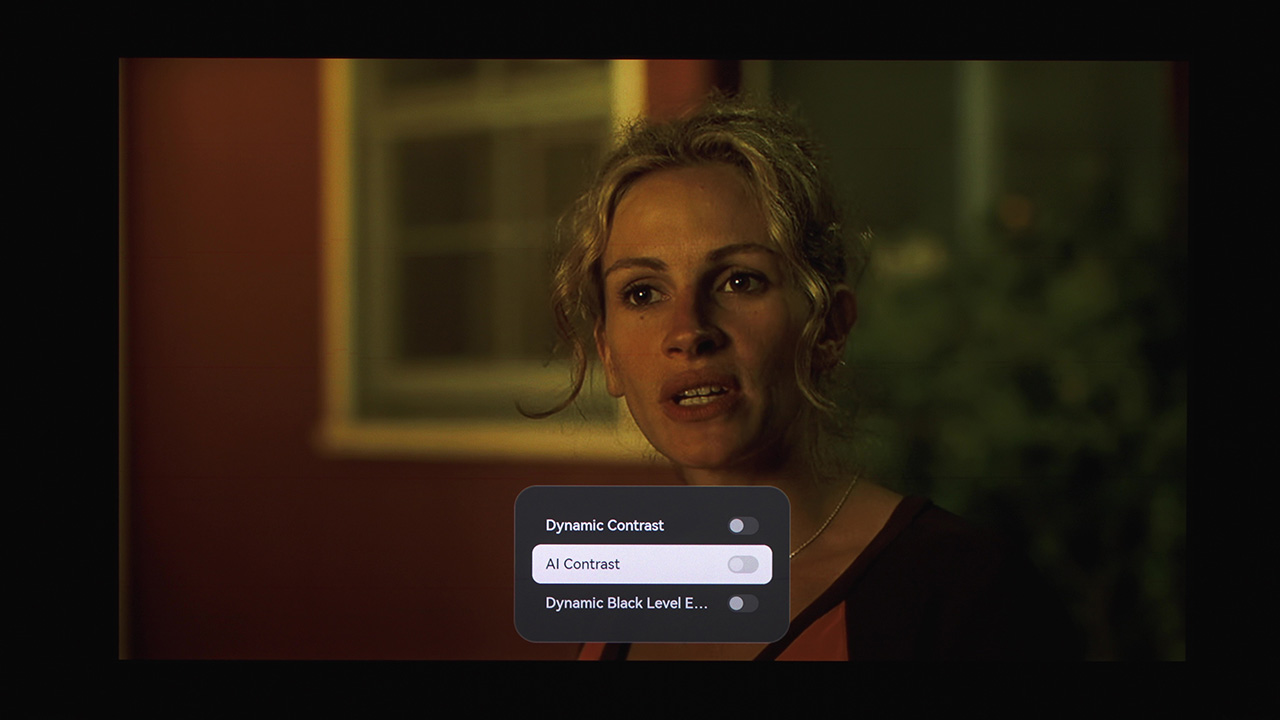
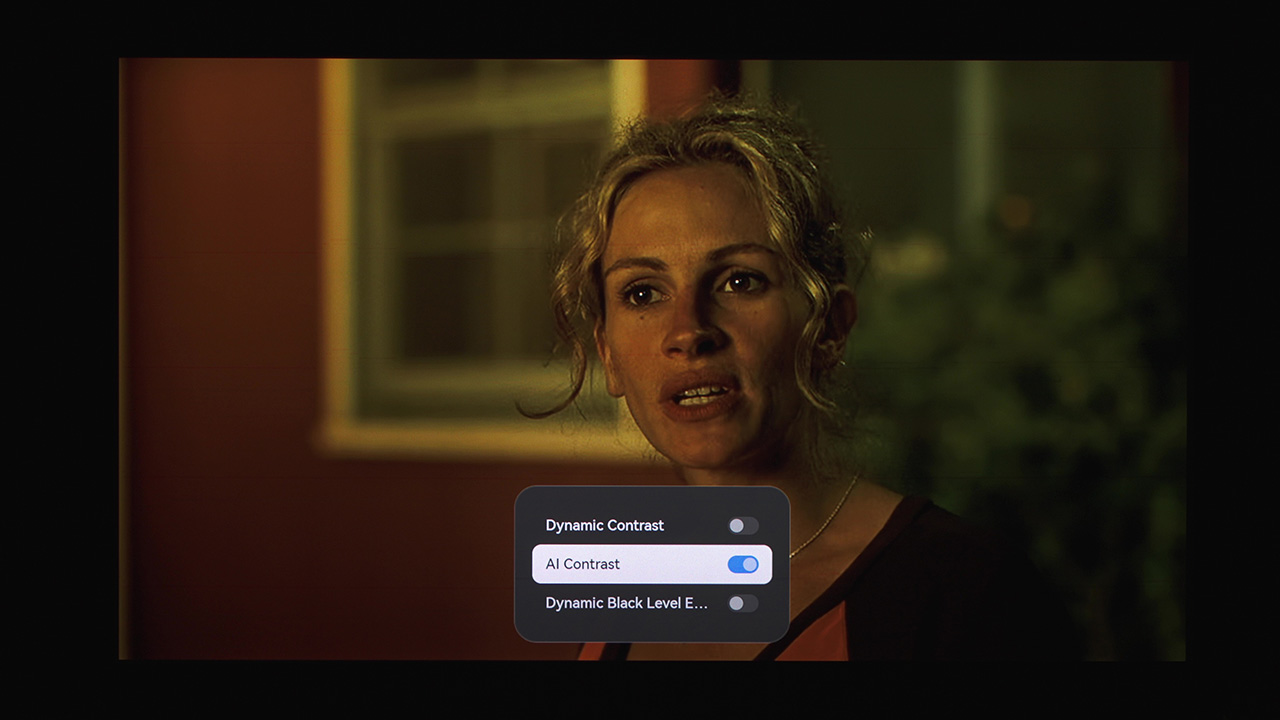
AI Contrast: Another AI tool where honestly I do not understand why XGIMI calls it “contrast” instead of “sharpness.” Although, to be fair, increased sharpness also creates the feeling of higher contrast, so maybe that is why they named it this way.
This feature works unbelievably well. It upgrades 1080p content into something that genuinely looks like a much higher-resolution image, to the point where it can seriously compete with native 4K content.
The truth is that it is quite aggressive, sometimes even harsh, and it may feel too much for some viewers. I honestly think some people will absolutely love it, while others will completely hate it.
Me? I am somewhere in the middle. I use it in some movies, and disable it in others.
Sound
Normally, for a projector like this, I would never spend time talking about something that might matter to very few people, such as the built-in sound system. But in the case of the Titan Noir Max, trust me, there was no way I could avoid it.
XGIMI has had a long partnership with Harman Kardon, a company well known for its sound quality, and honestly, during my review of the Horizon 20 Max, I was already pleasantly surprised by the performance of such a small audio system inside a projector.
So when I read that the Titan Noir Max will have integraded speaker setup, I thought: “OK, on a projector like this, one that does not even include Google TV, XGIMI probably just added a pair of basic speakers so users can at least hear some sound if needed.”
Wrong. Completely wrong.
Second, the dialogue quality itself, which honestly makes even my personal Monitor Audio center speaker a little jealous.
And finally, the DTS tuning is just excellent. You watch a movie and every sound feels perfectly balanced and in harmony with everything else.
I would really like those of you who end up buying the Titan Noir Max to come back here to Projectorjunkies.com and leave a comment about what you think of its sound performance.
Me? On a scale from 1 to 10, for a sound system built into a projector, the Harman Kardon setup inside the Titan Noir Max gets an 11.
Laser Speckle
And now we come to perhaps the only truly serious drawback of the Titan Noir Max.
Personally, I am not sensitive to the laser speckle effect at all. Actually, I would say I am almost completely immune to it. For some reason, once I start watching a movie, my brain simply rejects it, puts it aside, and I stop noticing it completely. I only see it if I actively try to look for it.
For the needs of this review, I tested and evaluated five different RGB laser projectors, and the Titan Noir Max easily took the last place when it comes to the visibility and intensity of the laser speckle effect.
Is it worse than the Valerion Pro 2? Yes.
Is it worse than the Valerion MAX? Yes.
Is it worse than the Nebula X1 and X1 Pro? Yes.
Is it worse than the AWOL Vision Aetherion MAX? Yes.
If you are extremely sensitive to speckle, you will probably struggle with the Titan Noir Max.
Here is a screenshot from a special ProjectorJunkies corner sharpness pattern I created specifically to test the lens sharpness and focus uniformity from corner to corner. Can you see speckle?
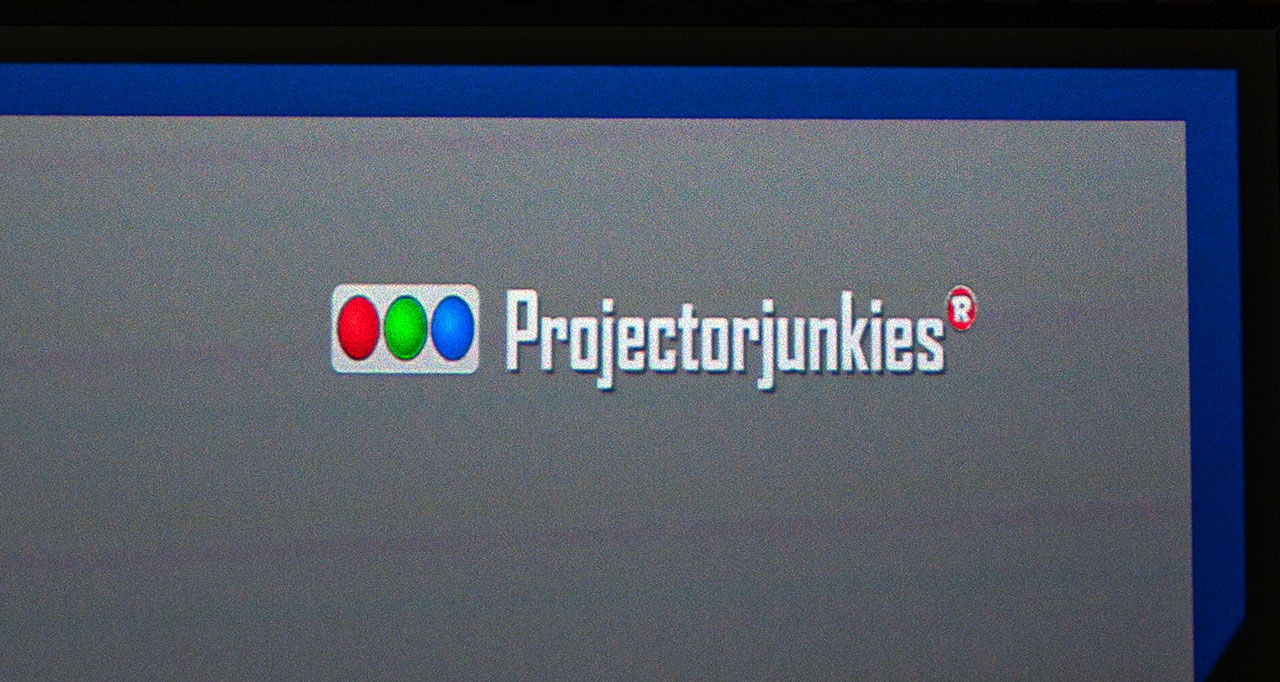
On the other hand, because there are screens on the market that can almost completely suppress the speckle effect, you can pair the Titan Noir Max with such a screen and practically solve the problem ( an in-depth review for such a screen from WUPRO is coming soon, stay tuned ).
Just to give you an idea, I personally enjoy the Titan Noir Max on a Fresnel screen, which is actually one of the worst possible choices for laser speckle, but as I said, each one of us has a completely different tolerance to this phenomenon.
3D
WOW, WOW, just WOW. You already know that I am a huge fan of 3D projection, and guys, the Titan Noir Max is the real deal. As far as 3D projection is concerned, this is simply the best projector money can buy, period.
I honestly do not know if I can fully transfer my excitement through written words, but I will try. Until today, I believed I had already experienced the best 3D implementations ever made, with the latest and greatest being the Aetherion MAX (before the latest firmware ruin it). Ladies and gentlemen, I had seen absolutely nothing, NOTHING.
The Titan Noir Max takes 3D projection to a level that no 3D enthusiast can truly imagine until experiencing it firsthand.
I will tell you just this: it is the first time that I watch a 3D movie and the 3D glasses completely disappear from the equation. The synchronization between the projector and the glasses is so perfect that even the slightest discomfort, the slightest feeling that something exists between your eyes and the screen, simply vanishes.
What the Titan Noir Max achieves here is unbelievable, truly unbelievable. It is the first time I watch a 3D movie and completely forget that I am even wearing 3D glasses. There is zero fatigue, zero discomfort, and you can literally watch 3D movies one after another for hours.
The depth and sense of dimensionality created by such a refined and bright 3D image feels almost unreal, genuinely unreal.
And it is not only the 3D performance, it is the colors! The colors, the white balance, the dark details, the gamma, everything feels extremely close to perfection during 3D playback on the Titan Noir Max.
Forget everything you knew until today about 3D projection. Forget every previous 3D experience you had. Put all of it aside. The Titan Noir Max comes here to change everything.
I am honestly putting aside every other strength of the Titan Noir Max, its incredible contrast, its sharpness, its brightness, EVERYTHING. If you are a fan of 3D projection, this projector is worth buying for its 3D performance alone. And if you are not already a fan of 3D, then buy the Titan and start watching 3D movies immediately.
The Titan Noir Max gets a 10/10 in 3D projection performance. The next best projector I have seen in 3D performance, and I am being generous here, would barely get a 4/10.
But…(why ALWAYS have to be a but??That’s not fair..)
There is, however, one huge drawback here, and that is the motion performance.
The Titan Noir Max does not (why XGIMI??) perform the well-known 5:5 pulldown, where a 24p signal is multiplied and displayed at 120 Hz. Instead, it first performs a 3:2 pulldown, converting the original 24p signal into 60 Hz for each eye, and only after that does it continue with the rest of the 3D processing chain.
In other words, XGIMI gave users the option through the MEMC menu to achieve proper 24p playback for 2D content with the latest beta firmware, but left 3D playback completely on its own.
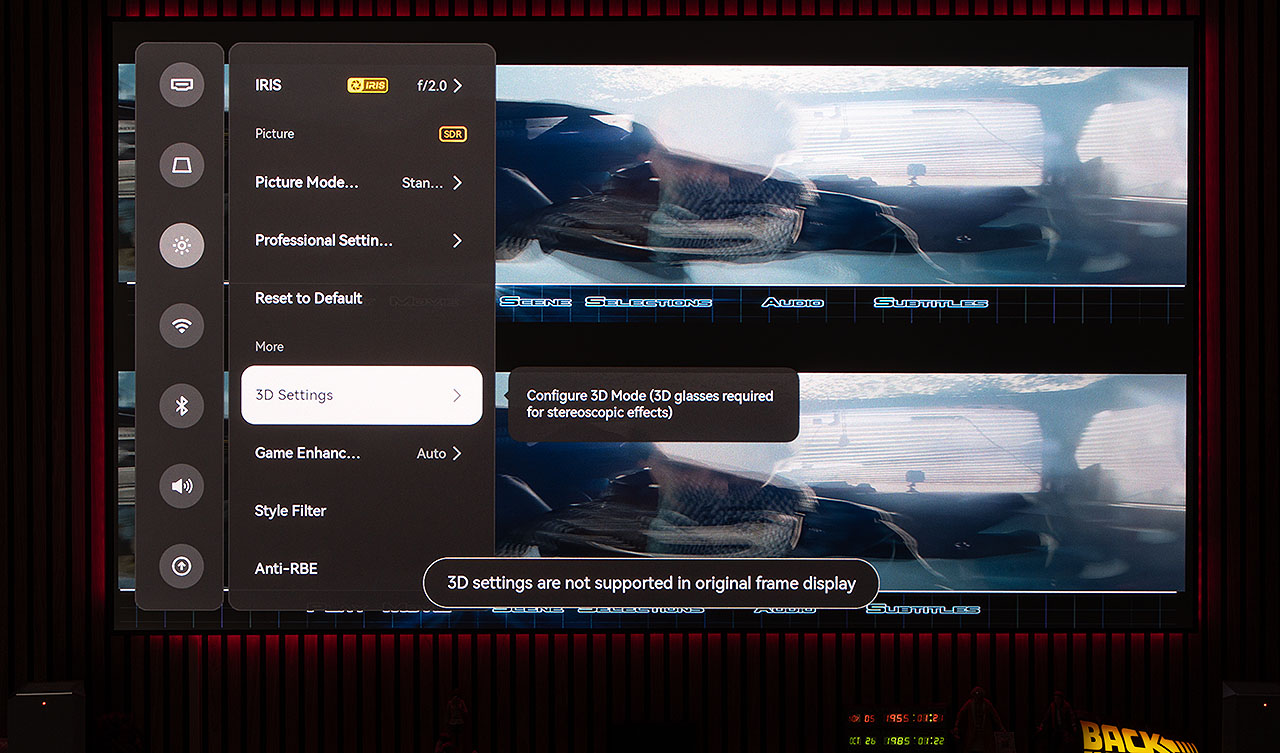
And this brings us to a truly frustrating conclusion. While the 3D projection quality of the Titan Noir Max is genuinely the best we have ever seen on a projector, the motion performance in 3D 24p playback is simply terrible.
Although, to be fair, there is also the possibility that this limitation comes directly from Texas Instruments and the underlying SST platform itself or the Mediatek SoC. At this point, I simply do not know.
Two strange things I want to mention here.
First, the motion performance on SBS 1080p files is noticeably better than on frame-packing Blu-ray 3D playback (properly 5:5 pulldown?).
Second, the strange pink posterization issue on skies that I mentioned earlier suddenly appears in some SBS 3D movies I tested, even though neither Anti-RBE nor DBLE was enabled.
Strange, really strange.
But here at Projectorjunkies you already know that we like to verify what we see with actual measurements and testing, and that is exactly what we did at this stage of the review as well.
I created a simple 5-minute 3D test clip that allowed us to directly evaluate the isolation between the two eyes performed by the 3D glasses. The concept was very simple: the right eye displays only 100% green, while the left eye displays only 100% red. That’s it.
By alternately closing each eye, you should see only one of the two colors, without any artifacts at all, exactly like displaying a full solid color pattern in normal 2D projection.
Anything else means there is a synchronization problem.
This is the clip.
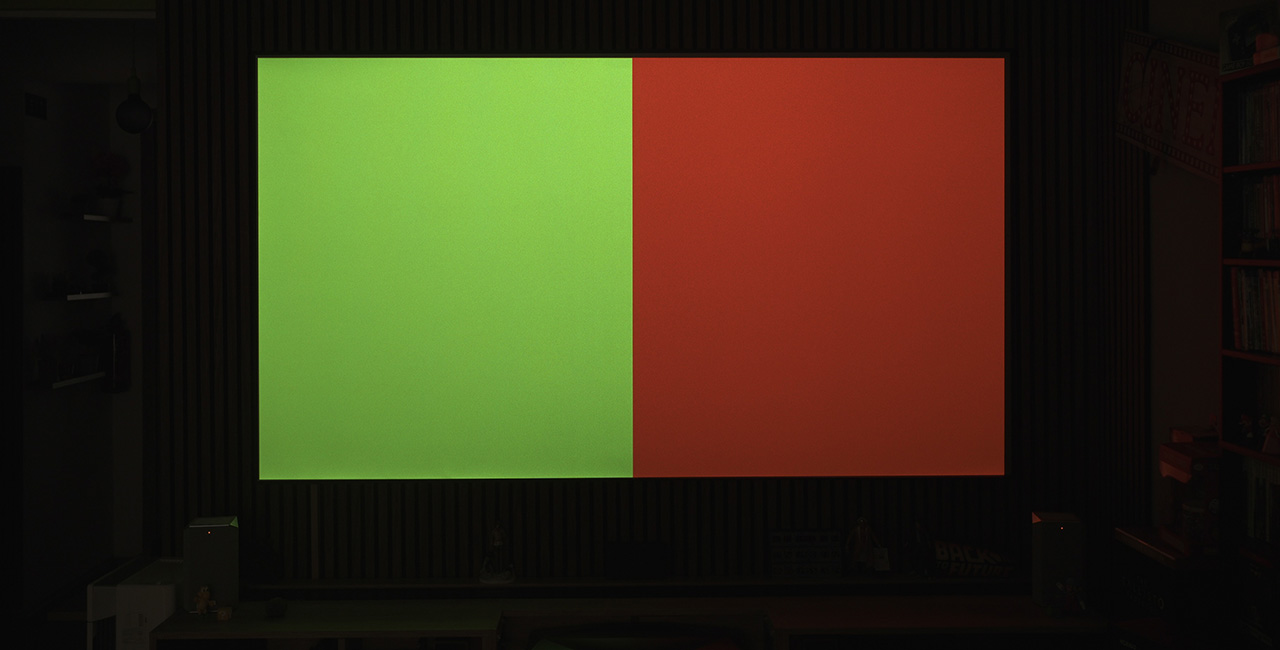
The clip itself is a simple SBS 3D clip, and once you enable the Left/Right 3D mode from the Titan Noir Max menu, each eye sees only its correct color channel.
Advice, clean your 3D glasses frequently, especially when you are about to photograph them for review purposes, OK guys? 😄
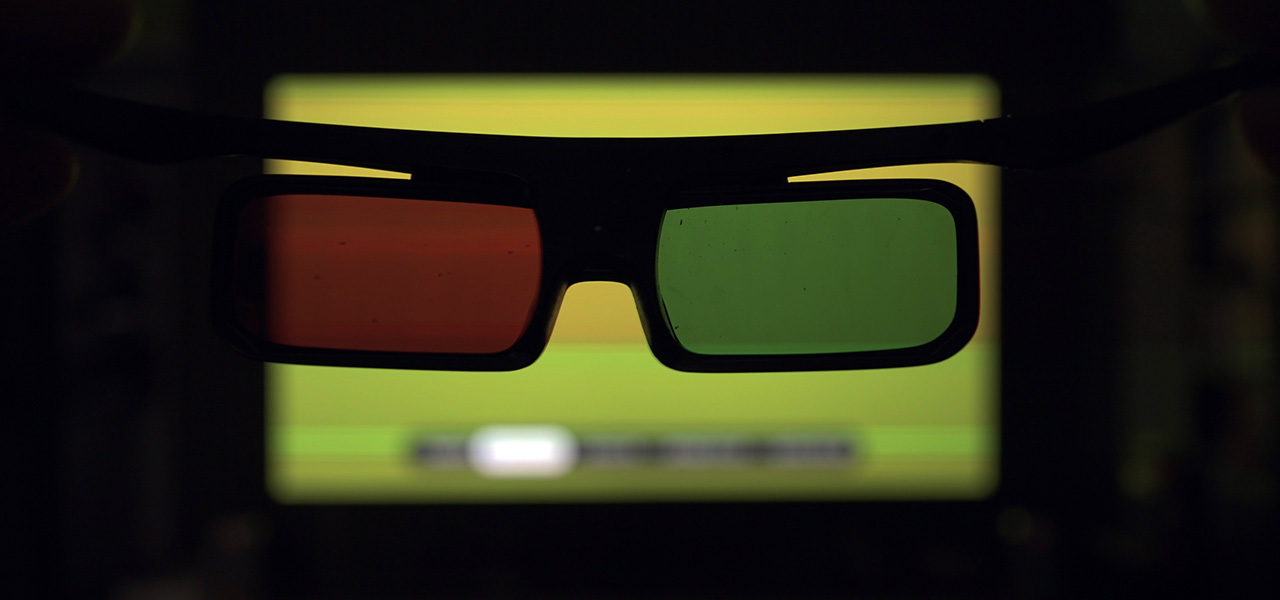
The separation between the two eyes is simply flawless. Each eye not only sees the correct color channel, but it also sees it without the slightest flickering, without any visible artifacts, just a pure solid color exactly like you would see in a normal 2D projection without glasses. (For your reference, this level of clean separation simply did not exist on any other projector model I have tested)
This test was an absolute success.
Of course, seeing it with my own eyes was not enough for me. I also had to measure it, and naturally compare it with other projectors as well.
Here is the oscilloscope measurements of this clip without the 3D glasses, exactly as it is reproduced by the projector.
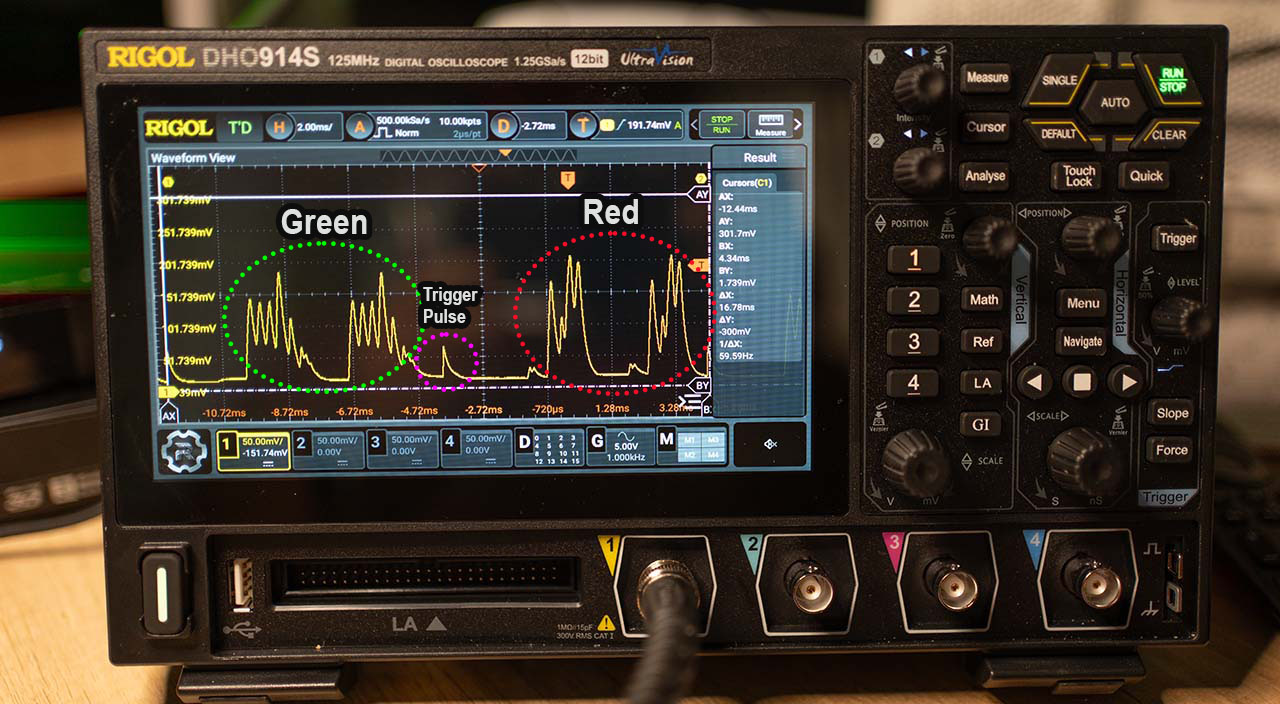
For the more observant readers, the gap between the trigger pulse for the glasses and the next frame is approximately 1.8 ms, well above the 1 ms safety margin recommended by Texas Instruments itself.
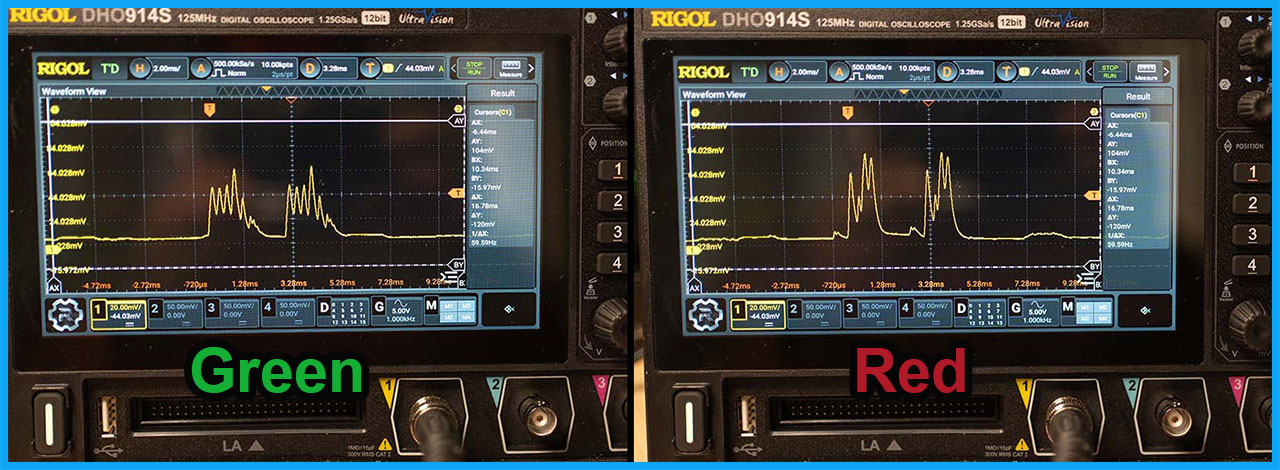
By placing the 3D glasses directly in front of the sensor, we can accurately measure the behavior of each individual eye separately.
The result is an extremely clean waveform consisting of two main pulses for each color, with each pulse containing 4 to 5 sub-pulses inside it.
I do not want to tire you by showing even more measurements from other projectors, so I will simply give you my conclusions, conclusions based both on what I saw with my own eyes and on what I measured with my instruments.
The Titan Noir Max has the best and most stable synchronization between the two eyes out of all the projectors I currently own that support 3D playback.
At the same time, among RGB laser projectors, it also has by far the fastest PWM behavior in its laser engine during 3D playback (most sub-pulses).
Even though the Anti-RBE feature itself is not available in 3D mode, the preservation of the multiple sub-pulses even during 3D playback naturally creates conditions for a very low rainbow effect and an extremely comfortable viewing experience.
Let’s not forget something also important here, that the Titan Noir Max delivers the full 1080p resolution per eye across all supported 3D formats.
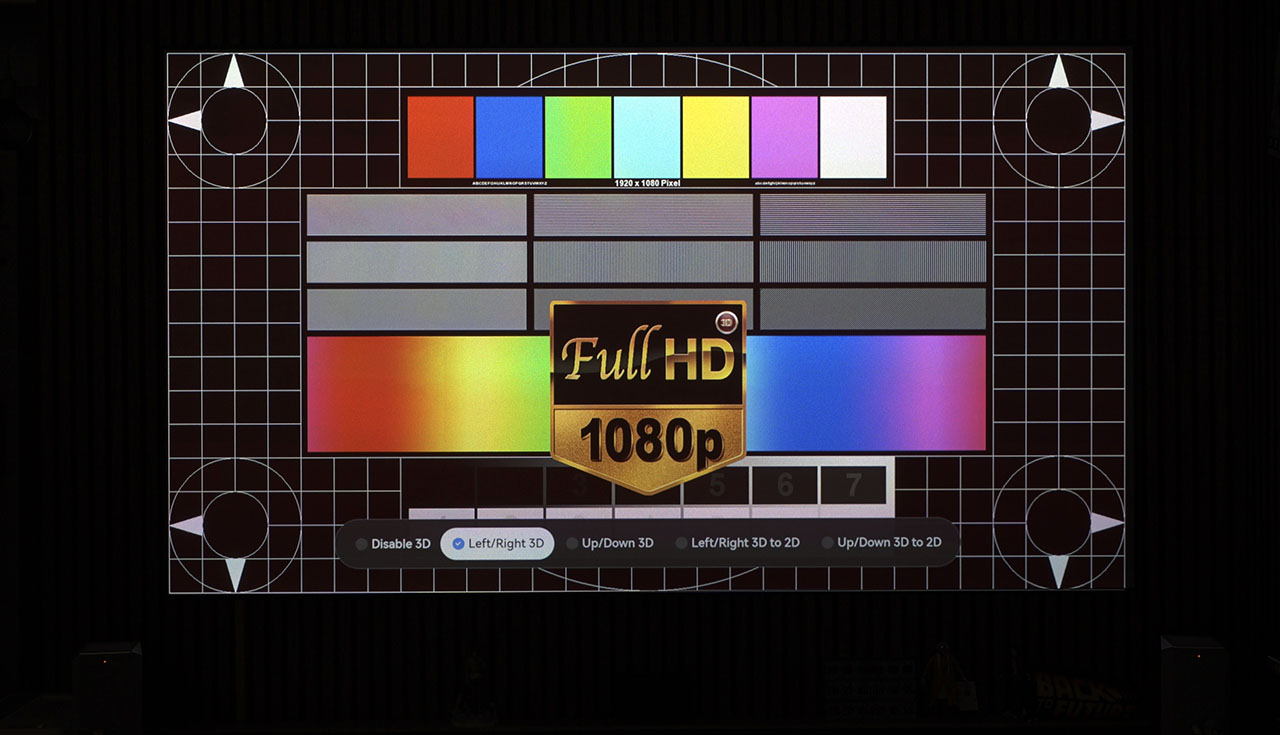
Finally, a few bugs and limitations, such as not being able to adjust the laser brightness levels or other image settings while 3D mode is active, or the lack of automatic 3D detection, simply cannot overshadow the incredible performance of the Titan Noir Max once you put on your 3D glasses and start enjoying your movie. If XGIMI adds proper 24p support in 3D playback through a future firmware update, that would be the ideal scenario. Let’s wait and see.
As always, I have also prepared a video of the Titan Noir Max so you can watch it in action. Just enjoy it!

XGIMI Titan Noir Max
Projectorjunkies Review
Pros
- Extremely bright for a home cinema projector
- Outstanding contrast and black levels for a DLP projector
- The DBLE algorithm works extremely well
- Sharp lens with a huge 0.9–2.0 throw ratio
- Horizontal and vertical lens shift
- Excellent HDR and Dolby Vision performance
- One of the best 3D implementations ever seen on a projector
- Extremely low fan noise
- Ideal for gaming
- 24p support
Cons
- The Anti-RBE system needs serious tuning
- The grayscale behavior is quite unstable
- Quite strong laser speckle depending on the screen material
- Some minor bugs still need improvement in future firmware updates
Conclusion
XGIMI just did it. The Titan Noir Max is not just another projector model, it is a new benchmark for the market, one that every other company will now have to compete against, and surpass if they can. Personally, I honestly did not see this coming.
A company that for years was building mostly lifestyle projectors suddenly delivered its first true high-end home cinema projector, and with its very first attempt, it raised the bar for the entire category.
I could easily describe the Titan Noir Max as the absolute contrast king in the world of DLP projectors. It is not only the outstanding contrast and deep black levels it delivers, but also the way it gives the user full control over them.
The user can choose exactly how much brightness and contrast best fit their room and personal taste through multiple different tools: step iris, dynamic iris, DBLE, or any combination of them.
Its lens, with the almost unbelievable 0.9 to 2.0 throw ratio for a DLP projector, combined of course with both horizontal and vertical lens shift, makes the Titan Noir Max perhaps the only realistic option for many rooms, while also dramatically simplifying the installation process in almost any setup.
And finally, the brightness, guys. We are talking about a projector that produces an enormous amount of light output without effort and without noise. It is one of the brightest home cinema projectors you can currently buy, something that also makes its 3D performance feel genuinely next level, even for experienced users.
And we come again to the one-million-dollar question. Is this the best DLP projector money can buy today in terms of image quality?
Look, this is a difficult question. I have to take many things into account, many different parameters, and also some serious drawbacks that the Titan Noir Max has with this current firmware.
So, honestly, I would say that I cannot clearly answer this question.(yes it is!)
For those lucky enough to get it at this incredible Kickstarter price, what can I say… just hurry up!
And if you use this link https://xgimi-titan-noir-series-4k-projector.kckb.me/2b8d6215, you are going to make me rich! 😄
I am joking of course. But if you are interested in backing the Titan Noir Max and do it through this link, you pay the same price but I do earn a small commission that helps me continue running this blog and producing non-sponsored reviews.
Bravo XGIMI, truly congratulations for this little diamond you gave us.
You just pushed the entire DLP market forward, and you genuinely made us DLP fans really happy.
(Please though, if possible, fix the 3D 24p bug soon. I already dusted off my entire 3D movie collection, charged all my 3D glasses, and I am ready for a full 3D marathon, so do not make me wait too long. Thanks!)
Sorry for tiring you with such a technical and long article 😀
Until our next review, take care everyone and do not forget! Enjoy your personal home theater to the fullest!
Nikos Tsolas
Fantastic job! Thank you!
Very nice review!!!!
Good job!
Just as a heads up:
ANSI Contrast describes one specific test picture with black and white squares which equals 50% ADL.
This contrast is meaningless in normal viewing, all pictures in this review are well below 50% ADL, most seem to be below 5% ADL.
So ANSI is not in-scene-contrast for 99,9 of pictures.
One of the best and comprehensive reviews I have ever read. I’m a kickstarter backer already. Thanks
Excellent review as always Nikos. Very informative. Thank you so much.
I currently own the VMAX and quite happy wit it. I have also pledged for the TNM. But the more I research about this new laser DLP PJ from Xgimi, the more I am inclined to cancel my pledge on KS. Doesn’t seem as refined as the Valerion and a few but very significant issues still unresolved. I also think Valerion or Anker or someone else will come up with a new refined dedicated HT projector in the near future. I still have 3 weeks more to mull this over.
Hi,
First of all, I just wanted to say a massive thank you for your incredibly detailed review of the Titan Noir Max. The hard data, measurements, and thermal analyses you provided are exactly what the community needs. Honestly, it’s the most comprehensive breakdown of this machine out there right now. Amazing work!
I’m reaching out because I look at these projectors from a slightly different angle. In my day job, I work as a film colorist. We are constantly hunting for high-end DLP models that could serve as reference SDR/DCI-P3 displays for professional grading studios (hoping to finally bypass that ridiculous “Pro Tax” on enterprise-level gear).
I noticed you focused heavily on the projector’s HDR performance. While HDR is obviously a huge selling point for home theaters, in the strict color grading world, projection and HDR are somewhat two different worlds. Because projectors rely on reflected light rather than pixel-level emissive highlights (like OLEDs), they are forced to use aggressive tone-mapping. This compresses our midtones and crushes the exact shadow details we spend hours trying to perfect.
Because of this physical limitation, we strictly treat projectors as SDR/DCI-P3 devices. This gave me an idea for a unique test that I think would make for a phenomenal follow-up article on your site.
I would be absolutely thrilled to see how this raw SST DMD chip and triple laser hold up under a strict, standard post-production protocol:
Zero Dynamic Interference: Completely disable HDR, DBLE, the rainbow reduction system (to kill dithering), and set it to a purely static state.
Locked Light Path: Lock the physical iris (e.g., at f7) and treat the projector as a “dumb,” linear light cannon.
Strict Cinema Targets: Target only Rec.709 (Gamma 2.4 locked at exactly 100 nits) and DCI-P3 (Gamma 2.6 locked at exactly 14 fL).
Controlled Optical Environment: Run the measurements in a true batcave to protect the black floor, and crucially, use an RGB laser-certified screen to eliminate speckle and room reflections.
External 3D LUT (The Ultimate Test): Since you noted the internal CMS is non-linear, the ultimate pro test would be to bypass it entirely. If you have access to an external LUT box, building a 3D LUT over this locked state would show what this optical engine is truly capable of.
I am genuinely curious if this projector can maintain linearity and clean gradients when treated purely as a slave display. If it can, it would be a massive game-changer for boutique post-houses worldwide.
Thanks again for the great read, and keep doing what you do!
Cheers,
Jarek Sterczewski
Senior Colorist, ColorPRO
Estoy empezando a plantear seriamente comprar este proyector… Pero pienso que quizás el pro sea suficiente, la diferencia de 6 mil a 7 mil lumens no debe ser un problema, más temiendo en cuneta que la revisión dice que el modo más luminoso es inservible.
I really value your objective, fact-based measurements & reviews, so thank you for that.
I have a few questions:
– If the device does not have streaming abilities, nor can one install apps such as Plex or Jellyfin, what are the points of having TWO network adaptors? namely the fast Ethernet & the WIFI. The occasional software upgrade does not justify them.
– Can the device, playback .mkv or .mp4 files, directly from a USB storage? I am talking about having all the codecs to be able to play Dolbyvision, HDR10+ , together with all the supporting audio codecs.
– Lastly in your opinion, would an external streaming device such as Roku or Amazon devices, impact the onscreen picture quality?
It’s going to be a good seeing the improvement against my old 3D Optoma UHD51, before I sell it I will do a comparison!
I just understood from an answered question on the kickstarter project page and a review (see The Hook Up channel) that the lens shift percentages of XGimi are w.r.t. half the screen width and height, meaning that 50% horizontal shift on a 2m wide screen allows for a horizontal shift of +-50cm instead of +-1m. As such, when using conventional definitions, the “real” lens shift is V+-65% and H+-25%, or a total (left+right) of V130% and H50%. You might want to clarify this in your review.
Incredible review, this projector sounds like a serious home theater upgrade. On a completely different note, I’ve been reading about third eye chakra awakening lately and found this explanation really thought-provoking: https://astrologerglobal.com/third-eye-chakra-awakening-signs-and-how-to-open-your-inner-vision
Does this projector have vertical stretch to support an anamorphic lens? Otherwise the Valerian with less lumens would outperform the Titan Max.
Does the Titan Noir have vertical stretch mode to support an anamorphic lens ?
Ich kann die Begeisterung voll und ganz nachvollziehen und sehe darin auch einen riesigen Schritt nach vorn, was die DLP-Technik betrifft. Allerdings halte ich den Vergleich in der 3D-Darstellung, der nächstbesten Darstellung eine 4/10 zu geben, für klar übertrieben und doch etwas zu überschwänglich – zumal die Bewegungsleistung doch noch recht stark kritisiert wird. Das Hauptkriterium ist die Helligkeit, und die liefern auch schon andere RGB- oder Dual-Laser-Modelle zur Genüge. Mag sein, dass der Noir Max derzeit führend ist, aber definitiv nicht im Verhältnis 10/10 zu 4/10. Das ist unrealistisch…